Share on Facebook
 Share on X
 Share by Email
 Share on Google Classroom
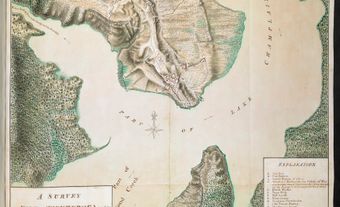
Fort Carillon was built in 1755 on the orders of the governor of New France, Pierre de Rigaud de Vaudreuil. Situated at the junction of Lake George and Lake Champlain, the fort was intended to reinforce France's military presence in an area contested by the British colonies. In 1759, Fort Carillon was abandoned by the French and renamed Fort Ticonderoga by the British. (See Seven Years’ War.) Fort Ticonderoga later played a decisive role in the American Revolution. Since 1909, this historic site has been open to the public.

Physical Design
In 1755, the governor of New France, Pierre de Rigaud de Vaudreuil, ordered the construction of a new fort at the junction of Lake George and Lake Champlain. The fort was built to strengthen the French military's presence in the region. This new fort was designed in particular to support Fort Saint-Frédéric in the Seven Years’ War.
The task of building the fort was entrusted to Michel Chartier de Lotbinière, who was an engineer and the governor’s cousin. In doing so, he greatly helped by the Sieur de German, an officer from the Troupes de Terre. Initially called Fort Vaudreuil, the site became better known later on as Fort Carillon. Construction began in the fall of 1755 and took nearly two years to complete. The fortress was a star fort along the lines developed by Vauban, with broad bastions, trenches and ravelins. Although it was designed as a masonry fort, a great deal of wood was used in its construction, giving it a very distinctive mixed appearance. The fort’s walls were about 3 metres thick and rested on stone foundations, atop which heavy hewn oak logs were mounted. The inside of the ramparts was reinforced with earth and rubble to absorb the shock of cannonballs. In addition to having considerable defences, the fort was heavily armed. From 1756 on, more than 36 cannon were mounted on its walls. The fort’s defences were augmented by the Lotbinière Battery, built on a rocky outcrop to the east of the fort and commanding all movement on the lake. (See also Louisbourg.)

Battle of Fort Carillon
In 1757, the French commanding general, Louis-Joseph de Montcalm, anticipating an attack on the uncompleted Fort Carillon, was ordered to take the offensive and laid siege to the British Fort William Henry, at the south end of Lake George. General Montcalm took over the fort, depriving the British of a strategically important position. In the following year, 1758, the Scottish general James Abercrombie, seeking to avenge the British defeat, attacked Fort Carillon with a force of 15,000 men. Montcalm decided not to defend the fortress and instead held and fortified a position on a nearby height. General Abercrombie’s army shattered itself on this position, providing the French with an important victory against their rivals. (See Battle of Carillon.)
Fort Ticonderoga
In 1759, the British undertook a vast operation to capture New France in a pincers movement: while an expeditionary force led by James Wolfe came up the St. Lawrence River valley and attacked Quebec City, another army, commanded by Jeffrey Amherst, came up Lake George. (See The Conquest of New France.) Compelled to defend the capital of New France, the French forces abandoned Fort Carillon after a siege of a few days. It was taken over by the British and renamed Fort Ticonderoga, from a Haudenosaunee (Iroquois) word meaning “where the waters meet” or “the noisy waters.” In their retreat, the French also abandoned Fort Saint-Frédéric, leaving the British masters of the region.
American Revolution
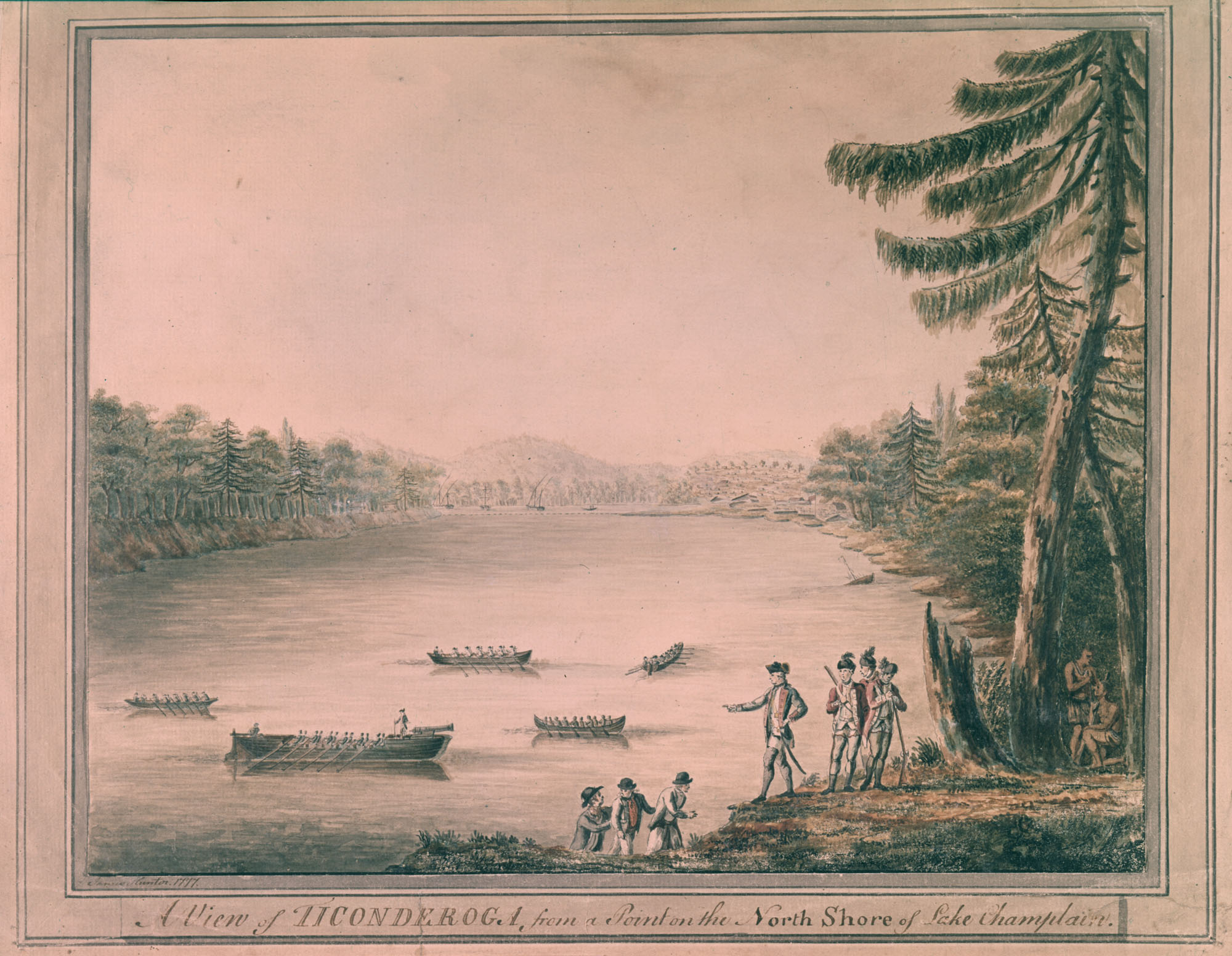
Fort Ticonderoga played a decisive role in the American Revolution. Open war broke out between American rebels and British forces on 19 April 1775 at Lexington, Massachusetts. Less than a month later, a small group of rebels under Ethan Allen and Benedict Arnold attacked the British garrison at Fort Ticonderoga.
Arnold and Allen launched a surprise attack early in the morning of 10 May 1775. About 85 rebels crossed Lake Champlain from Vermont in small boats and attacked the fort. The garrison of 50 men surrendered quickly. The next day, a small group of Allen’s men captured the British fort at Crown Point as well. The capture of Fort Ticonderoga and Fort Crown Point emboldened American rebels. On 27 June 1775, the Continental Congress approved the invasion of Canada.
Arnold and a detachment garrisoned Fort Ticonderoga until June 1775, when they were relieved by a larger force. In the winter of 1775–76, rebel forces under Henry Knox transported Fort Ticonderoga’s artillery to Boston — a gruelling journey of approximately 500 km — where they were used against British forces.
Fort Ticonderoga was recaptured by the British on 5 July 1777 during the Saratoga Campaign. After John Burgoyne’s forces were defeated in October 1777, however, British military operations moved south, and Fort Ticonderoga no longer played a major role in the war.