Share on Facebook
 Share on X
 Share by Email
 Share on Google Classroom
Emancipation Day takes place yearly on 1 August. It marks the day in 1834 that the Slavery Abolition Act came into effect across the British Empire. On 1 August 1834, over 800,000 enslaved people of African descent were freed in many parts of the Caribbean, South America and Canada. Black communities in Canada have celebrated Emancipation Day since the 1850s. In March 2021, the Canadian House of Commons officially designated Emancipation Day. Emancipation Day is a time to reflect, educate and celebrate the strength, fortitude and determination of Black communities across Canada.
Black Enslavement in Canada
The enslavement of African peoples and Indigenous peoples in the lands that would become Canada lasted for over 200 years (approximately from 1629 to 1834). (See Black Enslavement in Canada; Enslavement of Indigenous People in Canada.) Enslavement was a legal institution practised by European colonists. They practised chattel slavery, which treated people as personal property to be bought, sold, traded or inherited.
Enslavement was a dehumanizing and violent system. It was rooted in white supremacy. This ideology justified the exploitation of Indigenous and African peoples by viewing them as less than human.
Canada was also connected to the practice of enslavement through international trade. Canadian products like timber and salted cod were exchanged for slave-produced goods. These included items such as rum, molasses, tobacco and sugar from Caribbean colonies.
Enslavement continued under the British after the Conquest of New France in 1760. The Articles of Capitulation included a specific clause (Article 47) that ensured French inhabitants and Canadians could keep their enslaved Black people (“Negroes”) and Indigenous people (“Panis”). This clause explicitly kept enslavement as legal under British rule.
Chloe Cooley and the 1793 Act to Limit Slavery
Chloe Cooley was a Black woman of African descent. During the late 18th century, she was enslaved in the Niagara region of Upper Canada. (See also Niagara Peninsula.) Cooley is mainly known for her relentless resistance to being sold across the border to the United States. On 14 March 1793, Cooley’s enslaver, Adam Vrooman, arranged to sell Cooley to an American in the state of New York. Vrooman and two other men violently bound her with a rope. They then forced her into a boat and transported her across the Niagara River.
Cooley resisted fiercely, screaming and struggling, but was unable to break free. Her neighbour, Peter Martin, was alerted to the events. Martin was a Black Loyalist and veteran, formerly enslaved by John Butler. He, along with William Grisley, another witness to the event, reported the incident to Lieutenant-Governor John Graves Simcoe. The capture of Chloe Cooley and her resistance helped push for legislative reform. On 9 July 1793, the Act to Limit Slavery was passed. It prevented more enslaved peoples from being brought to Upper Canada. The law was the first legislation in the British colonies to restrict the slave trade. The new law also established a system of gradual abolition of enslavement. However, the Act did not abolish enslavement outright. It also did not free those already enslaved, including Chloe Cooley.
Abolition of Enslavement in Canada
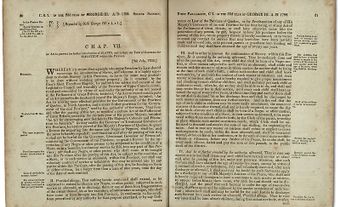
Forty years after the 1793 Act to Limit Slavery, abolition was finalized by an imperial statute. In 1833, the British Parliament passed the Slavery Abolition Act. The new law started taking effect on 1 August 1834. It abolished enslavement in most British colonies. The new policy freed over 800,000 enslaved Africans in the Caribbean, Latin America and South Africa, as well as a small number in Canada.
The Act to Limit Slavery and the Slavery Abolition Act established several key historical precedents in Canada. These included making Canada a “free land” for enslaved Black Americans. This set the stage for the extension of the Underground Railroad farther north into Canada.
Abolition ended the institution of enslavement. However, Black Canadians continued to face racism and discrimination. ( See Anti-Black Racism in Canada.) Individuals of African descent continued to be barred from many public areas. Furthermore, policies kept segregation in housing, education, employment and in other areas. (See Racial Segregation of Black People in Canada.)
Emancipation Day Celebrations
The passage of the Slavery Abolition Act of 1833 led to the creation of Emancipation Day as a cultural event. The date of 1 August was commemorated as it was the actual day in 1834 when the Slavery Abolition Act came into effect across the British Empire.
In the 19th century, communities organized Emancipation Day celebrations in what are now Ontario, Quebec, Nova Scotia, New Brunswick and British Columbia. They became an annual tradition in Canada. Celebrations and activities included parades, speeches, meals, church activities, sporting events, musical performances and fundraisers. These community events aimed to honour ancestors who had endured enslavement and their descendants. The activities were also opportunities to strengthen Black communities, expose racism, fight for equality and celebrate freedom.

For more than 25 years, many community advocates and activists have called for Emancipation Day to be recognized nationally (see, for example, Rosemary Sadlier). In 2018, Senator Dr. Wanda Thomas Bernard presented a private member’s bill in the Senate to recognize Emancipation Day. However, the bill was dropped. In 2021, MP Majid Jowhari tried again by way of a motion in the House of Commons. This time, Parliament unanimously voted to officially designate 1 August as Emancipation Day.
As of 2025, a number of Emancipation Day celebrations happen across Canada. In Toronto, the Underground Freedom Train is a yearly special subway train ride. The trip is filled with songs, African drumming and speeches to honour the Underground Railroad. Across Ontario and other provinces like Nova Scotia and British Columbia, there are also celebrations in parks, auditoriums and churches. There are also receptions and flag-raising ceremonies. At these various celebrations and events, music is performed, poetry is recited and speeches are given on topics such as freedom, resistance and perseverance.
In Toronto, like across various Caribbean islands, the Toronto Caribbean Carnival parade is held on the first weekend in August. These are vibrant, joyful and colourful parades. They take place to celebrate and commemorate the resistance of enslaved people and their freedom. The carnival highlights the Caribbean’s diverse cultural expressions. (See Caribbean Canadians.) It features Indigenous music, dance, masquerade, storytelling and folk traditions, along with an assortment of traditional foods.
Legacy and Significance
Emancipation Day in Canada represents a complex legacy. It goes beyond historical recognition and has several significant purposes. Emancipation Day embodies a national commitment to addressing past injustices. The day promotes resilience in confronting systemic racism and celebrates the perseverance of Black communities. It also recognizes the resistance by enslaved people against both their bondage and the broader institution of enslavement. Emancipation Day is both a commemoration of freedom and an important occasion for Canadians to learn, reflect and engage actively in efforts to address anti-Black racism, discrimination and oppression.