Share on Facebook
 Share on X
 Share by Email
 Share on Google Classroom
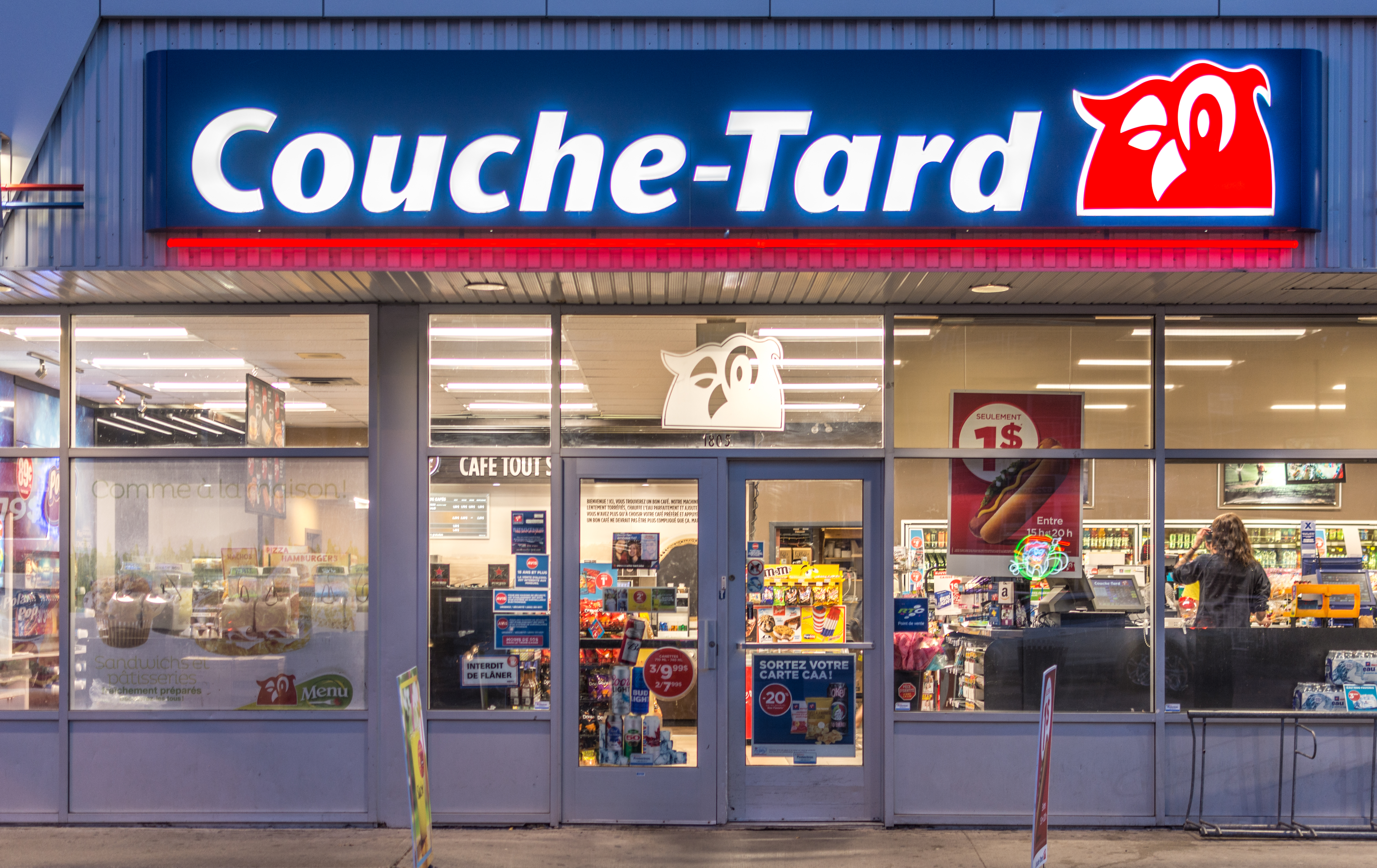
Alimentation Couche-Tard is a convenience store and fuel retailer, headquartered in Laval, Quebec. Tracing its origins to one store that opened in 1980, it is one of the largest convenience store operators in the world. As of 2026, it consisted of over 17,300 stores globally under the Circle K, Couche-Tard and Ingo banners.
Origins
In 1980, Alain Bouchard partnered with Jacques D’Amours to launch their first dépanneur (convenience store) location in Quebec. By 1984, Richard Fortin and Réal Plourde had also become business partners. Bouchard served as CEO, D’Amours managed real estate, Fortin finances and Plourde operations.
Reflecting during the company’s 45th anniversary, Bouchard observed that “from day one, it was all about our customers and our people — how to be a good manager, serve the customer, keep the store clean and have it ready for visitors.”
In 1985, the company purchased the 11-store, Quebec City-based Couche-Tard chain and took on its name. Other banners the company utilized included Dépan-Escompte.
In 1987, it acquired 75 Sept-Jour convenience stores from supermarket operator Métro-Richelieu Inc. (later Metro Inc.), who in exchange received a 17 per cent ownership stake. Metro’s share of the company fluctuated over time, but it held onto its shares until it began selling them in 2013.
Expansion during the 1990s
After a previous failed attempt, Couche-Tard purchased 54 of Silcorp’s Quebec Mac’s and La Maisonnée locations as they exited the province in 1993. For several months in 1996 and 1997 Couche-Tard unsuccessfully tried to buy the rest of Silcorp.
In April 1997, Couche-Tard purchased Provigo’s convenience-store subsidiary C Corp for $85 million, which included 245 Provi-Soir stores in Quebec, 30 Red Rooster locations in Alberta, and 20 Winks in Ontario. It kept Provi-Soir’s owl mascot when those stores were rebranded as Couche-Tard. The deal made it the second-largest convenience store operator in the country.
It became the largest in March 1999, when it succeeded in taking over Silcorp, which now also included the Becker’s chain. The $220-million deal added 974 stores located in Ontario and Western Canada. During the early 2000s, the former Silcorp banners in Ontario were unified under the Mac’s branding, with its cat logo replaced with Couche-Tard’s owl. Much of Silcorp’s management was retained, as part of Couche-Tard’s decentralized management philosophy, which it felt made it easier to satisfy regional customer preferences.
In 2001, it partnered with Irving Oil to operate convenience stores in eastern Quebec, the beginning of a business relationship that expanded over the next decade. (See also Irving Group of Companies.) Two years later, it acquired the master franchise for Dunkin’ Donuts in Quebec.
Entering the United States
Couche-Tard entered the American market in 2001 when it purchased the 225-store Bigfoot chain in Kentucky, Illinois and Indiana from Johnson Oil for US$65.8 million.
In 2003, it acquired Circle K from ConocoPhillips for $1.1 billion, which added just over 2,000 locations, concentrated in Arizona and Florida. Over the rest of the 2000s, the company picked up numerous local chains in the United States, as well as much of ExxonMobil’s On the Run convenience store network.
Global Expansion
In 2012, Couche-Tard bought the retail unit of the Norwegian state-owned oil company Statoil ASA for $2.8 billion, which included 2,300 locations in Scandinavia, the Baltic States and Poland.
A global rebranding program was announced in September 2015, which would see most retail locations operate under the Circle K banner. Some exceptions were made due to the nature of particular markets, such as retaining the Couche-Tard name in Quebec. The rebranding was given the internal code name “Skyfall” after the James Bond movie.
Circle K
A Circle K convenience store located at a gas station in Toronto, Ontario, 19 August 2024.
(photo by Laura Proctor/Bloomberg via Getty Images)
Major American purchases between 2014 and 2017 included the retail operations of Pantry Inc., CST Brands and Holiday Stationstores. In Canada, it purchased the retail assets of Imperial Oil in Ontario and Quebec, which added 279 locations in 2016.
As the retail cannabis market opened up, Couche-Tard bought a 9.9 per cent stake in Edmonton-based Fire & Flower Holdings in 2019. (See also Cannabis Legalization in Canada.) After Fire & Flower filed for bankruptcy in 2023, Couche-Tard failed to win the company at auction and removed its ownership holdings.
In 2023, Couche-Tard purchased 2,193 retail sites from TotalEnergies SE in Western Europe for $4.4 billion.
Three major takeover attempts were rejected between 2019 and 2025. Caltex Australia, that country’s largest convenience and fuel chain, rejected a $7.7-billion offer in 2019. An attempted €16.2 billion (US$19.6-billion) takeover of French grocery giant Carrefour SA broke down in 2021 after they failed to persuade French finance minister Bruno Le Maire, who believed it would be a bad deal for France amid fears of the food supply falling into foreign hands. A US$47-billion bid made for Japan-based Seven & i Holdings Co. Ltd., who owned the world’s largest convenience-store chain, 7-Eleven, was abandoned in 2025.
Alain Bouchard
Alain Bouchard during a press conference in Tokyo, Japan, 13 March 2025.
(photo by Kazuhiro NOGI/AFP via Getty Images)
Asked by the Financial Post in 2012 why Couche-Tard succeeded in its global expansion, Alain Bouchard noted it was its willingness to keep the employees and management of the companies it absorbed, who already knew the local markets, rather than imposing executives from Canada.
Did you know?
During the early 2000s, one of Couche-Tard’s most popular products in Quebec was Sloche, a frozen slushie beverage whose outrageous flavour names successfully attracted teenagers. Introduced in 2000, its brightly coloured drinks included Sang Froid (Cold Blood), Goudron Sauvage (Wild Tar), Rosebeef (Roast Beef) and Schtroumpf Écrasé (Crushed Smurf, later changed to Winchire Wacheur).An attempt was made to similarly transform the Froster line in its Ontario stores, including a 2005 ad campaign spotlighting the sour cherry flavoured Bloody Zit, which boosted sales by 48 per cent.
Controversies
A line of Sloche-branded candies sold in Quebec drew complaints in 2005. The packaging for strawberry-flavoured gummy spiders depicted a stereotyped Black male youth with a scowling face, crooked mouth, prominent gold tooth, and dreadlocks shaped like spider-legs. A complaint was filed with the Quebec Human Rights Commission. After initially defending the product, it was pulled from shelves. The remaining inventory was destroyed, while the company agreed to pay a Montreal Black youth group $18,000.
Leadership Changes
In 2014, Alain Bouchard stepped down as CEO and moved into the position of executive chairman. He was succeeded by Brian Hannasch, who had joined the company following its takeover of Bigfoot.
In 2024, Alex Miller was appointed CEO after serving as chief operating officer for a year. He had joined the company as Director of Fuels, Real Estate and Facilities in 2012.
As of 2026, Couche-Tard’s primary markets are the United States (7,306 stores), Europe (5,217 stores) and Canada (2,071 stores).