Share on Facebook
 Share on X
 Share by Email
 Share on Google Classroom
A dépanneur — often shorted to dep in both Quebec French and Quebec English — is a convenience store particular to the province of Quebec. It is distinct from other convenience stores in Canada primarily because of a law that permitted small establishments the right to operate and sell certain items that were deemed essential outside of normal business hours. Dépanneurs are found throughout Quebec. In large cities like Montreal it is not uncommon for many dépanneurs to be found in close proximity in high-density neighbourhoods. Canada’s largest chain of convenience stores, Couche-Tard, is headquartered in Quebec and emerged from the popularity of dépanneurs in the province. The dépanneur has historically been a viable small business, particularly for low-income families or new immigrants. Independently owned dépanneurs tend to be highly idiosyncratic, carrying a diverse range of goods tailored to the unique needs of the community they serve. Some dépanneurs will also sell freshly made food, like sandwiches or baked goods, while others may offer other diverse items — such as houseplants, fresh fruit and vegetables, or hard-to-find ethnic foods — to distinguish themselves from their competitors.
Dépanneur Storefront
Pedestrians walk past a dépanneur in Montreal, Quebec, c. 2000.
(photo by David Lefranc/Kipa/Sygma via Getty Images)
Origin of the Word Dépanneur
In French the word panne means mechanical breakdown, failure, or outage. Dépanner means to help out or troubleshoot, literally undoing the breakdown. Therefore, a dépanneur is a place that can help an individual out of a bind: if a person needs a basic food item, but does not have the time to go to the grocery store.
The term dépanneur became official on 19 March 1983, when it was added to the Gazette officielle du Québec. In 2015, it was added to the Oxford English Dictionary.
History of the Dépanneur
Before the creation of the dépanneur there were small independently owned and operated corner stores (in urban areas), general stores (in suburban and rural areas), and convenience stores attached to gas bars and service stations (along highways, boulevards, and other major thoroughfares). In Montreal, prior to the advent of the dépanneur, there were small corner stores, some of which combined the selection of a small grocery store with a lunch counter.
As with many other jurisdictions in Canada, shopping hours used to be tightly controlled and regulated by the provincial government. In Quebec, the Commercial Establishments Business Hours Act, passed in 1969, forbade shopping on Sundays, as well as all on other days before 8:30 a.m., and after 5:00, 6:00 and 9:00 p.m. for the other nights of the week. There were a number of exemptions to this rule, which included businesses that sold tobacco products, newspapers, pastries, as well as businesses that sold alcoholic beverages, or general foodstuffs, provided such an establishment did not employ more than three people at a given time.
Paul-Émile Maheu is generally credited with developing the concept of the dépanneur, as well as with originating the term. Maheu was already the proprietor of a small grocery store located in Montreal’s Rosemont neighbourhood, but upon the passage of the new law he reorganized his business both to comply with and take advantage of the new regulations. He named his new business, which opened in 1970, Dépanneur St-Zotique, after the street it was on. For a while, Maheu’s dépanneur was the only establishment in Montreal selling bottled beer after normal weekday and Saturday business hours, and on Sundays. Maheu’s store became an overnight sensation and also attracted police officers unaware that the provincial laws had changed. The dépanneur model was also successful because it could sell staple food items — like bread and milk — on Sundays, the day of the week in which all stores were expected to be closed in Quebec.
The first book to examine the history of the dépanneur in its social context was Sacré Dépanneur ! (2010) written by Quebec journalist Judith Lussier. According to Lussier, the golden age of the dépanneur in Quebec was the 1980s, when there was one on virtually every street corner in Montreal.
As of 2023 the original location of Dépanneur St-Zotique is still occupied by a dépanneur, though the business has changed its name. According to a 2023 article by The Gazette the dépanneur is owned and operated by a Lebanese immigrant, who shares a 16-hour daily shifts with his son. (See also Arab Canadians.) It carries 600 brands of beer and 100 brands of wine and is open from 7:00 a.m. to 11:00 p.m.
Contemporary Dépanneurs
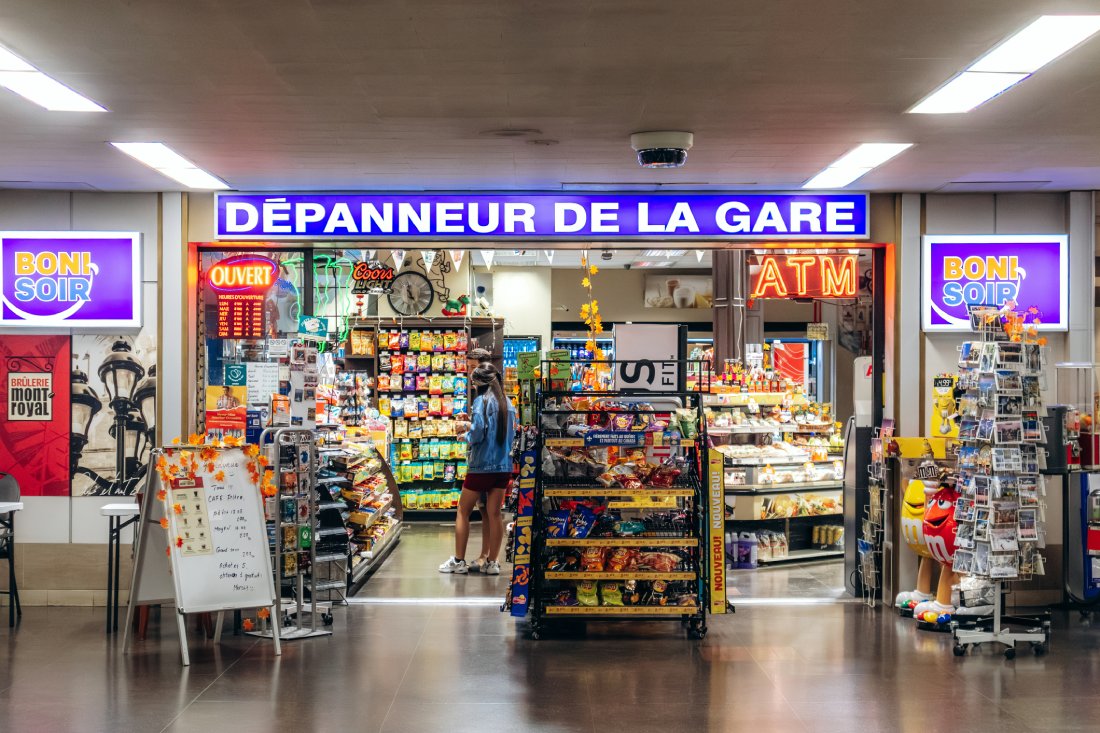
Dépanneurs today face considerable competition from large chains, such as Couche-Tard, as well as from grocery stores that sell beer and wine and are open much later than in earlier generations. Despite that, most independent dépanneurs have loyal customer bases and comparatively fewer employees. They can therefore offer products specific to their customers’ tastes and can also afford to charge a lower markup. Independent dépanneur owners also have greater flexibility in acquiring merchandise from distributors, allowing them to exploit deals and sales faster than a larger corporation.
However, many dépanneurs have closed in recent years, and their future is in doubt. A major factor is that the legislation that made dépanneurs possible — strict regulations on business hours and the sale of alcoholic beverages — has been softened in recent years. Dépanneurs also became associated with tolerated vices, including drinking, gambling (the sale of lottery tickets is a major source of income for Quebec’s dépanneurs), tobacco and junk food. Sales of these items have declined significantly in recent years.
As of 2024, there are between 5,000 and 6,000 dépanneurs in Quebec, but only about 400 are believed to be wholly independently owned and operated. Many of the others belong to several chains, including Couche-Tard, Provi-Soir and Dépanneur 7 Jours, all of which were once separate chains, but are now brands owned by Alimentation Couche-Tard. Owning and operating a dépanneur is no easy feat: owners report dedicating upwards of 100 hours per week to their enterprise, and average year-end profit margins are between 1.5 and 2 per cent. In addition, there are at least 48 different licences and permits that must be obtained in order to operate a dépanneur. Despite these considerable hurdles, they remain popular businesses for immigrant families.
Couche-Tard Storefront
A pedestrian walks past a Couche-Tard in Montreal, Quebec, 13 January 2020.
(photographer Christinne Muschi/Bloomberg via Getty Images)
Did you know?
Alain Bouchard, who opened his first dépanneur in Laval, Quebec, in 1980, is the owner of Alimentation Couche-Tard, Canada’s largest chain of dépanneurs and convenience stores, with over 17,000 locations worldwide as of 2026. Alain Bouchard is one of Canada’s wealthiest people.
“Dep Wine”
While rules for the sale of alcohol varies in other parts of Canada, dépanneurs in Quebec are permitted to sell beer and wine. In Quebec, it is common to find a wide selection of beers in even modestly sized dépanneurs. (See also Craft Brewing in Canada; Brewing Industry in Canada.) By contrast, while dépanneurs and grocery stores in Quebec are allowed to sell wine, the selection is very limited. (See also Wine Industry.) This is due to regulations that favour the provincial liquor commission (the Société des alcools du Québec (SAQ)) in terms of the quality and variety of wines that they may sell. Dépanneurs are permitted to sell wine that is imported in bulk and bottled in Quebec. As such, wine purchased from the dépanneur — colloquially referred to as “dep wine” — has taken on negative connotations as denoting products of inferior quality.