
Browse "Things"
-
Article
Sinnisiak
Sinnisiak (d c 1930) and Uluksuk (d 1924), Inuit hunters from the Coppermine region of the NWT, were the first Inuit to be tried for murder under Canadian law.
"https://thecanadianencyclopedia.ca/images/tce_placeholder.jpg?v=e9dca980c9bdb3aa11e832e7ea94f5d9" // resources/views/front/categories/view.blade.php
https://thecanadianencyclopedia.ca/images/tce_placeholder.jpg?v=e9dca980c9bdb3aa11e832e7ea94f5d9
-
Article
Sioui Case
The Supreme Court of Canada ruling in the R. v. Sioui case on 24 May 1990 transformed understandings of treaty interpretations in Canada. Four Huron-Wendat brothers were charged and convicted of illegally camping, starting fires and cutting down trees in Jacques-Cartier Park in Québec. The Supreme Court found that the brothers were justified in arguing that a document signed by General James Murray and the Huron-Wendat chief in 1760 protected their right to use the land for ceremonial purposes and overturned the convictions.
"https://d3d0lqu00lnqvz.cloudfront.net/media/media/7fcab8e5-f524-4202-83cf-ebd903262d70.jpg" // resources/views/front/categories/view.blade.php
https://d3d0lqu00lnqvz.cloudfront.net/media/media/7fcab8e5-f524-4202-83cf-ebd903262d70.jpg
-
Article
Sir Ernest MacMillan Memorial Foundation
Sir Ernest MacMillan Memorial Foundation. Established in 1984 in Toronto on the initiative of, and with an initial gift from, the family of Sir Ernest MacMillan in order to commemorate Sir Ernest's unique career and his untiring support of talented young Canadian musicians.
"https://thecanadianencyclopedia.ca/images/tce_placeholder.jpg?v=e9dca980c9bdb3aa11e832e7ea94f5d9" // resources/views/front/categories/view.blade.php
https://thecanadianencyclopedia.ca/images/tce_placeholder.jpg?v=e9dca980c9bdb3aa11e832e7ea94f5d9
-
Article
Sir George Williams Affair
The Sir George Williams affair (also known as the Sir George Williams riot) took place in winter 1969, when more than 200 students decided to peacefully occupy the ninth floor of the Henry F. Hall Building at Sir George Williams University in Montreal. (See Concordia University.) These students were protesting the university administration’s decision regarding a complaint of racism that had been filed several months earlier by six Black students from the Caribbean. On 11 February 1969, to dislodge the students occupying the building, the police intervened forcefully, and the situation deteriorated, resulting in over $2 million worth of damage and the arrest of 97 people. The Sir George Williams affair is regarded as the largest student riot in Canadian history. For many observers and historians, it represents a key moment in the rebirth of Black militancy in Montreal.
"https://d3d0lqu00lnqvz.cloudfront.net/media/media/e31f1667-bf31-4052-95c4-22a3da881f96.jpg" // resources/views/front/categories/view.blade.php
https://d3d0lqu00lnqvz.cloudfront.net/media/media/e31f1667-bf31-4052-95c4-22a3da881f96.jpg
-
Article
Sir William Ralph Meredith
Sir William Ralph Meredith, lawyer, judge, politician, educator, public servant (born 31 March 1840 in Westminster Township, Upper Canada; died 21 August 1923 in Montreal, QC). William Ralph Meredith had a long tenure as the opposition leader in the Ontario legislature, leading the provincial Conservatives to five consecutive defeats between 1879 and 1894 (see Conservative Party). His findings while conducting the Meredith Commission on workmen’s compensation between 1910 and 1913 resulted in reforms to labour legislation that formed the basis of Canada’s modern workers’ compensation system, which follows the “Meredith Principles.”
"https://d3d0lqu00lnqvz.cloudfront.net/sirwilliamralphmeredith/williamralphmeredith.jpg" // resources/views/front/categories/view.blade.php
https://d3d0lqu00lnqvz.cloudfront.net/sirwilliamralphmeredith/williamralphmeredith.jpg
-
Article
Sisters of Providence
A female religious congregation founded in 1844 in Montréal by the widow Marie-Émilie Gamelin, née Tavernier, under the name of Daughters of Charity, Servants of the Poor (the present name has been in official usage since 1970).
"https://thecanadianencyclopedia.ca/images/tce_placeholder.jpg?v=e9dca980c9bdb3aa11e832e7ea94f5d9" // resources/views/front/categories/view.blade.php
https://thecanadianencyclopedia.ca/images/tce_placeholder.jpg?v=e9dca980c9bdb3aa11e832e7ea94f5d9
-
Article
Sisters of St Anne
Sisters of St Anne, a female religious congregation founded in 1850 in Vaudreuil, Qué, by the Servant of God Marie-Esther Sureau, dit Blondin (Mother Marie-Anne), for the education of young rural girls and some activities of mercy.
"https://thecanadianencyclopedia.ca/images/tce_placeholder.jpg?v=e9dca980c9bdb3aa11e832e7ea94f5d9" // resources/views/front/categories/view.blade.php
https://thecanadianencyclopedia.ca/images/tce_placeholder.jpg?v=e9dca980c9bdb3aa11e832e7ea94f5d9
-
Article
Sisters of St Joseph
In 1966, 6 Canadian congregations of Sisters of St Joseph (Hamilton, London, Pembroke, Peterborough, Sault Ste Marie, Toronto) working in the fields of education and health-care activities formed the Federation of the Sisters of St Joseph of Canada.
"https://thecanadianencyclopedia.ca/images/tce_placeholder.jpg?v=e9dca980c9bdb3aa11e832e7ea94f5d9" // resources/views/front/categories/view.blade.php
https://thecanadianencyclopedia.ca/images/tce_placeholder.jpg?v=e9dca980c9bdb3aa11e832e7ea94f5d9
-
Article
Sisters of the Holy Names of Jesus and Mary
Sisters of the Holy Names of Jesus and Mary, a religious congregation of women founded in LONGUEUIL, Québec, by the blessed Eulalie Durocher (Mother Marie-Rose) to educate young girls. The spirituality of the congregation is Ignatian (Jesuit).
"https://thecanadianencyclopedia.ca/images/tce_placeholder.jpg?v=e9dca980c9bdb3aa11e832e7ea94f5d9" // resources/views/front/categories/view.blade.php
https://thecanadianencyclopedia.ca/images/tce_placeholder.jpg?v=e9dca980c9bdb3aa11e832e7ea94f5d9
-
Article
Six Nations Pottery
Six Nations of the Grand River in Southern Ontario is the largest reserve community by population in Canada. It is the location for one of Canada’s largest cultural revitalization movements. During the mid-20th century, artist Elda “Bun” Smith began collecting pottery shards that she found throughout Six Nations. With the assistance of potter Tessa Kidick, Smith and other local potters helped to revitalise pottery on Six Nations. They influenced future generations of artists. Six Nations pottery is now one of the most collected ceramics in Canada. It features in gallery and museum collections around the world.
"https://d3d0lqu00lnqvz.cloudfront.net/SixNationsPottery/Steve-Smith-Talking-Earth-no-date-private-collection.jpg" // resources/views/front/categories/view.blade.php
https://d3d0lqu00lnqvz.cloudfront.net/SixNationsPottery/Steve-Smith-Talking-Earth-no-date-private-collection.jpg
-
Article
Sixties Scoop
The “Sixties Scoop” refers to the large-scale removal or “scooping” of Indigenous children from their homes, communities and families of birth through the 1960s, and their subsequent adoption into predominantly non-Indigenous, middle-class families across the United States and Canada. This experience left many adoptees with a lost sense of cultural identity. The physical and emotional separation from their birth families continues to affect adult adoptees and Indigenous communities to this day. This article is a full-length entry about the Sixties Scoop. For a plain-language summary, please see Sixties Scoop (Plain-Language Summary).
"https://d3d0lqu00lnqvz.cloudfront.net/media/media/9fee628e-1ce5-4c82-9ebb-d5b2764b09c4.jpg" // resources/views/front/categories/view.blade.php
https://d3d0lqu00lnqvz.cloudfront.net/media/media/9fee628e-1ce5-4c82-9ebb-d5b2764b09c4.jpg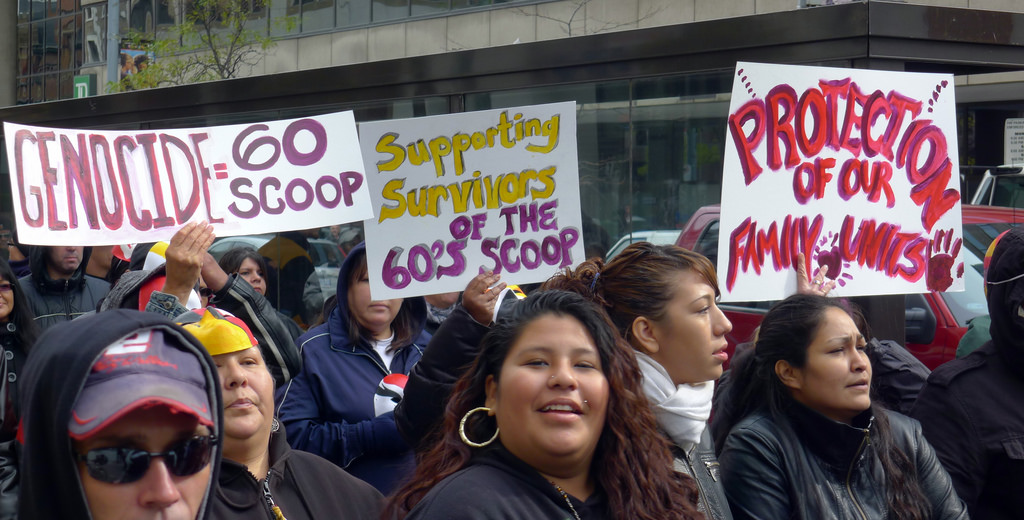
-
Article
Sixties Scoop (Plain-Language Summary)
The term “Sixties Scoop” refers to the large numbers of Indigenous children who were taken from their homes (scooped) throughout the 1960s. Most of these children were adopted by non-Indigenous families in Canada and the United States. The “Sixties Scoop” has left a lasting legacy on the children, families and communities involved. This article is a plain-language summary of the Sixties Scoop. If you are interested in reading about this topic more in depth, please see our full-length entry, Sixties Scoop.
"https://d3d0lqu00lnqvz.cloudfront.net/media/media/9fee628e-1ce5-4c82-9ebb-d5b2764b09c4.jpg" // resources/views/front/categories/view.blade.php
https://d3d0lqu00lnqvz.cloudfront.net/media/media/9fee628e-1ce5-4c82-9ebb-d5b2764b09c4.jpg
-
Editorial
Sixty Years On, Korean War Still Echoes
When is a war not a war? For the Korean War, the answer is not always clear. This year, 2013, marks the 60th anniversary of the ceasefire of a war that not everyone describes that way. It had ambiguous beginnings, more than 20 participating countries, and still no formal end. But some things are evident. This year, Historica Canada is commemorating this sometimes-forgotten but still-resonant period of our recent history, and Canada’s role therein. Our country sent more than 26,000 members of our military to the Korean “theatre.” More than 500 Canadians died, and another 1,000 were wounded; 32 became prisoners of war.
"https://thecanadianencyclopedia.ca/images/tce_placeholder.jpg?v=e9dca980c9bdb3aa11e832e7ea94f5d9" // resources/views/front/categories/view.blade.php
https://thecanadianencyclopedia.ca/images/tce_placeholder.jpg?v=e9dca980c9bdb3aa11e832e7ea94f5d9
-
Article
Ski Jumping
Although informal ski jumping had taken place for decades, the first officially measured jump (30.5 m) was made by Sondre Norheim in Norway in 1860. About 20 years later, Scandinavian miners and lumbermen brought the sport to western Canada, where it flourished.
"https://thecanadianencyclopedia.ca/images/tce_placeholder.jpg?v=e9dca980c9bdb3aa11e832e7ea94f5d9" // resources/views/front/categories/view.blade.php
https://thecanadianencyclopedia.ca/images/tce_placeholder.jpg?v=e9dca980c9bdb3aa11e832e7ea94f5d9
-
Article
Alpine Skiing
The birth of modern skiing in North America, nearly 1000 years later, can be credited to their direct descendants.
"https://d3d0lqu00lnqvz.cloudfront.net/media/media/422e8bec-0d3c-48b7-b19e-f4fd6cfaaa96.jpg" // resources/views/front/categories/view.blade.php
https://d3d0lqu00lnqvz.cloudfront.net/media/media/422e8bec-0d3c-48b7-b19e-f4fd6cfaaa96.jpg