
Browse "Things"
-
Article
Arion Male Voice Choir
Arion Male Voice Choir. Possibly Canada's oldest existing male choir devoted to the singing of secular music. It was founded in February 1893 (with initial, informal activities beginning in 1892) as the Arion Club of Victoria (BC) and gave its first concert 17 May 1893 at Institute Hall.
"https://thecanadianencyclopedia.ca/images/tce_placeholder.jpg?v=e9dca980c9bdb3aa11e832e7ea94f5d9" // resources/views/front/categories/view.blade.php
https://thecanadianencyclopedia.ca/images/tce_placeholder.jpg?v=e9dca980c9bdb3aa11e832e7ea94f5d9
-
Article
Arkells
Arena rockers Arkells formed in Hamilton, Ontario, in 2004. Since releasing their debut album, Jackson Square (2008), the band has won nine Juno Awards and been nominated 17 times. They currently hold the record for most wins by a band in the Group of the Year category with six. They also won for New Group of the Year in 2010 and for Rock Album of the Year in 2015 and 2019. Their hit songs include “Leather Jacket,” “11:11” and the sports anthem “Knocking at the Door.”
"https://d3d0lqu00lnqvz.cloudfront.net/28521848541_14fce39945_c.jpg" // resources/views/front/categories/view.blade.php
https://d3d0lqu00lnqvz.cloudfront.net/28521848541_14fce39945_c.jpg
-
"https://thecanadianencyclopedia.ca/images/tce_placeholder.jpg?v=e9dca980c9bdb3aa11e832e7ea94f5d9" // resources/views/front/categories/view.blade.php
https://thecanadianencyclopedia.ca/images/tce_placeholder.jpg?v=e9dca980c9bdb3aa11e832e7ea94f5d9
-
Article
Canadian Armed Forces
The Canadian Armed Forces (CAF) is the military arm of the federal government. Its role is to defend Canada’s security, interests and values and to contribute to international peace and security. There are 68,000 Regular Force and 27,000 Reserve Force members in the CAF, which includes the Royal Canadian Navy, the Canadian Army and the Royal Canadian Air Force. Members of these three services can also be assigned to different commands, including Canadian Joint Operations Command (CJOC), Canadian Special Operations Forces Command (CANSOFCOM) and the North American Aerospace Defense Command (NORAD). The CAF is supported by 24,000 DND civilians, who are not part of the CAF.
"https://d3d0lqu00lnqvz.cloudfront.net/media/media/a4d84cbe-1111-4723-a254-b38995831a6b.jpg" // resources/views/front/categories/view.blade.php
https://d3d0lqu00lnqvz.cloudfront.net/media/media/a4d84cbe-1111-4723-a254-b38995831a6b.jpg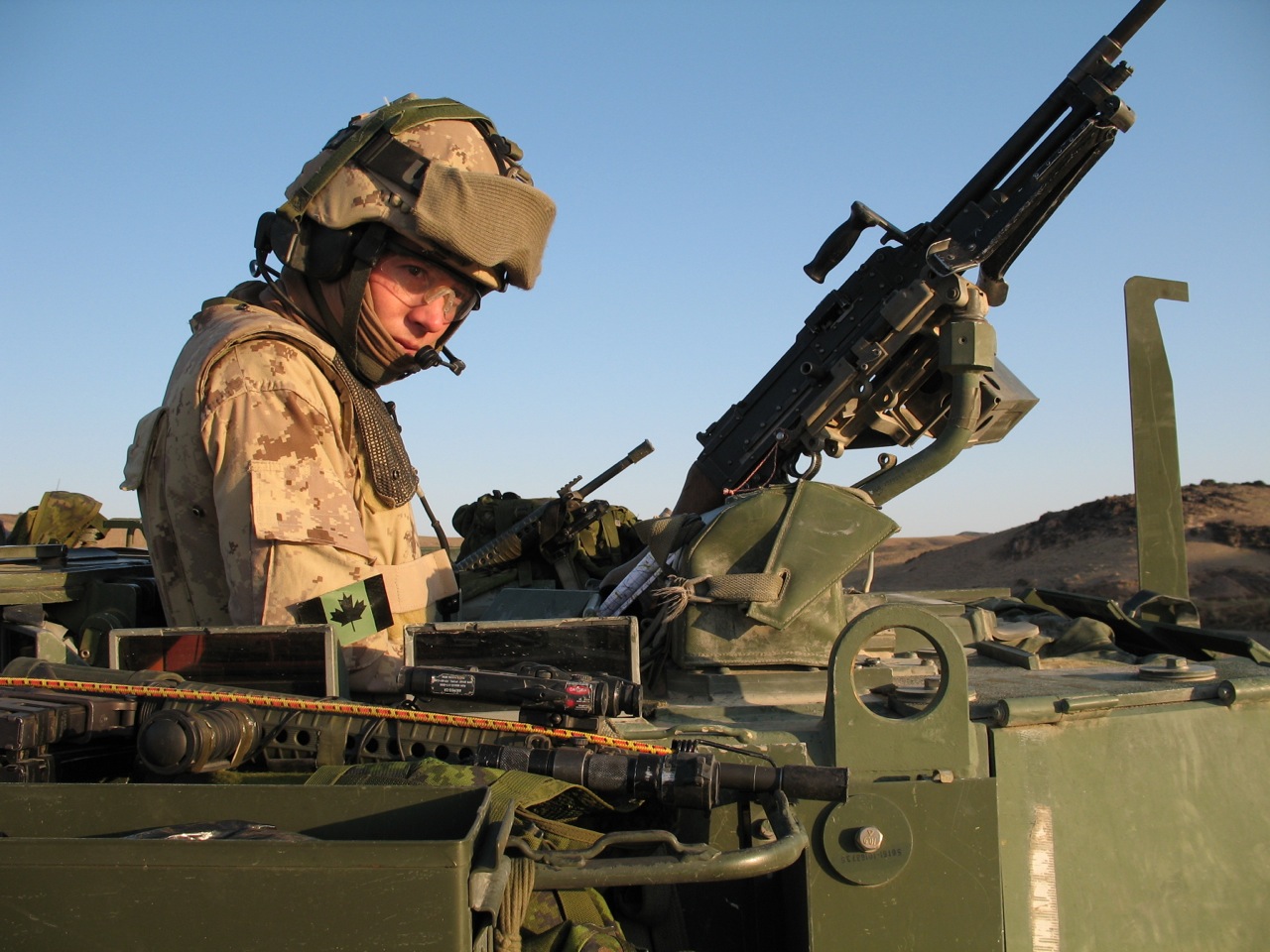
-
Article
Armed Forces Bands in Canada
Large regimental bands first came to Canada in the late 18th century. By 1869, there were some 46 bands in the Canadian militia. The first regular armed forces bands in Canada were formed in 1899. Their main purpose has been to provide music for military or public functions. As of 2023, there were a total of 73 bands in the Canadian Armed Forces: 53 in the Army, 12 in the Air Force, and 8 in the Navy.
"https://d3d0lqu00lnqvz.cloudfront.net/media/media/1007px-438_Squadron_RCAF_Band_1960s.jpg" // resources/views/front/categories/view.blade.php
https://d3d0lqu00lnqvz.cloudfront.net/media/media/1007px-438_Squadron_RCAF_Band_1960s.jpg
-
Article
Armenian Music in Canada
Beginning about 1900, but mostly from 1950 to 1965, some 20,000 Armenians emigrated to Canada from the Middle East.
"https://thecanadianencyclopedia.ca/images/tce_placeholder.jpg?v=e9dca980c9bdb3aa11e832e7ea94f5d9" // resources/views/front/categories/view.blade.php
https://thecanadianencyclopedia.ca/images/tce_placeholder.jpg?v=e9dca980c9bdb3aa11e832e7ea94f5d9
-
Article
Armoured Vehicle General Purpose (AVGP)
The Armoured Vehicle General Purpose was a series of armoured fighting vehicles in service with the Canadian Army from 1978 to 2005. All three versions — Cougar, Grizzly and Husky — used a common hull based on the six-wheeled Swiss MOWAG Piranha 1. The main difference was the turret, or lack thereof. All versions were equipped with propellers and could swim. When production was completed in 1982, 491 vehicles had been built.
"https://d3d0lqu00lnqvz.cloudfront.net/AVGP/AVGP-Grizzly-5301185.jpg" // resources/views/front/categories/view.blade.php
https://d3d0lqu00lnqvz.cloudfront.net/AVGP/AVGP-Grizzly-5301185.jpg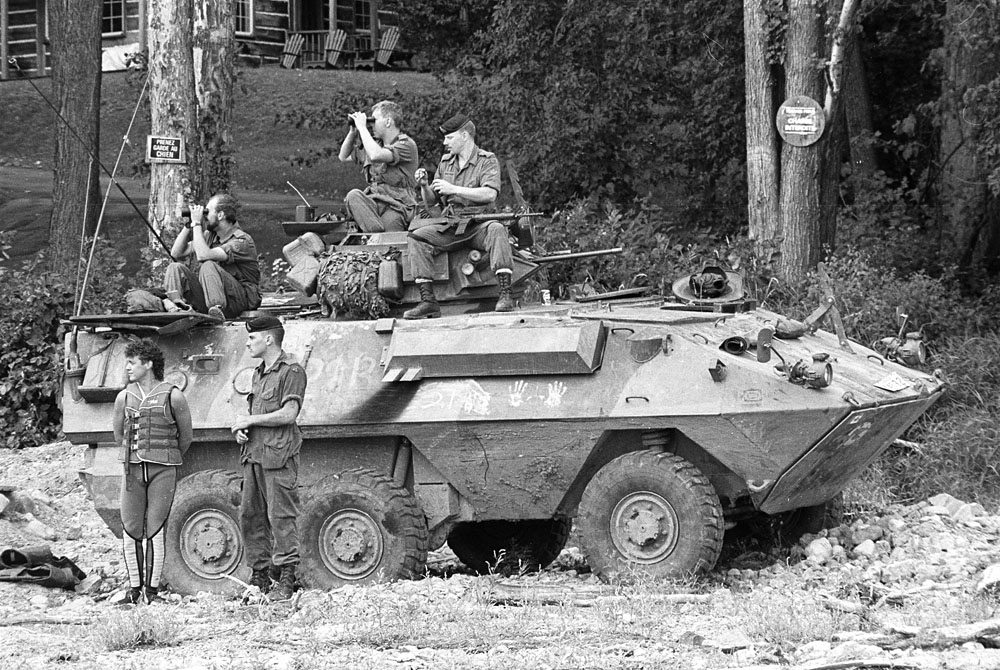
-
Article
Arms and the Men of the War of 1812
The British land forces that defended British North America during the War of 1812 were drawn from a number of organizations. The British "army" of the time consisted of the infantry, cavalry, the Royal Waggon Train and the Royal Sappers and Miners.
"https://thecanadianencyclopedia.ca/images/tce_placeholder.jpg?v=e9dca980c9bdb3aa11e832e7ea94f5d9" // resources/views/front/categories/view.blade.php
https://thecanadianencyclopedia.ca/images/tce_placeholder.jpg?v=e9dca980c9bdb3aa11e832e7ea94f5d9
-
Article
Army Benevolent Fund Board
The Army Benevolent Fund Board was established under the Army Benevolent Fund Act (1947) to administer funds in special accounts existing in the Consolidated Revenue Fund.
"https://thecanadianencyclopedia.ca/images/tce_placeholder.jpg?v=e9dca980c9bdb3aa11e832e7ea94f5d9" // resources/views/front/categories/view.blade.php
https://thecanadianencyclopedia.ca/images/tce_placeholder.jpg?v=e9dca980c9bdb3aa11e832e7ea94f5d9
-
Article
Aroostook War
The Aroostook War was a confrontation between British and Maine authorities in disputed territory known as Madawaska. During the Napoleonic Wars, Britain was in dire need of wood and the region’s pine forests became an important commodity. Claimed by both Maine and New Brunswick, Madawaska became fertile ground for confrontations between the two. The war peaked in 1838‒39 when the governor of Maine, John Fairfield, sent a group, led by Rufus McIntyre, to stop “provincials” from entering territory that Fairfield believed was Maine’s. McIntyre was captured and accused of invading the colony. The conflict ended in 1842 with the Webster-Ashburton Treaty, which divided the territory along the Saint John River.
"https://d3d0lqu00lnqvz.cloudfront.net/media/media/0052e055-bf0b-4980-8f10-08f926f15b9b.jpg" // resources/views/front/categories/view.blade.php
https://d3d0lqu00lnqvz.cloudfront.net/media/media/0052e055-bf0b-4980-8f10-08f926f15b9b.jpg
-
Article
Arpent
Arpent, a French measure of length and area. Numerous regional variants of the arpent coexisted in 17th-century France; of these, the arpent de Paris came into use in Canada before 1636 as part of a system of measures. The arpent de superficie, or square arpent (equivalent to 0.
"https://thecanadianencyclopedia.ca/images/tce_placeholder.jpg?v=e9dca980c9bdb3aa11e832e7ea94f5d9" // resources/views/front/categories/view.blade.php
https://thecanadianencyclopedia.ca/images/tce_placeholder.jpg?v=e9dca980c9bdb3aa11e832e7ea94f5d9
-
Article
Arrowhead Sash
Traditionally made of wool and intricately finger-woven into a colourful lengthwise “zigzag” pattern, they have numerous names, including “arrowhead,” “Indian,” “Métis” and “voyageur” sashes.
"https://d3d0lqu00lnqvz.cloudfront.net/media/media/4216020a-f88c-4f1d-a5f1-d6b4b361720e.jpg" // resources/views/front/categories/view.blade.php
https://d3d0lqu00lnqvz.cloudfront.net/media/media/4216020a-f88c-4f1d-a5f1-d6b4b361720e.jpg
-
Article
Art
Objects of curiosity as well as of conquest, the Indigenous people of the New World were first depicted on maps by illustrators who had no direct knowledge of their subject.
"https://d3d0lqu00lnqvz.cloudfront.net/media/media/7950f0eb-9670-402a-a0b7-105831184703.mov" // resources/views/front/categories/view.blade.php
https://d3d0lqu00lnqvz.cloudfront.net/media/media/7950f0eb-9670-402a-a0b7-105831184703.mov -
Article
Editorial: Canadian Art and the Great War
The following article is an editorial written by The Canadian Encyclopedia staff. Editorials are not usually updated. Canadian painting in the 19th century tended towards the pastoral. It depicted idyllic scenes of rural life and represented the country as a wondrous Eden. Canadian painter Homer Watson, under the influence of such American masters as Frederic Edwin Church and Albert Bierstadt, created images that are serene and suffused with golden light. In On the Mohawk River (1878), for instance, a lazy river ambles between tall, overhanging trees; in the background is a light-struck mountain. In Watson’s world, nature is peaceful, unthreatening and perhaps even sacred.
"https://d3d0lqu00lnqvz.cloudfront.net/media/media/62472ac0-198a-4d62-b24b-61a481415215.jpg" // resources/views/front/categories/view.blade.php
https://d3d0lqu00lnqvz.cloudfront.net/media/media/62472ac0-198a-4d62-b24b-61a481415215.jpg
-
Article
Art Association of Montreal
The Art Association of Montreal, the forerunner of the Montreal Museum of Fine Arts, was founded in 1860.
"https://thecanadianencyclopedia.ca/images/tce_placeholder.jpg?v=e9dca980c9bdb3aa11e832e7ea94f5d9" // resources/views/front/categories/view.blade.php
https://thecanadianencyclopedia.ca/images/tce_placeholder.jpg?v=e9dca980c9bdb3aa11e832e7ea94f5d9
