
Browse "Treaties"
-
Article
Peace and Friendship Treaties
Between 1725 and 1779, Britain signed a series of treaties with various Mi’kmaq, Wolastoqiyik (Maliseet), Abenaki, Penobscot and Passamaquoddy peoples living in parts of what are now the Maritimes and Gaspé region in Canada and the northeastern United States. Commonly known as the Peace and Friendship Treaties, these agreements were chiefly designed to prevent war between enemies and to facilitate trade. While these treaties contained no monetary or land transfer provisions, they guaranteed hunting, fishing and land-use rights for the descendants of the Indigenous signatories. The Peace and Friendship Treaties remain in effect today. In 2026, the Government of Canada recognized the 1726 Peace and Friendship Treaty as a National Historic Event.
"https://d3d0lqu00lnqvz.cloudfront.net/media/Twitter_Cards/Native land 4.png" // resources/views/front/categories/view.blade.php
https://d3d0lqu00lnqvz.cloudfront.net/media/Twitter_Cards/Native land 4.png
-
Article
Penetanguishene Treaty (No. 5)
The Penetanguishene Treaty of 1798 (also known as Treaty 5 in the Upper Canada treaties numbering system) was an early land agreement between First Nations and British authorities in Upper Canada (later Ontario). It was one of a series of Upper Canada Land Surrenders. The Penetanguishene Treaty encompasses land on Georgian Bay at the northern tip of the peninsula at present-day Penetanguishene, as well as an island in Penetanguishene harbour. The British wanted to establish a naval presence on Lake Huron before the Americans could and the purchase of land at Penetanguishene would allow this. The British also realized that they might have to evacuate their post at Michilimackinac some day and wanted an alternative location.
"https://d3d0lqu00lnqvz.cloudfront.net/PenetangTreaty5.jpg" // resources/views/front/categories/view.blade.php
https://d3d0lqu00lnqvz.cloudfront.net/PenetangTreaty5.jpg
-
Article
Pennefather Treaties
In the summer of 1859, Superintendent General of the Indian Department Richard T. Pennefather signed three separate but essentially identical treaties with Batchewana First Nation (Treaty 91 [A]), Garden River First Nation (Treaty 91 [B]) and Thessalon First Nation (Treaty 91 [C]). The three treaties were part of a series of land surrenders that occurred after the 1850 Robinson Treaties. The Pennefather treaties opened additional acres for settlement and resource exploitation. (See also Treaties with Indigenous Peoples in Canada.)
"https://d3d0lqu00lnqvz.cloudfront.net/media/new_article_images/Nebenaigoching/Chippewa_Indian_Chiefs_At_Montreal_1849_image.jpg" // resources/views/front/categories/view.blade.php
https://d3d0lqu00lnqvz.cloudfront.net/media/new_article_images/Nebenaigoching/Chippewa_Indian_Chiefs_At_Montreal_1849_image.jpg
-
Article
Rush-Bagot Agreement
The Rush-Bagot Agreement (or Rush-Bagot Treaty) was signed in 1817 by Acting Secretary of State Richard Rush and Sir Charles Bagot, British minister in Washington. The treaty reduced the number of military ships on the Great Lakes and Lake Champlain and helped secure the Canadian-American border.
"https://d3d0lqu00lnqvz.cloudfront.net/Royal_Military_College_of_Canada_Rush_Bagot_Agreement.jpg" // resources/views/front/categories/view.blade.php
https://d3d0lqu00lnqvz.cloudfront.net/Royal_Military_College_of_Canada_Rush_Bagot_Agreement.jpg
-
Article
Sombra Township Treaty (No.7)
The Sombra Township Treaty of 1796 (also known as Treaty 7 in the Upper Canada treaties numbering system) was an early land agreement between First Nations and British authorities in Upper Canada (later Ontario). It was one of a series of Upper Canada Land Surrenders. The Sombra Township Treaty encompassed a tract of land 12 miles square (about 31 kilometres square) on the St. Clair River in the southwestern part of the colony. The British originally purchased it to offer it for settlement to their Indigenous allies who had fought with them during the American Revolution but who still lived in the new nation of the United States."
"https://d3d0lqu00lnqvz.cloudfront.net/SombraTreaty.jpg" // resources/views/front/categories/view.blade.php
https://d3d0lqu00lnqvz.cloudfront.net/SombraTreaty.jpg
-
Article
Indigenous Peoples and Specific Claims
Specific claims originate in First Nations’ grievances over outstanding treaty obligations, or the administration of Indigenous lands and assets under the Indian Act. Specific claims have been dealt with by several mechanisms since 1973. The Specific Claims Tribunal — an independent judicial body created by the federal government in 2009 — has the authority to make final and binding decisions.
"https://d3d0lqu00lnqvz.cloudfront.net/media/media/4dcbf639-bbf0-4543-b290-714440cf9c81.JPG" // resources/views/front/categories/view.blade.php
https://d3d0lqu00lnqvz.cloudfront.net/media/media/4dcbf639-bbf0-4543-b290-714440cf9c81.JPG
-
Article
St. Joseph's Island Treaty (No. 11)
The St. Joseph’s Island Treaty of 1798 (also known as Treaty 11 in the Upper Canada numbering system) was an early land agreement between First Nations and British authorities in Upper Canada (later Ontario). It was one of a series of Upper Canada Land Surrenders. The St. Joseph’s Island Treaty encompassed all of St. Joseph’s Island, known as Payentanassin in Anishinaabemowin and today called St. Joseph Island. The 370 km2 island is situated at the northern end of Lake Huron, in the channel between Lakes Huron and Superior. The British needed a post in the area to protect their interests and maintain contact with Indigenous peoples of the region. The British also realized they would have to evacuate their post at Michilimackinac under the terms of Jay’s Treaty and needed an alternative location.
"https://d3d0lqu00lnqvz.cloudfront.net/StJosephIslandTreaty/StJosephIslandTreaty1.jpg" // resources/views/front/categories/view.blade.php
https://d3d0lqu00lnqvz.cloudfront.net/StJosephIslandTreaty/StJosephIslandTreaty1.jpg
-
Timelines
The Indian Act
The Indian Act is the principal law through which the federal government administers Indian status, local First Nations governments and the management of reserve land and communal monies. The Indian Act does not include Métis or Inuit peoples. The Act came into power on 12 April 1876. It consolidated a number of earlier colonial laws that sought to control and assimilate Indigenous peoples into Euro-Canadian culture. The Indian Act has been amended many times over...
"https://d3d0lqu00lnqvz.cloudfront.net/media/media/cbcd31d1-03f6-4fba-a45d-96ee89c4617d.jpg" // resources/views/front/categories/view.blade.php
https://d3d0lqu00lnqvz.cloudfront.net/media/media/cbcd31d1-03f6-4fba-a45d-96ee89c4617d.jpg
-
Article
Toronto Purchase (Treaty 13)
The Toronto Purchase of 1805 (also known as Treaty 13) was negotiated in an attempt to clarify and confirm the terms of the Johnson-Butler Purchase of 1787-88. Ultimately, it failed to do this and additional negotiations were required. These later discussions resulted in the Williams Treaties of 1923 and a compensatory settlement between the Government of Canada and the Mississaugas of the New Credit First Nation in 2010. (See also Upper Canada Land Surrenders.)
"https://d3d0lqu00lnqvz.cloudfront.net/TorontoPurchase.jpg" // resources/views/front/categories/view.blade.php
https://d3d0lqu00lnqvz.cloudfront.net/TorontoPurchase.jpg
-
Article
Treaty 10
Treaty 10 is the 10th of the 11 Numbered Treaties. It was signed in 1906–07 by the Canadian government and Indigenous peoples in northern Saskatchewan and Alberta. Treaty 10 covers nearly 220,000 km2 of Saskatchewan and Alberta. The terms of Treaty 10 have had ongoing legal and socioeconomic impacts on Indigenous communities.
"https://d3d0lqu00lnqvz.cloudfront.net/media/media/22da8ac5-1905-4c28-ad2e-c9f55c67c7aa.jpg" // resources/views/front/categories/view.blade.php
https://d3d0lqu00lnqvz.cloudfront.net/media/media/22da8ac5-1905-4c28-ad2e-c9f55c67c7aa.jpg
-
Article
Treaty 11
Treaty 11 is the last of the Numbered Treaties signed on 22 August 1921 between First Nations and the Canadian government following Confederation, as Canada expanded its borders north and west. It covers more than 950,000 km2 of present-day Yukon, Northwest Territories and Nunavut. The First Nations involved were predominately Dene, and include the Gwich’in, Tlicho (Dogrib) and Sahtu. As with other Numbered Treaties, the government did not want to enter into treaty until its interests would be served by doing so; accordingly, Treaty 11 was only created in 1921, after oil and gas prospects in the Mackenzie region sparked its interests. However, hasty negotiations combined with weak implementation of the terms — particularly with regard to reserves and land claims — have led to considerable disagreement between the parties on what was meant by the treaty and which promises have not been fulfilled. As a result, many of the signatories to Treaty 11 have also been involved in the modern treaties process ( see Indigenous Peoples: Treaties).
"https://d3d0lqu00lnqvz.cloudfront.net/media/media/ec35153e-3722-48ad-b760-64812a063ffe.jpg" // resources/views/front/categories/view.blade.php
https://d3d0lqu00lnqvz.cloudfront.net/media/media/ec35153e-3722-48ad-b760-64812a063ffe.jpg
-
Article
Treaty 6
Treaty 6 was signed by Crown representatives and Cree, Assiniboine and Ojibwe leaders on 23 August 1876 at Fort Carlton , Saskatchewan, and on 9 September 1876 at Fort Pitt, Saskatchewan. The treaty boundaries extend across central portions of present-day Alberta and Saskatchewan. This is the full-length entry about Treaty 6. For a plain-language summary, please see Treaty 6 (Plain-Language Summary).
"https://d3d0lqu00lnqvz.cloudfront.net/media/media/2a58e580-6da4-4fd4-b1fe-dc1357c14c36.jpg" // resources/views/front/categories/view.blade.php
https://d3d0lqu00lnqvz.cloudfront.net/media/media/2a58e580-6da4-4fd4-b1fe-dc1357c14c36.jpg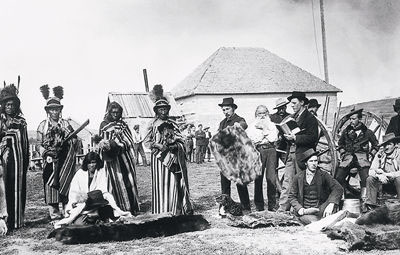
-
Article
Treaty 6 (Plain-Language Summary)
Treaty 6 was created in 1876. It is a treaty between the federal government and Indigenous peoples on the Prairies. Cree, Assiniboine and Ojibwe leaders signed the treaty. Treaty 6 territory is located in Alberta and Saskatchewan. This article is a plain-language summary of Treaty 6. If you are interested in reading about this topic in more depth, please see our full-length entry, Treaty 6.
"https://d3d0lqu00lnqvz.cloudfront.net/media/media/2a58e580-6da4-4fd4-b1fe-dc1357c14c36.jpg" // resources/views/front/categories/view.blade.php
https://d3d0lqu00lnqvz.cloudfront.net/media/media/2a58e580-6da4-4fd4-b1fe-dc1357c14c36.jpg
-
Article
Treaty 7
Treaty 7 is the last of the Numbered Treaties made between the Government of Canada and the Plains First Nations (see Indigenous Peoples: Plains). It was signed on 22 September 1877 by five First Nations: the Siksika (Blackfoot), Kainai (Blood), Piikani (Peigan), Stoney-Nakoda, and Tsuut’ina (Sarcee). Different understandings of the treaty’s purpose, combined with significant culture and language barriers and what some have argued were deliberate attempts to mislead the First Nations on the part of the government negotiators, have led to ongoing conflicts and claims. This article is a full-length entry about Treaty 7. For a plain-language summary, please see Treaty 7 (Plain-Language Summary).
"https://d3d0lqu00lnqvz.cloudfront.net/media/media/0729607a-735a-424b-a138-3e76e6053763.jpg" // resources/views/front/categories/view.blade.php
https://d3d0lqu00lnqvz.cloudfront.net/media/media/0729607a-735a-424b-a138-3e76e6053763.jpg
-
Article
Treaty 7 (Plain-Language Summary)
Treaty 7 was signed on 22 September 1877. It was the final Numbered Treaty between the Government of Canada and Plains First Nations (see also Plains Indigenous Peoples in Canada). Five First Nations signed the treaty: the Siksika, Kainai, Piikani, Stoney-Nakoda and Tsuut’ina. There were different understandings of the treaty’s purpose. There were also cultural and language barriers that contributed to different understandings. The government wanted title to land for settlement. It wanted Indigenous peoples to give up their Aboriginal title to the land. First Nations thought they were signing peace treaties to allow settlement. They did not believe they were giving up their title to land. Some argue the government negotiators tried to mislead First Nations. There are ongoing conflicts and claims about Treaty 7. This article is a plain-language summary of Treaty 7. If you are interested in reading about this topic more in depth, please see our full-length entry, Treaty 7.
"https://thecanadianencyclopedia.ca/images/tce_placeholder.jpg?v=e9dca980c9bdb3aa11e832e7ea94f5d9" // resources/views/front/categories/view.blade.php
https://thecanadianencyclopedia.ca/images/tce_placeholder.jpg?v=e9dca980c9bdb3aa11e832e7ea94f5d9