
Browse "Legislation"
-
Article
Act of Union (Plain-Language Summary)
The Act of Union was passed by the British Parliament in July 1840. It became law on 10 February 1841. It merged Canada West (formerly Upper Canada) and Canada East (formerly Lower Canada) into the Province of Canada (1841–67). The Act was based on the findings of the Durham Report. It was presented by Lord Durham in 1839. The Act sought to assimilate French Canadians, limit the power of the Family Compact and promote economic growth. This article is a plain-language summary of the Act of Union. If you would like to read about this topic in more depth, please see our full-length entry: Act of Union.
"https://d3d0lqu00lnqvz.cloudfront.net/media/media/1bddc49a-9bfc-45cf-9e3e-1a42362ed5d4.jpg" // resources/views/front/categories/view.blade.php
https://d3d0lqu00lnqvz.cloudfront.net/media/media/1bddc49a-9bfc-45cf-9e3e-1a42362ed5d4.jpg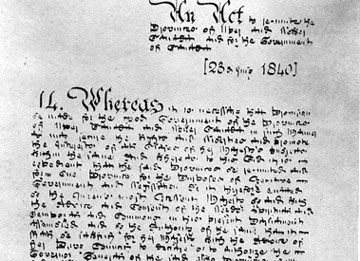
-
Article
Autonomy Bills
The Autonomy Bills were the 1905 laws that created the provinces of Saskatchewan and Alberta out of the North-West Territories (1870–1905). Despite strong support for provincehood, frustrations were evident. The Bills’ most fiercely contested elements revolved around boundaries, the federal government’s ongoing control over public lands and resources and the educational clauses in the Bills.
"https://d3d0lqu00lnqvz.cloudfront.net/media/media/d2da9148-e44f-454c-927a-f1d7b84066fd.jpg" // resources/views/front/categories/view.blade.php
https://d3d0lqu00lnqvz.cloudfront.net/media/media/d2da9148-e44f-454c-927a-f1d7b84066fd.jpg
-
Article
Bedard Case
R v. Bedard (1971) challenged section 12(1)(b) of the Indian Act, which concerns the rights of Status Indian women in Canada. The appellant in the case, Yvonne Bedard, took the federal government to court after losing her rights as a Status Indian because of her marriage to a Non-Status man. In 1973, before the Supreme Court of Canada, the Bedard case merged with AG v. Lavell, another case concerning gender discrimination (see Status of Women) in the Indian Act. Although Bedard ultimately lost her reinstatement claims, her case inspired future legal battles regarding women’s rights and the Indian Act, including Lovelace v. Canada (1981) (see Sandra Lovelace Nicholas) and the Descheneaux case (2015).
"https://thecanadianencyclopedia.ca/images/tce_placeholder.jpg?v=e9dca980c9bdb3aa11e832e7ea94f5d9" // resources/views/front/categories/view.blade.php
https://thecanadianencyclopedia.ca/images/tce_placeholder.jpg?v=e9dca980c9bdb3aa11e832e7ea94f5d9
-
Article
Bill 101 Case
On 26 July 1984, the Supreme Court of Canada declared invalid section 72 and section 73 of Bill 101 (the Charter of the French Language) concerning English-language schooling in Québec on the grounds that those provisions were incompatible with section 23 of the Canadian Charter of Rights and Freedoms. The constitutionality of the legislation had been challenged primarily by several Protestant school boards. Section 23 of the Charter gave Canadians, whose first language learned and...
"https://thecanadianencyclopedia.ca/images/tce_placeholder.jpg?v=e9dca980c9bdb3aa11e832e7ea94f5d9" // resources/views/front/categories/view.blade.php
https://thecanadianencyclopedia.ca/images/tce_placeholder.jpg?v=e9dca980c9bdb3aa11e832e7ea94f5d9
-
Article
Bill 178
In December 1988 the Liberal government of Québec introduced Bill 178, an Act to amend Bill 101, Charte de la langue française.
"https://d3d0lqu00lnqvz.cloudfront.net/media/media/4895dc54-1140-4625-918c-279bb935291c.jpg" // resources/views/front/categories/view.blade.php
https://d3d0lqu00lnqvz.cloudfront.net/media/media/4895dc54-1140-4625-918c-279bb935291c.jpg
-
Article
Bill 22
Bill 22, the Official Language Act, sponsored by the Québec Liberal government of Robert Bourassa and passed by the legislature July 1974. It made French the language of civic administration and services, and of the workplace.
"https://d3d0lqu00lnqvz.cloudfront.net/media/media/4895dc54-1140-4625-918c-279bb935291c.jpg" // resources/views/front/categories/view.blade.php
https://d3d0lqu00lnqvz.cloudfront.net/media/media/4895dc54-1140-4625-918c-279bb935291c.jpg
-
Article
Bill 63
Bill 63, (Nov 1969), required children receiving their education in English to acquire a working knowledge of French and required everything to be done so that immigrants acquired the knowledge of French upon arrival in Québec.
"https://thecanadianencyclopedia.ca/images/tce_placeholder.jpg?v=e9dca980c9bdb3aa11e832e7ea94f5d9" // resources/views/front/categories/view.blade.php
https://thecanadianencyclopedia.ca/images/tce_placeholder.jpg?v=e9dca980c9bdb3aa11e832e7ea94f5d9
-
Article
Bill 86
In December 1988, Bill 178 was adopted by the Québec government after the Supreme Court found provisions of Bill 101, those regarding commercial signs and advertising, contrary to the guarantee of freedom of expression in the Charter of Rights and Freedoms.
"https://d3d0lqu00lnqvz.cloudfront.net/media/media/d98c04c1-c758-4c0e-9a7d-b47015867171.jpg" // resources/views/front/categories/view.blade.php
https://d3d0lqu00lnqvz.cloudfront.net/media/media/d98c04c1-c758-4c0e-9a7d-b47015867171.jpg
-
Article
Canadian Free Trade Agreement
The Canadian Free Trade Agreement (CFTA) is an inter-governmental trade agreement regulating trade within Canada. It took effect on 1 July 2017. The goal of the agreement was to reduce or eliminate regulations against the free movement of goods, services, and investments within Canada. The officials who framed the new deal said they wanted to ensure that Canadian firms got the same access to the Canadian market as firms from the country’s international trading partners. CFTA also more closely matches the terms of the Canada-European Union Comprehensive Economic Trade Agreement (CETA), which began taking effect in 2017.
"https://d3d0lqu00lnqvz.cloudfront.net/media/media/133a2d02-51cc-4318-b7c7-5aeb80b30cf3.png" // resources/views/front/categories/view.blade.php
https://d3d0lqu00lnqvz.cloudfront.net/media/media/133a2d02-51cc-4318-b7c7-5aeb80b30cf3.png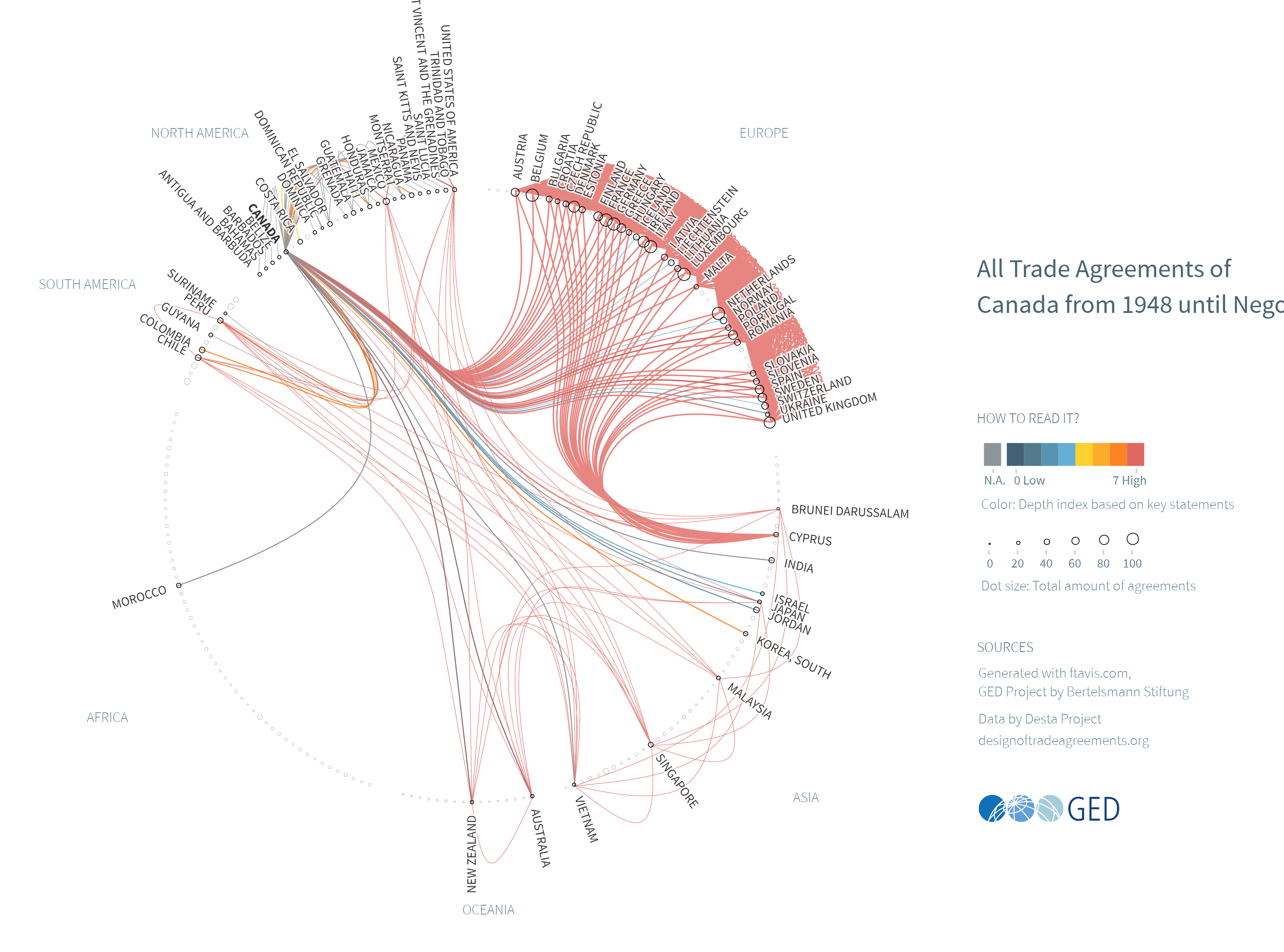
-
Article
Children, Education and the Law
In Canada, political and law-making power is shared by the provincial and federal levels of government, as set out in the constitution. Section 93 of the Constitution Act, 1867 gives the provincial governments the exclusive jurisdiction to make laws governing education.
"https://d3d0lqu00lnqvz.cloudfront.net/media/media/8b192352-63f2-4358-98bf-206f660e3b65.jpg" // resources/views/front/categories/view.blade.php
https://d3d0lqu00lnqvz.cloudfront.net/media/media/8b192352-63f2-4358-98bf-206f660e3b65.jpg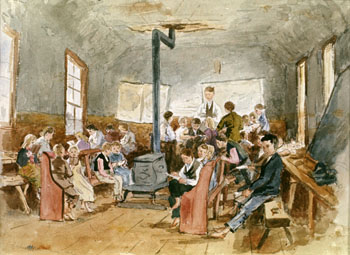
-
Article
Disallowance
The CONSTITUTION ACT of 1867 provides that any ACT of a provincial legislature must be promptly sent to the GOVERNOR GENERAL and that the governor general-in-council (federal CABINET) may disallow any such Act (wipe it off the statute book) within one year.
"https://thecanadianencyclopedia.ca/images/tce_placeholder.jpg?v=e9dca980c9bdb3aa11e832e7ea94f5d9" // resources/views/front/categories/view.blade.php
https://thecanadianencyclopedia.ca/images/tce_placeholder.jpg?v=e9dca980c9bdb3aa11e832e7ea94f5d9
-
Article
Dominion Lands Act
The Dominion Lands Act was a federal law that received royal assent on 14 April 1872. It allowed for lands in Western Canada to be granted to individuals, colonization companies, the Hudson’s Bay Company, railway construction, municipalities and religious groups. The Act set aside land for First Nations reserves. Métis lands were organized by the government outside the Dominion Lands Act, using the scrip system. The Act also set aside lands for what would become National Parks (1883). The Dominion Lands Act devised specific homestead policies to encourage settlement in the West. It covered eligibility and settlers’ responsibilities, and outlined a standard measure for surveying and subdividing land. Some 1.25 million homesteads were made available over an expanse of about 80 million hectares — the largest survey grid in the world. The Act was repealed in 1930, when lands and resources were transferred from the federal government to the provinces of Manitoba, Saskatchewan and Alberta. From 1870 to 1930, roughly 625,000 land patents were issued to homesteaders. As a result, hundreds of thousands of settlers poured into the region.
"https://d3d0lqu00lnqvz.cloudfront.net/media/media/45847956-16b4-43b7-b79d-e6ba45b9c9f4.jpg" // resources/views/front/categories/view.blade.php
https://d3d0lqu00lnqvz.cloudfront.net/media/media/45847956-16b4-43b7-b79d-e6ba45b9c9f4.jpg
-
Article
Election Expenses Act
There have been problems with the interpretation and application of this legislation, partly as a consequence of imprecise or ambiguous wording in the Act itself. Many of these questions were examined by the Royal Commission on Electoral Reform and Party Financing which reported early in 1992.
"https://thecanadianencyclopedia.ca/images/tce_placeholder.jpg?v=e9dca980c9bdb3aa11e832e7ea94f5d9" // resources/views/front/categories/view.blade.php
https://thecanadianencyclopedia.ca/images/tce_placeholder.jpg?v=e9dca980c9bdb3aa11e832e7ea94f5d9
-
Article
Finance Act
Finance Act, August 1914, emergency measure ending Canada's GOLD STANDARD and giving the Department of Finance new powers.
"https://thecanadianencyclopedia.ca/images/tce_placeholder.jpg?v=e9dca980c9bdb3aa11e832e7ea94f5d9" // resources/views/front/categories/view.blade.php
https://thecanadianencyclopedia.ca/images/tce_placeholder.jpg?v=e9dca980c9bdb3aa11e832e7ea94f5d9
-
Article
Food Legislation
Legislation designed to prevent the sale of unsafe or unwholesome food represents one of the oldest forms of governmental or societal intervention in the AGRICULTURE AND FOOD system.
"https://thecanadianencyclopedia.ca/images/tce_placeholder.jpg?v=e9dca980c9bdb3aa11e832e7ea94f5d9" // resources/views/front/categories/view.blade.php
https://thecanadianencyclopedia.ca/images/tce_placeholder.jpg?v=e9dca980c9bdb3aa11e832e7ea94f5d9