
Browse "Nature & Geography"
-
Article
Gray Treefrog
The gray treefrog (Dryophytes versicolor, synonym Hyla versicolor) is a small to medium-sized treefrog native to Central and Northeastern North America. In Canada, they are found in New Brunswick, Quebec, Ontario, Manitoba and a small part of Eastern Saskatchewan. Gray treefrogs are well camouflaged; the scientific name versicolor means “changing colour” and refers to the frog’s ability to make their skin lighter or darker. Gray treefrogs have one of the loudest calls of any North American frog.
"https://d3d0lqu00lnqvz.cloudfront.net/graytreefrog/Crowley-Gray-Treefrog-Hyla-versicolor-9.jpg" // resources/views/front/categories/view.blade.php
https://d3d0lqu00lnqvz.cloudfront.net/graytreefrog/Crowley-Gray-Treefrog-Hyla-versicolor-9.jpg
-
Article
Great Auk
The great auk (Pinguinus impennis), the largest and only flightless auk, is extinct. All auks are expert divers which swim underwater using their wings, but the great auk had flipper-like wings, too short for flight. It was the original penguin (true penguins are unrelated birds native to the Southern Hemisphere), and the largest recent member of the family Alcidae, probably weighing 5,500–8,000 g and stretching 65 cm long.
"https://d3d0lqu00lnqvz.cloudfront.net/media/media/007ecccd-3ff4-4c68-81c8-4416ce44836c.jpg" // resources/views/front/categories/view.blade.php
https://d3d0lqu00lnqvz.cloudfront.net/media/media/007ecccd-3ff4-4c68-81c8-4416ce44836c.jpg
-
List
Great Canadian Fauna
To celebrate its 30th anniversary, The Canadian Encyclopedia created 30 lists of 30 things that make us proud to be Canadian, from famous people and historic events, to iconic foods and influential artists.
"https://d3d0lqu00lnqvz.cloudfront.net/media/media/a7c708ef-3e7b-4890-a1ad-f637397985a6.jpg" // resources/views/front/categories/view.blade.php
https://d3d0lqu00lnqvz.cloudfront.net/media/media/a7c708ef-3e7b-4890-a1ad-f637397985a6.jpg
-
Macleans
Great Ice Storm of 1998
Then, Margaret's son, Allan, urged her to stay with him in Ottawa - but all trains in and out of the two cities were cancelled, and roads closed. Meanwhile, Allan, his wife, Lori, and their three young sons hosted nine neighborhood boys whose own homes were without power.This article was originally published in Maclean's Magazine on January 19, 1998
"https://thecanadianencyclopedia.ca/images/tce_placeholder.jpg?v=e9dca980c9bdb3aa11e832e7ea94f5d9" // resources/views/front/categories/view.blade.php
https://thecanadianencyclopedia.ca/images/tce_placeholder.jpg?v=e9dca980c9bdb3aa11e832e7ea94f5d9
-
Article
Great Lakes Storm of 1913
The Great Lakes Storm of 1913, also referred to as the “White Hurricane,” the “Big Blow” and the “Freshwater Fury,” was a devastating and deadly storm that occurred over several days in November 1913. It is generally believed to be the worst storm to have ever occurred in the Great Lakes region, and was responsible for the deaths of up to 300 people, the sinking of 12 ships, and the wrecking of at least 19 more. The storm was an example of the “November gale,” also referred to as the “Witch of November,” a unique and intense weather phenomenon that produces hurricane-force winds. In terms of total ships lost and total number of deaths, it is considered one of the worst inland maritime disasters in both Canadian and American history. The storm killed the entire crews of eight ships that were lost on a single day on Lake Huron. Ships sank on every lake in the Great Lakes, except Lake Ontario. American sources have estimated damage caused by the storm exceeded $200 million, adjusted for inflation.
"https://d3d0lqu00lnqvz.cloudfront.net/greatlakesstorm1913/DetroitNews-11-13-1913.jpg" // resources/views/front/categories/view.blade.php
https://d3d0lqu00lnqvz.cloudfront.net/greatlakesstorm1913/DetroitNews-11-13-1913.jpg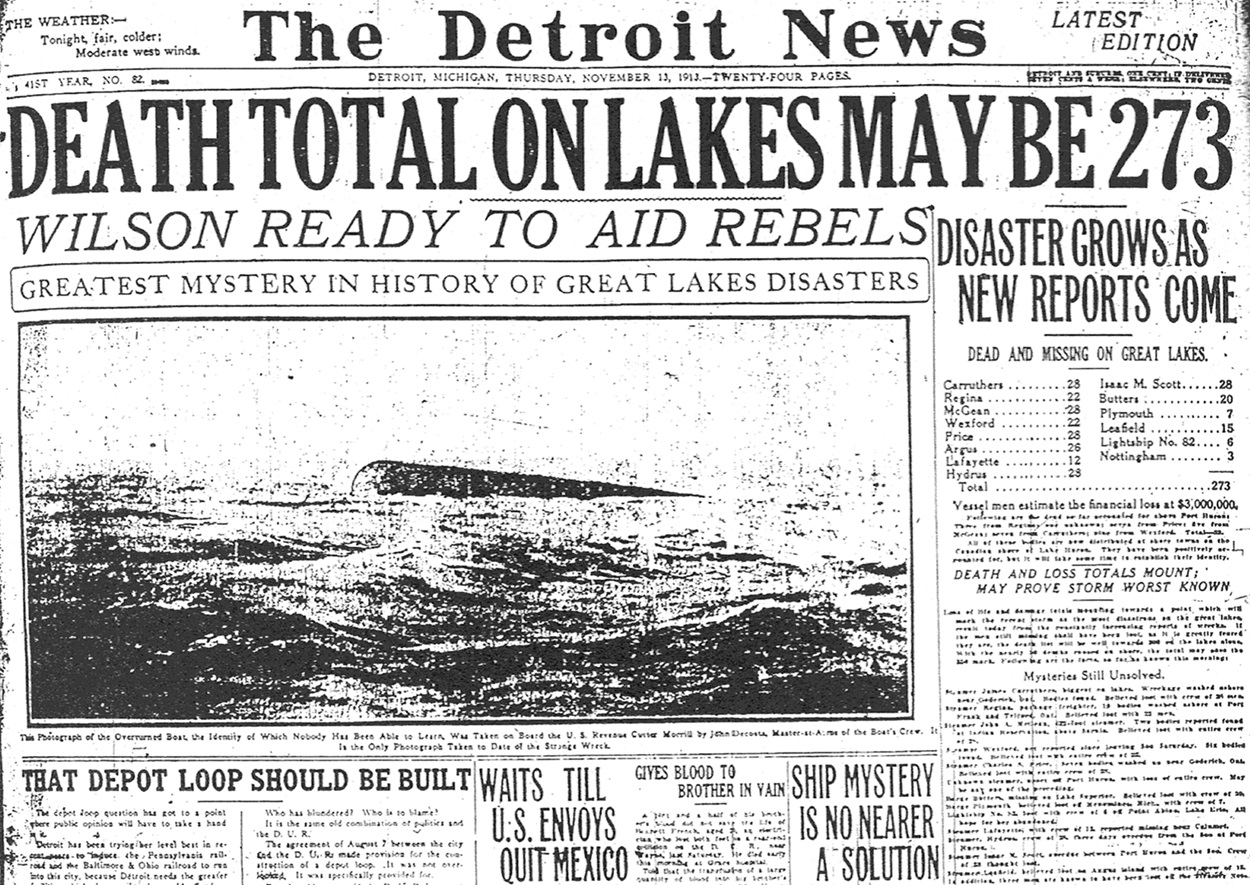
-
Article
Green Bean
There are at least six classes of green bean (Phaseolus vulgaris), and many cultivars (commercial varieties) are available within each class. Common types include the "snap" bean (green or wax) and kidney beans.
"https://d3d0lqu00lnqvz.cloudfront.net/media/media/3d0ac89b-9118-4b98-b4e5-064ff794bf9b.jpg" // resources/views/front/categories/view.blade.php
https://d3d0lqu00lnqvz.cloudfront.net/media/media/3d0ac89b-9118-4b98-b4e5-064ff794bf9b.jpg
-
Macleans
Greenhouse Gas Emissions Accord (Nov97 Updates)
Standing in the back of the room, Louise Comeau didn't even attempt to hide her anger.This article was originally published in Maclean's Magazine on November 24, 1997
"https://thecanadianencyclopedia.ca/images/tce_placeholder.jpg?v=e9dca980c9bdb3aa11e832e7ea94f5d9" // resources/views/front/categories/view.blade.php
https://thecanadianencyclopedia.ca/images/tce_placeholder.jpg?v=e9dca980c9bdb3aa11e832e7ea94f5d9
-
Article
Greenstone
Greenstone, general term for dark green, compact metamorphic rocks formed by the alteration of dark-coloured IGNEOUS ROCKS. Basalt, a common example, is a major component of the greenstone belts of the Canadian SHIELD. These belts contain the Shield's principal GOLD and base-metal mines.
"https://thecanadianencyclopedia.ca/images/tce_placeholder.jpg?v=e9dca980c9bdb3aa11e832e7ea94f5d9" // resources/views/front/categories/view.blade.php
https://thecanadianencyclopedia.ca/images/tce_placeholder.jpg?v=e9dca980c9bdb3aa11e832e7ea94f5d9
-
Article
Grosbeak
Grosbeak is a common name for large members of 2 families of birds, Cardinalidae (cardinal) and Fringillidae (finch).
"https://thecanadianencyclopedia.ca/images/tce_placeholder.jpg?v=e9dca980c9bdb3aa11e832e7ea94f5d9" // resources/views/front/categories/view.blade.php
https://thecanadianencyclopedia.ca/images/tce_placeholder.jpg?v=e9dca980c9bdb3aa11e832e7ea94f5d9
-
Article
Groundsel
Groundsel, or ragwort, common names for plants of genus Senecio, family Compositae or Asteraceae.
"https://d3d0lqu00lnqvz.cloudfront.net/media/media/9a776da6-54b7-4271-b584-7af19ab25d8b.jpg" // resources/views/front/categories/view.blade.php
https://d3d0lqu00lnqvz.cloudfront.net/media/media/9a776da6-54b7-4271-b584-7af19ab25d8b.jpg
-
Article
Groundwater
Groundwater interacts with lakes and rivers as part of the hydrologic cycle. The cycle begins with the formation of clouds through evaporation from the ocean, lakes, rivers, plants and soil.
"https://d3d0lqu00lnqvz.cloudfront.net/media/media/1aa8fafc-a0a0-48c9-86a8-6e588b13ecfe.jpg" // resources/views/front/categories/view.blade.php
https://d3d0lqu00lnqvz.cloudfront.net/media/media/1aa8fafc-a0a0-48c9-86a8-6e588b13ecfe.jpg
-
Article
Gypsum
The principal use for gypsum is wallboard. Crude gypsum is pulverized and heated to form stucco, which is mixed with water and aggregate (sand, vermiculite or expanded perlite) and applied over wood, metal or gypsum lath to form interior wall finishes.
"https://d3d0lqu00lnqvz.cloudfront.net/media/media/d296e1a0-9748-4a50-b6ea-9863ac520767.jpg" // resources/views/front/categories/view.blade.php
https://d3d0lqu00lnqvz.cloudfront.net/media/media/d296e1a0-9748-4a50-b6ea-9863ac520767.jpg
-
Article
Hagfish
Hagfish, group of primitive vertebrates which together with lampreys and various extinct forms comprise the fish class Agnatha.
"https://d3d0lqu00lnqvz.cloudfront.net/media/media/917408af-771b-4db4-bc1b-9a5098db913a.jpg" // resources/views/front/categories/view.blade.php
https://d3d0lqu00lnqvz.cloudfront.net/media/media/917408af-771b-4db4-bc1b-9a5098db913a.jpg
-
Article
Halibut Treaty
The Halibut Treaty of 1923 (formally the Convention for the Preservation of Halibut Fishery of the Northern Pacific Ocean) was an agreement between Canada and the United States on fishing rights in the Pacific Ocean. It was the first environmental treaty aimed at conserving an ocean fish stock. It was also the first treaty independently negotiated and signed by the Canadian government; one of several landmark events that transitioned Canada into an autonomous sovereign state. It also indicated a shift in Canada’s economic focus from Britain to the US during the 1920s, when the US passed Britain as Canada’s largest trading partner. The treaty created the International Pacific Halibut Commission, which continues in its role today.
"https://d3d0lqu00lnqvz.cloudfront.net/media/new_article_images/HalibutTreaty/Pacific_halibut_range_2.png" // resources/views/front/categories/view.blade.php
https://d3d0lqu00lnqvz.cloudfront.net/media/new_article_images/HalibutTreaty/Pacific_halibut_range_2.png
-
Article
Harvestmen
Harvestmen are Arachnids of the order Opiliones. Harvestmen is the preferred term but they are commonly called daddy-long-legs - even though many have short legs.
"https://d3d0lqu00lnqvz.cloudfront.net/media/media/5f9b522a-c0a2-4525-934e-96b9f48c2665.jpg" // resources/views/front/categories/view.blade.php
https://d3d0lqu00lnqvz.cloudfront.net/media/media/5f9b522a-c0a2-4525-934e-96b9f48c2665.jpg