
Browse "Nature & Geography"
-
Article
Forage Crops
Forage refers to plants consumed by animals, particularly livestock. Forage may be preserved by drying the plants to produce hay, it may be fermented to produce silage, and dried material is also compressed to produce compacted hay, pellets, and cubes .
"https://d3d0lqu00lnqvz.cloudfront.net/media/Twitter_Cards/Saskatchewan storm.jpg" // resources/views/front/categories/view.blade.php
https://d3d0lqu00lnqvz.cloudfront.net/media/Twitter_Cards/Saskatchewan storm.jpg
-
Article
Forest
A forest is an ecosystem characterized by a dense and extensive tree cover. It includes not only trees but also shrubs, vines, herbs, mosses, microorganisms, insects, and vertebrate animals that interact with each other and with their environment. This complex pattern of life is a system in delicate balance. Natural or human-caused alterations may trigger far-reaching and sometimes disastrous changes.
"https://d3d0lqu00lnqvz.cloudfront.net/forest/Spruce-Forest-in-Winter.jpg" // resources/views/front/categories/view.blade.php
https://d3d0lqu00lnqvz.cloudfront.net/forest/Spruce-Forest-in-Winter.jpg
-
Article
Forest Economics
Container seedlings such as this white spruce are grown in greenhouses and planted in March or June (courtesy Alberta Forest Service).Forest Economics FOREST economics is the application of economic principles to a wide range of subjects extending from management of the various forest resources through the processing, marketing and consumption of forest products. Forest economics has much in common with AGRICULTURAL ECONOMICS, but although the latter discipline has an established academic history in Canada, no...
"https://thecanadianencyclopedia.ca/images/tce_placeholder.jpg?v=e9dca980c9bdb3aa11e832e7ea94f5d9" // resources/views/front/categories/view.blade.php
https://thecanadianencyclopedia.ca/images/tce_placeholder.jpg?v=e9dca980c9bdb3aa11e832e7ea94f5d9
-
Article
Forest Fires in Canada
A forest fire is a moving combustion reaction, spreading outwards in a band from its ignition point, leaving burned-out forest behind it. On average, about 6,000 forest fires occur annually in Canada.
"https://d3d0lqu00lnqvz.cloudfront.net/media/media/f1b3faef-e78e-49ab-8b0e-e0aa1a121f26.jpg" // resources/views/front/categories/view.blade.php
https://d3d0lqu00lnqvz.cloudfront.net/media/media/f1b3faef-e78e-49ab-8b0e-e0aa1a121f26.jpg
-
Article
Forest Harvesting
Forest harvesting involves cutting trees and delivering them to sawmills, pulp mills and other wood-processing plants. Its practical components include road construction, logging and log transportation.
"https://d3d0lqu00lnqvz.cloudfront.net/media/media/8b0c97bf-7642-4d5a-9eff-4010192da77d.jpg" // resources/views/front/categories/view.blade.php
https://d3d0lqu00lnqvz.cloudfront.net/media/media/8b0c97bf-7642-4d5a-9eff-4010192da77d.jpg
-
Article
Forest Survey
Foresters use forest surveys to obtain information on the condition of the FOREST and monitor any changes, since there are not only surveys of standing trees, but also surveys after logging as well as forestry surveys aimed at prescribing treatments.
"https://thecanadianencyclopedia.ca/images/tce_placeholder.jpg?v=e9dca980c9bdb3aa11e832e7ea94f5d9" // resources/views/front/categories/view.blade.php
https://thecanadianencyclopedia.ca/images/tce_placeholder.jpg?v=e9dca980c9bdb3aa11e832e7ea94f5d9
-
Article
Forestry
Forestry is the science and practice of caring for forests. Both the meaning and practice of forestry in Canada have evolved over time.
"https://d3d0lqu00lnqvz.cloudfront.net/media/media/e919b19c-7ba7-46cc-9c8e-d6867c26a6f7.jpg" // resources/views/front/categories/view.blade.php
https://d3d0lqu00lnqvz.cloudfront.net/media/media/e919b19c-7ba7-46cc-9c8e-d6867c26a6f7.jpg
-
Article
Forestry Education
Throughout the late 1980s and the 1990s, there was a tremendous evolution of FORESTRY in Canada and around the world. Forestry became increasingly important for both the ECONOMY and the ENVIRONMENT, and the practice of forestry became more complex.
"https://thecanadianencyclopedia.ca/images/tce_placeholder.jpg?v=e9dca980c9bdb3aa11e832e7ea94f5d9" // resources/views/front/categories/view.blade.php
https://thecanadianencyclopedia.ca/images/tce_placeholder.jpg?v=e9dca980c9bdb3aa11e832e7ea94f5d9
-
Article
Fossil
Fossils [Lat fossilis, "dug up"] are traces of ancient animals or plants preserved in the Earth's crust. Paleontology is the modern, scientific study of fossils, but these curious objects have attracted attention since ancient times.
"https://d3d0lqu00lnqvz.cloudfront.net/media/new_article_images/MistakenPoint/48170013536_89398a21f7_c.jpg" // resources/views/front/categories/view.blade.php
https://d3d0lqu00lnqvz.cloudfront.net/media/new_article_images/MistakenPoint/48170013536_89398a21f7_c.jpg
-
Article
Fossil and Dinosaur Bonebeds
Part of a macrofossil, ceratopsian (horned) dinosaur bonebed at Dinosaur Provincial Park, Alberta (courtesy David A. Eberth).Fossil and Dinosaur Bonebeds Bonebeds are notable accumulations of modern or FOSSIL bones and teeth from more than one individual that occur in a geologic stratum or on the surface of the ground. Although modern bonebeds are common, the term is most often used in reference to ancient occurrences, in particular, fossil bones of large animals such as DINOSAURS...
"https://d3d0lqu00lnqvz.cloudfront.net/media/media/02a642a0-0d77-4886-9c75-55a389c9b77a.jpg" // resources/views/front/categories/view.blade.php
https://d3d0lqu00lnqvz.cloudfront.net/media/media/02a642a0-0d77-4886-9c75-55a389c9b77a.jpg
-
Article
Fossil Animals
The first animals were microscopic in size and left no known fossil remains. The oldest animal fossils occur in sediments deposited under shallow equatorial seas over 600 million years ago.
"https://thecanadianencyclopedia.ca/images/tce_placeholder.jpg?v=e9dca980c9bdb3aa11e832e7ea94f5d9" // resources/views/front/categories/view.blade.php
https://thecanadianencyclopedia.ca/images/tce_placeholder.jpg?v=e9dca980c9bdb3aa11e832e7ea94f5d9
-
Article
Fossil Plants
"Plant" refers to familiar land plants, and also to aquatic plants, mosses, liverworts and algae plants. Although not technically plants, fungi and bacteria are often included. Palaeobotany is the study of ancient plant life using fossil evidence. Plant fossils are found coast-to-coast in Canada, from 45-million-year-old mosses in British Columbia to fossil forests on Axel Heiberg and Ellesmere islands in the Canadian Arctic.
"https://d3d0lqu00lnqvz.cloudfront.net/media/media/17c83e96-a43b-4b20-82a8-016902d93bab.jpg" // resources/views/front/categories/view.blade.php
https://d3d0lqu00lnqvz.cloudfront.net/media/media/17c83e96-a43b-4b20-82a8-016902d93bab.jpg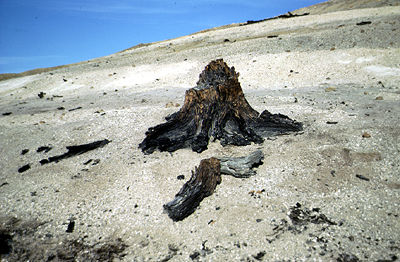
-
Article
Four Major Insect Pests of Forests in Canada
Many insects are considered pests to Canada’s forests, meaning they cause significant ecological or economic damage to forest ecosystems. These species can injure trees in various ways, including boring through wood, eating leaves, and introducing pathogens to trees. These stressors can cause economic damage by reducing the amount of wood fibre that can be harvested and can sometimes negatively impact the ecosystem. While some of these pests have been recently introduced to Canadian forests from other parts of the globe, the majority of insect forest pests in Canada are native species. Under ordinary conditions, these species are natural sources of disturbance and diversity that can help to maintain healthy forests over long periods. However, human-mediated factors such as climate change, the introduction of non-native species, and biodiversity loss have more recently worsened the impacts that certain species can have on Canadian forests. Below is a list of just a few of the many such insects impacting Canadian forests, along with the estimated area of forest, in hectares, that a population outbreak defoliated or killed as well as the year that outbreak occurred.
"https://d3d0lqu00lnqvz.cloudfront.net/insectpestsofforests/spongy-moth.jpg" // resources/views/front/categories/view.blade.php
https://d3d0lqu00lnqvz.cloudfront.net/insectpestsofforests/spongy-moth.jpg
-
Article
Fowler's Toad
The Fowler’s toad (Anaxyrus fowleri) is a medium-sized, earthen-coloured toad that is native to Eastern North America. In Canada, Fowler’s toads are only found in a few small areas along the north shore of Lake Erie. This species lives in places with sandy or gravelly soils into which individuals can burrow; Fowler’s toads spend much of their time underground. Due to small and declining populations, the Fowler’s toad is endangered in Canada.
"https://d3d0lqu00lnqvz.cloudfront.net/FowlersToad/CrowleyFowlersToad.jpg" // resources/views/front/categories/view.blade.php
https://d3d0lqu00lnqvz.cloudfront.net/FowlersToad/CrowleyFowlersToad.jpg
-
Article
Foxes in Canada
The fox is a small, carnivorous mammal of the Canidae family. Four species are present in Canada: the red fox (Vulpes vulpes), the swift fox (Vulpes velox), the grey fox (Urocyon cinereoargenteus) and the Arctic fox (Vulpes lagopus). Red and Arctic foxes have a circumpolar distribution, whereas grey and swift foxes are only present in the Americas. Red foxes are the provincial mammal of Prince Edward Island.
"https://d3d0lqu00lnqvz.cloudfront.net/media/media/9cf35f56-1812-464a-8f23-5b00ef613b07.jpg" // resources/views/front/categories/view.blade.php
https://d3d0lqu00lnqvz.cloudfront.net/media/media/9cf35f56-1812-464a-8f23-5b00ef613b07.jpg