Browse "Military"
-
Macleans
Rape in the Military Investigated
This article was originally published in Maclean’s magazine on December 14, 1998. Partner content is not updated.Tracey Constable was understandably skeptical when, last May, Canada's top soldier, chief of defence staff Gen. Maurice Baril, called on women who had been sexually assaulted in the Canadian Forces to come forward and tell their stories. Constable, a native of Grand Falls, Nfld.This article contains sensitive material that may not be suitable for all audiences.This article was originally published in Maclean's Magazine on December 14, 1998
"https://thecanadianencyclopedia.ca/images/tce_placeholder.jpg?v=e9dca980c9bdb3aa11e832e7ea94f5d9" // resources/views/front/categories/view.blade.php
https://thecanadianencyclopedia.ca/images/tce_placeholder.jpg?v=e9dca980c9bdb3aa11e832e7ea94f5d9
-
Article
RCAF Blackouts
RCAF Blackouts. Entertainment troupe, one of several organized during World War II by air force personnel.
"https://thecanadianencyclopedia.ca/images/tce_placeholder.jpg?v=e9dca980c9bdb3aa11e832e7ea94f5d9" // resources/views/front/categories/view.blade.php
https://thecanadianencyclopedia.ca/images/tce_placeholder.jpg?v=e9dca980c9bdb3aa11e832e7ea94f5d9
-
Article
Rebellion in Lower Canada (The Patriots' War)
In 1837 and 1838, French Canadian militants in Lower Canada took up arms against the British Crown in a pair of insurrections. The twin rebellions killed more than 300 people. They followed years of tensions between the colony’s anglophone minority and the growing, nationalistic aspirations of its francophone majority. The rebels failed in their campaign against British rule. However, their revolt led to political reform, including the unified Province of Canada and the introduction of responsible government. The rebellion in Lower Canada, which is also known as the Patriots' War (la Guerre des patriotes), also gave French Canadians one of their first nationalist heroes in Louis-Joseph Papineau.
"https://d3d0lqu00lnqvz.cloudfront.net/media/media/37aadc48-3f88-4946-a9aa-0d2ad30495cd.jpg" // resources/views/front/categories/view.blade.php
https://d3d0lqu00lnqvz.cloudfront.net/media/media/37aadc48-3f88-4946-a9aa-0d2ad30495cd.jpg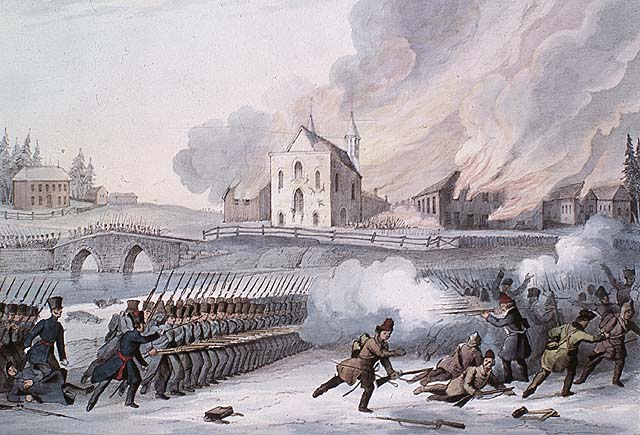
-
Article
Regiment
A regiment is a body of troops composed of squadrons, batteries or companies; it is often divided into battalions for military operations. A single-battalion regiment ranges in size from 300 to 1,000.
"https://d3d0lqu00lnqvz.cloudfront.net/CAF/RCR_1907.jpg" // resources/views/front/categories/view.blade.php
https://d3d0lqu00lnqvz.cloudfront.net/CAF/RCR_1907.jpg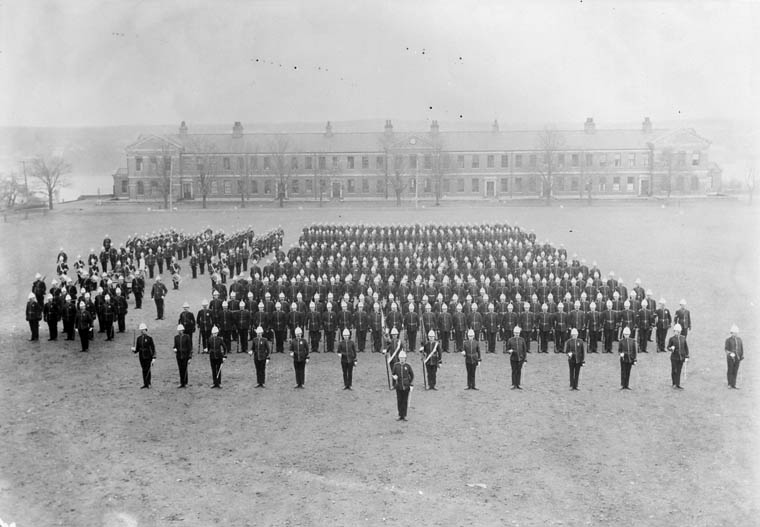
-
Article
Remembering D-Day: The Making of a Heritage Minute
On 6 June 1944, Canadian Forces landed on Juno Beach. D-Day was the largest amphibious invasion of all time and marked the beginning of the end of the Second World War. In 2019, Historica Canada released a Heritage Minute telling the story of 47-year-old Major Archie MacNaughton, a First World War veteran and leader of the North Shore New Brunswick Regiment’s A Company. In this article, Anthony Wilson-Smith, president of Historica Canada, reflects on the making of the D-Day Minute.
"https://d3d0lqu00lnqvz.cloudfront.net/media/new_article_images/ArchieMacNaughton/IMG_2847.JPG" // resources/views/front/categories/view.blade.php
https://d3d0lqu00lnqvz.cloudfront.net/media/new_article_images/ArchieMacNaughton/IMG_2847.JPG
-
Article
Remembrance Day Poppy
The red poppy is a symbol of Remembrance Day that was inspired by the poem “In Flanders Fields,” written by Lieutenant-Colonel John McCrae. Canada officially adopted the poppy as a symbol of remembrance in 1921. Red poppy pins are sold by the Royal Canadian Legion and worn by millions of Canadians in the weeks leading up to and on 11 November.
"https://d3d0lqu00lnqvz.cloudfront.net/media/media/064a5591-1989-4fac-b81e-7bd9099c8053.jpg" // resources/views/front/categories/view.blade.php
https://d3d0lqu00lnqvz.cloudfront.net/media/media/064a5591-1989-4fac-b81e-7bd9099c8053.jpg
-
Article
Representing the Home Front: The Women of the Canadian War Memorials Fund
While they may not have had access to the battlefields, a number of Canadian women artists made their mark on the visual culture of the First World War by representing the home front. First among these were the women affiliated with the Canadian War Memorials Fund, Canada’s first official war art program. Founded in 1916, the stated goal of the Fund was to provide “suitable Memorials in the form of Tablets, Oil-Paintings, etc. […], to the Canadian Heroes and Heroines in the War.” Expatriates Florence Carlyle and Caroline Armington participated in the program while overseas. Artists Henrietta Mabel May, Dorothy Stevens, Frances Loringand Florence Wyle were commissioned by the Fund to visually document the war effort in Canada.
"https://d3d0lqu00lnqvz.cloudfront.net/media/media/c5bd4814-1974-4a38-b0bf-006c4ec26687.jpg" // resources/views/front/categories/view.blade.php
https://d3d0lqu00lnqvz.cloudfront.net/media/media/c5bd4814-1974-4a38-b0bf-006c4ec26687.jpg
-
Article
Reserve Force of Canada
The Reserve Force of Canada comprises part-time members of the ARMED FORCES, whose role is to augment and support the Regular Force. Compulsory universal military service for early settlers eventually became part-time, volunteer soldiering.
"https://thecanadianencyclopedia.ca/images/tce_placeholder.jpg?v=e9dca980c9bdb3aa11e832e7ea94f5d9" // resources/views/front/categories/view.blade.php
https://thecanadianencyclopedia.ca/images/tce_placeholder.jpg?v=e9dca980c9bdb3aa11e832e7ea94f5d9
-
Collection
Royal Canadian Air Force
On 1 April 2024, the Royal Canadian Air Force (RCAF) will mark its 100th anniversary. Canada didn't have its own air force during the First World War, although more than 20,000 Canadians served in a British Empire flying service. After the war, Canada established an Air Board to develop aviation policy, leading to a Canadian Air Force or “flying militia” that used wartime flyers and surplus British aircraft. On 1 April 1924, the air service...
"https://d3d0lqu00lnqvz.cloudfront.net/media/media/6a823326-afa8-474e-a4e7-8b72b9a5dd53.jpg" // resources/views/front/categories/view.blade.php
https://d3d0lqu00lnqvz.cloudfront.net/media/media/6a823326-afa8-474e-a4e7-8b72b9a5dd53.jpg
-
Article
Royal Canadian Naval Air Branch
The Royal Canadian Naval Air Branch was established in 1945 and disbanded upon unification of the Canadian Armed Forces in 1968. During that period, the Royal Canadian Navy (RCN) operated a succession of three aircraft carriers: HMC Ships Warrior, Magnificent and Bonaventure. The ability to exercise air power at sea was fundamental to the RCN’s core role of anti-submarine warfare (ASW) against the Cold War Soviet submarine fleet. As the nature of that threat evolved, the RCN Air Branch underwent a nearly continuous process of adaptation to incorporate new equipment and tactics, with increasingly higher performance aircraft and supporting equipment.
"https://d3d0lqu00lnqvz.cloudfront.net/RCNAirBranch/Bonaventure_-_Banshees.jpg" // resources/views/front/categories/view.blade.php
https://d3d0lqu00lnqvz.cloudfront.net/RCNAirBranch/Bonaventure_-_Banshees.jpg
-
Article
Royal Canadian Naval Air Service (RCNAS)
The Royal Canadian Naval Air Service (RCNAS) was formed during the closing months of the First World War to help counter the German U-boat threat on Canada’s East Coast. It was disbanded after only three months of existence. A Canadian naval air service was not created again until after the Second World War.
"https://d3d0lqu00lnqvz.cloudfront.net/RCNAS/HS-2L-1876.jpg" // resources/views/front/categories/view.blade.php
https://d3d0lqu00lnqvz.cloudfront.net/RCNAS/HS-2L-1876.jpg
-
Article
Royal Canadian Regiment
The Royal Canadian Regiment (RCR) is one of three permanent, regular army infantry regiments of the Canadian Armed Forces. The regimental headquarters is in Petawawa, Ontario. Consisting of three battalions and a reserve battalion, the RCR has a proud history of military service dating back to 1863.
"https://d3d0lqu00lnqvz.cloudfront.net/RCR/RCR_Italy.jpg" // resources/views/front/categories/view.blade.php
https://d3d0lqu00lnqvz.cloudfront.net/RCR/RCR_Italy.jpg
-
Article
Royal Flying Corps
During the First World War, more than 5,000 Canadian pilots served in the Royal Flying Corps (RFC). The RFC was formed on 13 April 1912 to satisfy Britain's need for a military presence in the expanding field of aviation. It joined with the Royal Naval Air Service (RNAS) in April 1918 to become the Royal Air Force. During the war, an RFC/RAF training program in Canada produced approximately 10,500 pilots, mechanics and aircraftmen.
"https://d3d0lqu00lnqvz.cloudfront.net/BillyBishop/Bishop-Barker.jpg" // resources/views/front/categories/view.blade.php
https://d3d0lqu00lnqvz.cloudfront.net/BillyBishop/Bishop-Barker.jpg
-
Article
Royal Hamilton Light Infantry Band
The Regimental Band of the Royal Hamilton Light Infantry (RHLI) is the oldest enlisted band in Canada. Formed in 1866 by Peter Grossman, it has been led by Captain Ryan W. Baker since 2016.
"https://d3d0lqu00lnqvz.cloudfront.net/ArmyUnits/1200px-Royal_Hamilton_Light_Infantry_band.jpg" // resources/views/front/categories/view.blade.php
https://d3d0lqu00lnqvz.cloudfront.net/ArmyUnits/1200px-Royal_Hamilton_Light_Infantry_band.jpg
-
Article
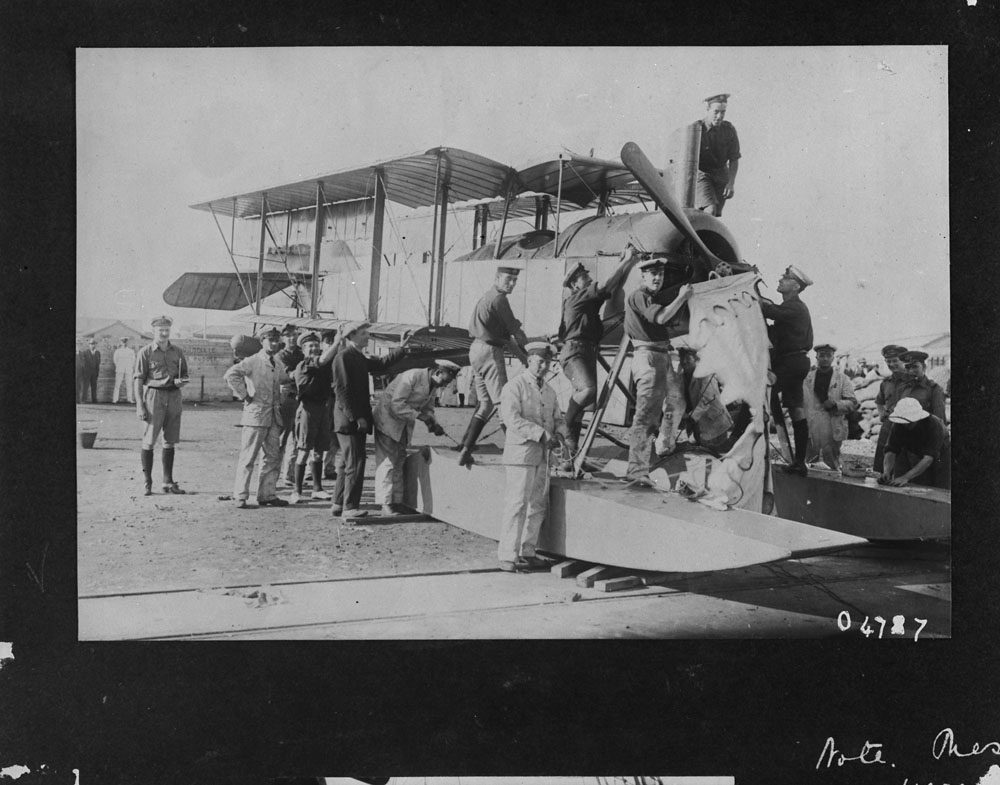
Canadians in the Royal Naval Air Service
During the First World War, more than 900 Canadians served in Britain’s Royal Naval Air Service (RNAS). Members of the RNAS were involved in the defence of Britain, support of land operations, and anti-submarine warfare.
"https://d3d0lqu00lnqvz.cloudfront.net/RNAS/assembling-seaplane-RNAS.jpg" // resources/views/front/categories/view.blade.php
https://d3d0lqu00lnqvz.cloudfront.net/RNAS/assembling-seaplane-RNAS.jpg