
Browse "History"
-
Article
Chesapeake Affair 1807
Wars often have many causes. Some are long-standing problems between nations, while others are dangerous sparks that inflame attitudes and push nations to a call to arms.
"https://thecanadianencyclopedia.ca/images/tce_placeholder.jpg?v=e9dca980c9bdb3aa11e832e7ea94f5d9" // resources/views/front/categories/view.blade.php
https://thecanadianencyclopedia.ca/images/tce_placeholder.jpg?v=e9dca980c9bdb3aa11e832e7ea94f5d9
-
Article
Chesapeake Affair 1863
On 7 December 1863, during the American Civil War, 16 Confederates seized American coastal steamer Chesapeake off Cape Cod and diverted it to Saint John, NB.
"https://thecanadianencyclopedia.ca/images/tce_placeholder.jpg?v=e9dca980c9bdb3aa11e832e7ea94f5d9" // resources/views/front/categories/view.blade.php
https://thecanadianencyclopedia.ca/images/tce_placeholder.jpg?v=e9dca980c9bdb3aa11e832e7ea94f5d9
-
Article
Chinese Head Tax in Canada
The Chinese head tax was enacted to restrict immigration after Chinese labour was no longer needed to build the Canadian Pacific Railway. Between 1885 and 1923, Chinese immigrants had to pay a head tax to enter Canada. The tax was levied under the Chinese Immigration Act (1885). It was the first legislation in Canadian history to exclude immigration on the basis of ethnic background. With few exceptions, Chinese people had to pay at least $50 to come to Canada. The tax was later raised to $100, then to $500. During the 38 years the tax was in effect, around 82,000 Chinese immigrants paid nearly $23 million in tax. The head tax was removed with the passing of the Chinese Immigration Act in 1923. Also known as the Chinese Exclusion Act, it banned all Chinese immigrants until its repeal in 1947. In 2006, the federal government apologized for the head tax and its other racist immigration policies targeting Chinese people. This is the full-length entry about the Chinese Head Tax. For a plain-language summary, please see Chinese Head Tax in Canada (Plain-Language Summary).
"https://d3d0lqu00lnqvz.cloudfront.net/media/media/d0c5f1d6-6030-4a96-900c-3efed6463116.jpg" // resources/views/front/categories/view.blade.php
https://d3d0lqu00lnqvz.cloudfront.net/media/media/d0c5f1d6-6030-4a96-900c-3efed6463116.jpg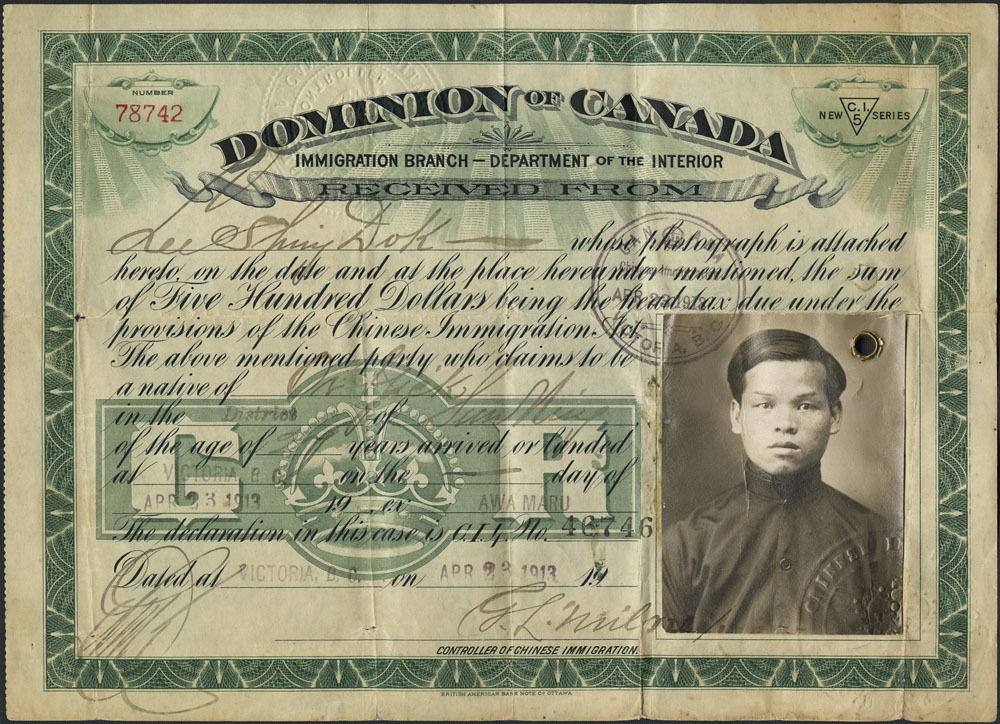
-
Article
Christmas in Canada
Christmas is celebrated in various ways in contemporary Canada. In particular, it draws form the French, British and American traditions. Since the beginning of the 20th century, it had become the biggest annual celebration and had begun to take on the form that we recognize today.
"https://d3d0lqu00lnqvz.cloudfront.net/media/media/a8ac9316-d4be-451e-9801-1c4f6a329d71.jpg" // resources/views/front/categories/view.blade.php
https://d3d0lqu00lnqvz.cloudfront.net/media/media/a8ac9316-d4be-451e-9801-1c4f6a329d71.jpg
-
Editorial
The First Christmas Tree in North America
The following article is an editorial written by The Canadian Encyclopedia staff. Editorials are not usually updated.
"https://d3d0lqu00lnqvz.cloudfront.net/media/media/b7110cb5-bfa8-4f96-803e-418fb5b41091.jpg" // resources/views/front/categories/view.blade.php
https://d3d0lqu00lnqvz.cloudfront.net/media/media/b7110cb5-bfa8-4f96-803e-418fb5b41091.jpg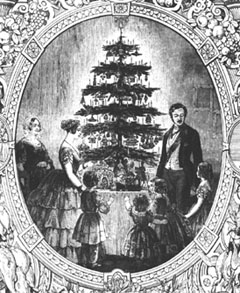
-
Article
Clergy Reserves
Clergy Reserves, one-seventh of the public lands of Upper and Lower Canada, reserved by the 1791 Constitutional Act for the maintenance of a "Protestant clergy," a phrase intended to apply to the Church of England alone.
"https://d3d0lqu00lnqvz.cloudfront.net/media/media/693e886b-aefa-4d54-b3e0-c1695d334bb0.jpg" // resources/views/front/categories/view.blade.php
https://d3d0lqu00lnqvz.cloudfront.net/media/media/693e886b-aefa-4d54-b3e0-c1695d334bb0.jpg
-
Article
Clocks and Watches
The manufacture of clocks and watches in Canada may have begun as early as 1700; however, practising watch and clockmakers through the 18th and much of the 19th centuries did not make the movements.
"https://thecanadianencyclopedia.ca/images/tce_placeholder.jpg?v=e9dca980c9bdb3aa11e832e7ea94f5d9" // resources/views/front/categories/view.blade.php
https://thecanadianencyclopedia.ca/images/tce_placeholder.jpg?v=e9dca980c9bdb3aa11e832e7ea94f5d9
-
Article
Co-operative Commonwealth Federation (CCF)
The Co-operative Commonwealth Federation (CCF) was founded in Calgary in 1932. It was a political coalition of progressive, socialist and labour groups. It sought economic reform to help Canadians affected by the Great Depression. The party governed Saskatchewan under Premier Tommy Douglas, who went on to be the first leader of the federal New Democratic Party (NDP). The CCF merged with the Canadian Labour Congress (CLC) to form the NDP in 1961. Although the CCF never held power nationally, the adoption of many of its ideas by ruling parties contributed greatly to the development of the Canadian welfare state.
"https://d3d0lqu00lnqvz.cloudfront.net/media/media/d27e812a-e155-4b23-94b4-55060feada96.jpg" // resources/views/front/categories/view.blade.php
https://d3d0lqu00lnqvz.cloudfront.net/media/media/d27e812a-e155-4b23-94b4-55060feada96.jpg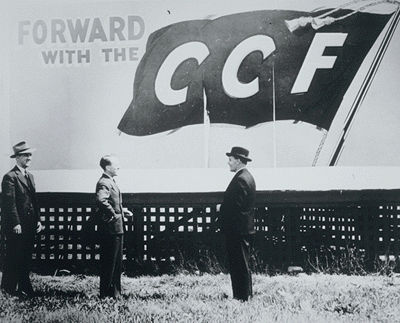
-
Article
Coal Mining
A carbonaceous fossil fuel, coal has a long history as the key energy source in the transition to industrialization, beginning in 17th-century Europe.
"https://d3d0lqu00lnqvz.cloudfront.net/media/media/0b6c36b6-4c5a-4a08-b2dd-78723d6b2e54.jpg" // resources/views/front/categories/view.blade.php
https://d3d0lqu00lnqvz.cloudfront.net/media/media/0b6c36b6-4c5a-4a08-b2dd-78723d6b2e54.jpg
-
Article
Coal Mining Disasters
Coal mining involves deep workings, soft rock, dust, poisonous and flammable gases, explosives, machinery, transport and ventilation systems, and, in early times, open-flame lamps. Each has been a factor in the many Canadian coal mine tragedies, the worst of which are detailed here.
"https://d3d0lqu00lnqvz.cloudfront.net/media/media/10dac7dd-3569-432a-8cb3-c5ad5f082f3f.jpg" // resources/views/front/categories/view.blade.php
https://d3d0lqu00lnqvz.cloudfront.net/media/media/10dac7dd-3569-432a-8cb3-c5ad5f082f3f.jpg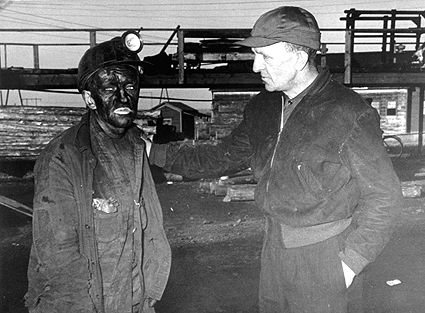
-
Article
Collapse of the Peace River Bridge
The spectacular suspension bridge across the Peace River south of Fort St. John, British Columbia, was opened in the summer of 1943, replacing a ferry crossing on the Alaska Highway.
"https://thecanadianencyclopedia.ca/images/tce_placeholder.jpg?v=e9dca980c9bdb3aa11e832e7ea94f5d9" // resources/views/front/categories/view.blade.php
https://thecanadianencyclopedia.ca/images/tce_placeholder.jpg?v=e9dca980c9bdb3aa11e832e7ea94f5d9
-
Article
Colonial Office
Colonial Office, a department established by the British government to administer its colonial possessions, including British North America.
"https://thecanadianencyclopedia.ca/images/tce_placeholder.jpg?v=e9dca980c9bdb3aa11e832e7ea94f5d9" // resources/views/front/categories/view.blade.php
https://thecanadianencyclopedia.ca/images/tce_placeholder.jpg?v=e9dca980c9bdb3aa11e832e7ea94f5d9
-
Article
Colored Hockey League of the Maritimes
The Colored Hockey League of the Maritimes (CHL) was an all-Black men’s hockey league. Organized by Black Baptists and Black intellectuals, it was founded in Halifax, Nova Scotia, in 1895. It was defunct during and after the First World War, reformed in 1921 and then fell apart during the Depression in the 1930s. Play was known to be fast, physical and innovative. The league was designed to attract young Black men to Sunday worship with the promise of a hockey game between rival churches after the services. Later, with the influence of the Black Nationalism Movement and rising interest in the sport of hockey, the league came to be seen as a potential driving force for the equality of Black Canadians. Canada Post issued a commemorative stamp in honour of the league in 2020. In 2024, the league was declared an event of national historic significance by Parks Canada.
"https://d3d0lqu00lnqvz.cloudfront.net/Coloured Hockey League.jpg" // resources/views/front/categories/view.blade.php
https://d3d0lqu00lnqvz.cloudfront.net/Coloured Hockey League.jpg
-
Article
Communauté des biens
Communauté des biens (community of property), term used in the legal codes of NEW FRANCE and Québec to describe the pooled assets of husband and wife. It began as part of the Coutume de Paris, introduced about 1640 and the sole legal code of the colony after 1664.
"https://thecanadianencyclopedia.ca/images/tce_placeholder.jpg?v=e9dca980c9bdb3aa11e832e7ea94f5d9" // resources/views/front/categories/view.blade.php
https://thecanadianencyclopedia.ca/images/tce_placeholder.jpg?v=e9dca980c9bdb3aa11e832e7ea94f5d9
-
Article
Communauté des habitants
Communauté des habitants (Compagnie des habitants), colonial merchants who held the fur trade monopoly in New France 1645-63.
"https://thecanadianencyclopedia.ca/images/tce_placeholder.jpg?v=e9dca980c9bdb3aa11e832e7ea94f5d9" // resources/views/front/categories/view.blade.php
https://thecanadianencyclopedia.ca/images/tce_placeholder.jpg?v=e9dca980c9bdb3aa11e832e7ea94f5d9