
Browse "Communities & Sociology"
-
Article
Quebec Film History: 1990 to Present
This entry presents an overview of Quebec cinema, from the explosion that followed Denys Arcand’s Le déclin de l’empire américain (1986) to the setback that followed 10 years later and the new wave of filmmaking that emerged at the beginning of the 21st century. It highlights the most important films, whether in terms of box office success or international acclaim, and covers both narrative features and documentaries. It also draws attention to an aspect of filmmaking that still has difficulty finding its place: women's cinema.
"https://d3d0lqu00lnqvz.cloudfront.net/media/media/3fc2649b-c4d7-4fc5-8f8f-d2d67ed75621.jpg" // resources/views/front/categories/view.blade.php
https://d3d0lqu00lnqvz.cloudfront.net/media/media/3fc2649b-c4d7-4fc5-8f8f-d2d67ed75621.jpg
-
Article
Quebec Resolutions
The Quebec Resolutions are a list of 72 policy directives that formed the basis of Canada’s Constitution. They emerged from the Charlottetown Conference (1–9 September 1864) and the Quebec Conference (10–27 October 1864). Those meetings were held by politicians from the five British North American colonies to work out the details of how they would unite into a single country. (See also: Confederation.) The Quebec Resolutions were finalized at the London Conference (4 December 1866 to March 1867). They formed the basis of the British North America Act — the first building block of Canada’s Constitution — which established the Dominion of Canada on 1 July 1867.
"https://d3d0lqu00lnqvz.cloudfront.net/media/media/3bac7236-85c5-44fe-8cea-2d0c2948c5df.jpg" // resources/views/front/categories/view.blade.php
https://d3d0lqu00lnqvz.cloudfront.net/media/media/3bac7236-85c5-44fe-8cea-2d0c2948c5df.jpg
-
Article
Reference re Secession of Quebec
The Reference re Secession of Quebec was a reference case of the Supreme Court of Canada. It came after the 1995 Quebec referendum. The Court was faced with the question of whether Quebec could decide on its own to secede from Canada.
"https://d3d0lqu00lnqvz.cloudfront.net/media/media/7ac02b0f-118b-4ccb-b6dc-81f218b68954.jpg" // resources/views/front/categories/view.blade.php
https://d3d0lqu00lnqvz.cloudfront.net/media/media/7ac02b0f-118b-4ccb-b6dc-81f218b68954.jpg
-
Article
Québec Shoe Workers' Strike
The Québec Shoe Workers' Strike, properly a lockout, 27 October-10 December 1900, was the first direct intervention in a labour conflict by Québec Catholic clergy and the first step toward the creation of Catholic unions (see CONFEDERATION OF NATIONAL TRADE UNIONS).
"https://thecanadianencyclopedia.ca/images/tce_placeholder.jpg?v=e9dca980c9bdb3aa11e832e7ea94f5d9" // resources/views/front/categories/view.blade.php
https://thecanadianencyclopedia.ca/images/tce_placeholder.jpg?v=e9dca980c9bdb3aa11e832e7ea94f5d9
-
Article
2012 Québec Student Strike
In 2012, Québec and Canada experienced the longest student strike in their histories. The strike lasted several months (from 13 February to 7 September 2012) and pitted students in Québec against the provincial government on the issue of tuition fee increases.
"https://d3d0lqu00lnqvz.cloudfront.net/media/media/4e6b7748-1d05-452c-87c2-f62bd4603344.JPG" // resources/views/front/categories/view.blade.php
https://d3d0lqu00lnqvz.cloudfront.net/media/media/4e6b7748-1d05-452c-87c2-f62bd4603344.JPG
-
Article
Racial Segregation of Black People in Canada
Racial segregation is the separation of people, or groups of people, based on race in everyday life. Throughout Canada’s history, there have been many examples of Black people being segregated, excluded from, or denied equal access to opportunities and services such as education, employment, housing, transportation, immigration, health care and commercial establishments. The racial segregation of Black people in Canada was historically enforced through laws, court decisions and social norms. (See also Anti-Black Racism in Canada.) (This is the full-length entry on racial segregation of Black people in Canada. For a plain-language summary, please see Racial Segregation of Black People in Canada (Plain-Language Summary).)
"https://d3d0lqu00lnqvz.cloudfront.net/media/new_article_images/RacialSegregationBlackPeopleCanada/Ar00710.png" // resources/views/front/categories/view.blade.php
https://d3d0lqu00lnqvz.cloudfront.net/media/new_article_images/RacialSegregationBlackPeopleCanada/Ar00710.png
-
Article
Racism
Racism is a belief that humans can be divided into a hierarchy of power on the basis of their differences in race and ethnicity. With some groups seen as superior to others on the sole basis of their racial or ethnic characteristics. Racism is frequently expressed through prejudice and discrimination. The belief can manifest itself through individuals, but also through societies and institutions.
"https://d3d0lqu00lnqvz.cloudfront.net/media/media/eb6ec132-1f25-4df9-b54d-d101ef2e4e7e.jpg" // resources/views/front/categories/view.blade.php
https://d3d0lqu00lnqvz.cloudfront.net/media/media/eb6ec132-1f25-4df9-b54d-d101ef2e4e7e.jpg
-
Macleans
RCMP Drug Operation Claims Lives
This article was originally published in Maclean’s magazine on March 31, 1997. Partner content is not updated. Eugene Uyeyama appeared to have it all. After 12 years, the woman of his dreams had finally said "yes," and married him. He and his new bride, Michele, had just returned from a luxurious two-week Caribbean cruise, and were looking forward to their first Christmas as husband and wife.
"https://thecanadianencyclopedia.ca/images/tce_placeholder.jpg?v=e9dca980c9bdb3aa11e832e7ea94f5d9" // resources/views/front/categories/view.blade.php
https://thecanadianencyclopedia.ca/images/tce_placeholder.jpg?v=e9dca980c9bdb3aa11e832e7ea94f5d9
-
Article
Rebellion in Lower Canada (The Patriots' War)
In 1837 and 1838, French Canadian militants in Lower Canada took up arms against the British Crown in a pair of insurrections. The twin rebellions killed more than 300 people. They followed years of tensions between the colony’s anglophone minority and the growing, nationalistic aspirations of its francophone majority. The rebels failed in their campaign against British rule. However, their revolt led to political reform, including the unified Province of Canada and the introduction of responsible government. The rebellion in Lower Canada, which is also known as the Patriots' War (la Guerre des patriotes), also gave French Canadians one of their first nationalist heroes in Louis-Joseph Papineau.
"https://d3d0lqu00lnqvz.cloudfront.net/media/media/37aadc48-3f88-4946-a9aa-0d2ad30495cd.jpg" // resources/views/front/categories/view.blade.php
https://d3d0lqu00lnqvz.cloudfront.net/media/media/37aadc48-3f88-4946-a9aa-0d2ad30495cd.jpg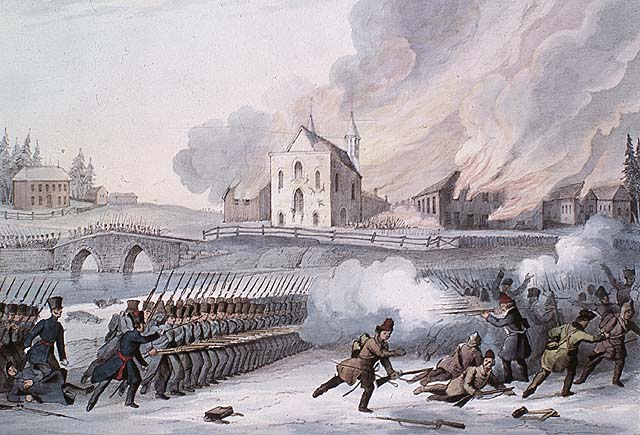
-
Article
Red River Resistance
The Red River Resistance (also known as the Red River Rebellion) was an uprising in 1869–70 in the Red River Colony. The resistance was sparked by the transfer of the vast territory of Rupert’s Land to the new Dominion of Canada. The colony of farmers and hunters, many of them Métis, occupied a corner of Rupert’s Land and feared for their culture and land rights under Canadian control. The Métis mounted a resistance and declared a provisional government to negotiate terms for entering Confederation. The uprising led to the creation of the province of Manitoba, and the emergence of Métis leader Louis Riel — a hero to his people and many in Quebec, but an outlaw in the eyes of the Canadian government.
"https://d3d0lqu00lnqvz.cloudfront.net/media/media/f0a1f84f-c420-4038-8815-42587e295b75.jpg" // resources/views/front/categories/view.blade.php
https://d3d0lqu00lnqvz.cloudfront.net/media/media/f0a1f84f-c420-4038-8815-42587e295b75.jpg
-
Article
Reform Movement in Upper Canada
After the War of 1812, Upper Canada began to develop rapidly. This resulted in social and economic tensions and political issues. These included the expulsion of Robert Gourlay, the Alien Question, the Anglican monopoly of the Clergy Reserves and education, and Tory control of patronage.
"https://d3d0lqu00lnqvz.cloudfront.net/media/media/9e9e3848-d959-4713-9a6f-8747181ebc24.jpg" // resources/views/front/categories/view.blade.php
https://d3d0lqu00lnqvz.cloudfront.net/media/media/9e9e3848-d959-4713-9a6f-8747181ebc24.jpg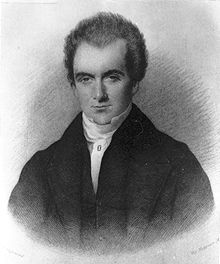
-
Article
Refus global
Refus global was a manifesto published in 1948 and signed by 16 figures from Quebec’s artistic community. It challenged the traditional values of Quebec. The manifesto also fostered an opening-up of Quebec society to international thought. (See also Quiet Revolution.)
"https://d3d0lqu00lnqvz.cloudfront.net/media/media/fe698d06-4a75-46e2-aa34-435400e0724e.jpg" // resources/views/front/categories/view.blade.php
https://d3d0lqu00lnqvz.cloudfront.net/media/media/fe698d06-4a75-46e2-aa34-435400e0724e.jpg
-
Article
Refus Global Manifesto
Refus Global Manifesto We are the offspring of modest French-Canadian families, working class or lower middle class, who, ever since their arrival from the Old Country, have always remained French and Catholic through resistance to the conqueror, through strong attachment to the past, by choice and sentimental pride and out of sheer necessity. We are the settlers who, in 1760, were first thrust into the fortress of fear, the usual refuge of the vanquished, and...
"https://d3d0lqu00lnqvz.cloudfront.net/media/media/1eeca976-046e-482e-ad6e-6c08419b4a46.jpg" // resources/views/front/categories/view.blade.php
https://d3d0lqu00lnqvz.cloudfront.net/media/media/1eeca976-046e-482e-ad6e-6c08419b4a46.jpg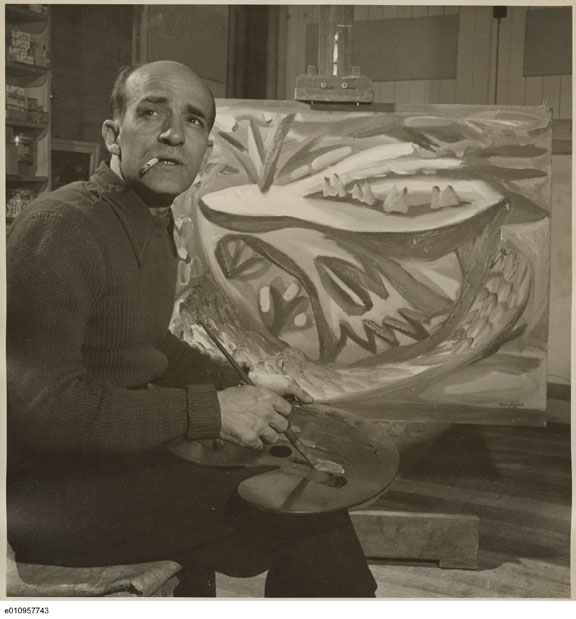
-
Article
Religion
Religion (from the Latin, religio, "respect for what is sacred") may be defined as the relationship between human beings and their transcendent source of value.
"https://d3d0lqu00lnqvz.cloudfront.net/media/media/cc179a05-9b3b-4d2c-aaf3-a1694d4f5288.jpg" // resources/views/front/categories/view.blade.php
https://d3d0lqu00lnqvz.cloudfront.net/media/media/cc179a05-9b3b-4d2c-aaf3-a1694d4f5288.jpg
-
Article
Religion and Spirituality of Indigenous Peoples in Canada
First Nation, Métis and Inuit religions in Canada vary widely and consist of complex social and cultural customs for addressing the sacred and the supernatural. The influence of Christianity — through settlers, missionaries and government policy — significantly altered life for Indigenous peoples. In some communities, this resulted in hybridized religious practices; while in others, European religion replaced traditional spiritual practices entirely. Though historically suppressed by colonial administrators and missionaries, especially from the late 19th- to mid-20th centuries, many contemporary Indigenous communities have revived, or continue to practice, traditional spirituality.
"https://d3d0lqu00lnqvz.cloudfront.net/media/media/f28b1ded-47a2-459d-9bfc-b26382f5c3b6.jpg" // resources/views/front/categories/view.blade.php
https://d3d0lqu00lnqvz.cloudfront.net/media/media/f28b1ded-47a2-459d-9bfc-b26382f5c3b6.jpg