
Browse "Communities & Sociology"
-
Macleans
Life Expectancy in Canada
This article was originally published in Maclean’s magazine on April 10, 2000. Partner content is not updated. Increasingly in recent years, surveys of mortality rates and other indicators have shown Canadians in some parts of the country to be much healthier than those in other regions. Now, a federal study shows just how dramatically one key indicator - life expectancy - varies among Canada's regions.
"https://thecanadianencyclopedia.ca/images/tce_placeholder.jpg?v=e9dca980c9bdb3aa11e832e7ea94f5d9" // resources/views/front/categories/view.blade.php
https://thecanadianencyclopedia.ca/images/tce_placeholder.jpg?v=e9dca980c9bdb3aa11e832e7ea94f5d9
-
Article
Lobbying in Canada
Lobbying is the process through which individuals and groups articulate their interests to federal, provincial or municipal governments to influence public policy or government decision-making. Lobbyists may be paid third parties who communicate on behalf of their clients; or they may be employees of a corporation or organization seeking to influence the government. Because of the possibility for conflict of interest, lobbying is the subject of much public scrutiny. At the federal level, lobbying activities are governed by the Lobbying Act. Provinces and municipalities have their own lobbying laws and by-laws.
"https://d3d0lqu00lnqvz.cloudfront.net/media/media/11551bec-a5f6-4e78-b101-265ddf7610cb.jpg" // resources/views/front/categories/view.blade.php
https://d3d0lqu00lnqvz.cloudfront.net/media/media/11551bec-a5f6-4e78-b101-265ddf7610cb.jpg
-
Article
Longhouse
A longhouse was the basic house type of pre-contact northern Iroquoian-speaking peoples, such as the Huron-Wendat, Haudenosaunee, Petun and Neutral. The longhouse sheltered a number of families related through the female line. In the 1700s, European-style single-family houses gradually replaced longhouses as primary residences. However, longhouses still function as important facilities in which some Indigenous peoples conduct ceremonies, political meetings and various community gatherings. (See also Architectural History of Indigenous Peoples in Canada.)
"https://d3d0lqu00lnqvz.cloudfront.net/media/media/c78ecb73-d7ac-4834-bc1e-a6d6bf206331.jpg" // resources/views/front/categories/view.blade.php
https://d3d0lqu00lnqvz.cloudfront.net/media/media/c78ecb73-d7ac-4834-bc1e-a6d6bf206331.jpg
-
Article
Lower Canada
Lower Canada was a British colony from 1791 to 1840. Its geographical boundaries comprised the southern portion of present-day Quebec. In 1791, Britain divided the Province of Quebec into Upper Canada and Lower Canada. (See: Constitutional Act 1791.) Britain had followed a similar policy of territorial division twice before. Prince Edward Island was detached from Nova Scotia in 1769. The provinces of Cape Breton and New Brunswick were created in 1784 in response to the wave of Loyalist immigration (which also occurred in Quebec). In 1841, Upper Canada and Lower Canada were renamed Canada West and Canada East, respectively. They were united as the single colony of the Province of Canada.
"https://d3d0lqu00lnqvz.cloudfront.net/media/media/0a40188b-4ef4-4e9e-90bb-ec21d39c1c45.jpg" // resources/views/front/categories/view.blade.php
https://d3d0lqu00lnqvz.cloudfront.net/media/media/0a40188b-4ef4-4e9e-90bb-ec21d39c1c45.jpg
-
Article
Music of the Lutherans
In 1980, Canada's fifth-largest Christian denomination, numbering approximately 716,000 persons, of whom 302,736 were members of congregations.
"https://thecanadianencyclopedia.ca/images/tce_placeholder.jpg?v=e9dca980c9bdb3aa11e832e7ea94f5d9" // resources/views/front/categories/view.blade.php
https://thecanadianencyclopedia.ca/images/tce_placeholder.jpg?v=e9dca980c9bdb3aa11e832e7ea94f5d9
-
Article
Madawaska: A Canadian-American Borderland, from Colonization to Division
Madawaska was a borderland that comprised parts of New Brunswick, Lower Canada, and the state of Maine, concentrated along the upper Saint John River valley.
"https://d3d0lqu00lnqvz.cloudfront.net/media/media/0052e055-bf0b-4980-8f10-08f926f15b9b.jpg" // resources/views/front/categories/view.blade.php
https://d3d0lqu00lnqvz.cloudfront.net/media/media/0052e055-bf0b-4980-8f10-08f926f15b9b.jpg
-
Article
Manitoba Act
The Manitoba Act provided for the admission of Manitoba as Canada’s fifth province. It received royal assent and became law on 12 May 1870. It marked the legal resolution of the struggle for self-determination between people of the Red River Colony and the federal government, which began with Canada’s purchase of Rupert’s Land in 1870. The Act contained protections for the region’s Métis. However, these protections were not fully realized. As a result, many Métis left the province for the North-West Territories.
"https://d3d0lqu00lnqvz.cloudfront.net/media/media/316b2dc2-7b32-4125-9417-bbecd843f730.jpg" // resources/views/front/categories/view.blade.php
https://d3d0lqu00lnqvz.cloudfront.net/media/media/316b2dc2-7b32-4125-9417-bbecd843f730.jpg
-
Article
Manitoba and Confederation
Canada’s fifth province, Manitoba entered Confederation with the passing of the Manitoba Act on 12 May 1870. The Assiniboine, Dakota, Cree and Dene peoples had occupied the land for up to 15,000 years. Since 1670, it was part of Rupert’s Land and was controlled by the Hudson’s Bay Company. The Canadian government purchased Rupert’s Land at the behest of William McDougall, Manitoba’s Father of Confederation. No residents of the area were consulted about the transfer; in response, Louis Riel and the Métis led the Red River Resistance. It resulted in an agreement to join Confederation. Ottawa agreed to help fund the new provincial government, give roughly 1.4 million acres of land to the Métis, and grant the province four seats in Parliament. However, Canada mismanaged its promise to guarantee the Métis their land rights. The resulting North-West Resistance in 1885 led to the execution of Riel. The creation of Manitoba — which, unlike the first four provinces, did not control its natural resources — revealed Ottawa’s desire to control western development.
"https://d3d0lqu00lnqvz.cloudfront.net/media/media/316b2dc2-7b32-4125-9417-bbecd843f730.jpg" // resources/views/front/categories/view.blade.php
https://d3d0lqu00lnqvz.cloudfront.net/media/media/316b2dc2-7b32-4125-9417-bbecd843f730.jpg
-
Article
Manitou
An Algonquian word meaning "mysterious being," or simply "mystery," that represents the unknown power of life and the universe.
"https://thecanadianencyclopedia.ca/images/tce_placeholder.jpg?v=e9dca980c9bdb3aa11e832e7ea94f5d9" // resources/views/front/categories/view.blade.php
https://thecanadianencyclopedia.ca/images/tce_placeholder.jpg?v=e9dca980c9bdb3aa11e832e7ea94f5d9
-
Article
Cannabis Legalization in Canada
Cannabis, also known as marijuana (among countless other names), is a psychoactive intoxicant that was banned in Canada from 1923 until medical cannabis became legal in 2001. The consumption and sale of recreational cannabis was legalized and regulated on 17 October 2018, after Parliament passed Bill C-45, the Cannabis Act. Legalization was supported by a majority of Canadians, despite concerns about the drug’s addictiveness and health effects, especially among young people.
"https://d3d0lqu00lnqvz.cloudfront.net/media/media/15a75b1f-63f9-44a5-a4b5-e145225ac9a7.jpg" // resources/views/front/categories/view.blade.php
https://d3d0lqu00lnqvz.cloudfront.net/media/media/15a75b1f-63f9-44a5-a4b5-e145225ac9a7.jpg
-
Article
Marriage in Canada
Marriage remains one of the most important social institutions in Canada. It has undergone profound changes since the 1960s. The marriage rate is in decline and the traditional idea of a family is being transformed. After the turn of the millennium, the marriage rate fell to 4.7 marriages per 1,000 people (compared to 10.9 in the 1940s). Married couples are still the predominant family structure. But between 2001 and 2016, the number of common-law couples rose 51.4 per cent; more than five times the increase for married couples over the same period. The definition of what constitutes a married couple also changed in 2005 with the legalization of same-sex marriage. In 2016, 65.8 per cent of Canadian families were headed by married couples; down from 70.5 per cent in 2001. Marriage falls under federal jurisdiction, but the provinces regulate marriage ceremonies and grant marriage licences.
"https://d3d0lqu00lnqvz.cloudfront.net/media/media/774be527-3b4e-4d62-8441-076a3a72ec1e.jpg" // resources/views/front/categories/view.blade.php
https://d3d0lqu00lnqvz.cloudfront.net/media/media/774be527-3b4e-4d62-8441-076a3a72ec1e.jpg
-
Article
Marxism
Marxism was brought to Canada by British worker intellectuals in the first years of the 20th century. It was the dominant ideology in the earliest socialist parties of Canada and was fully adopted by the COMMUNIST PARTY OF CANADA when it formed in 1921.
"https://d3d0lqu00lnqvz.cloudfront.net/media/media/abbfb032-ed66-462e-a59f-9f2a91759898.jpg" // resources/views/front/categories/view.blade.php
https://d3d0lqu00lnqvz.cloudfront.net/media/media/abbfb032-ed66-462e-a59f-9f2a91759898.jpg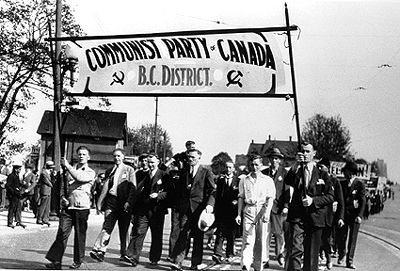
-
Article
Massey Commission
The Massey Commission was formally known as the Royal Commission on National Development in the Arts, Letters and Sciences. It was officially appointed by Prime Minister Louis St-Laurent on 8 April 1949. Its purpose was to investigate the state of arts and culture in Canada. Vincent Massey chaired the Commission. It issued its landmark report, the Massey Report, on 1 June 1951. The report advocated for the federal funding of a wide range of cultural activities. It also made a series of recommendations that resulted in the founding of the National Library of Canada (now Library and Archives Canada), the creation of the Canada Council for the Arts, federal aid for universities, and the conservation of Canada’s historic places, among other initiatives. The recommendations that were made by the Massey Report, and enacted by the federal government, are generally seen as the first major steps to nurture, preserve and promote Canadian culture.
"https://d3d0lqu00lnqvz.cloudfront.net/media/media/6dc56c29-5a10-4fff-ad08-000dc347c1e4.jpg" // resources/views/front/categories/view.blade.php
https://d3d0lqu00lnqvz.cloudfront.net/media/media/6dc56c29-5a10-4fff-ad08-000dc347c1e4.jpg
-
Article
McLean Gang
McLean Gang, BC outlaws (fl 1879). Consisting of Allan, Charlie and Archie McLean and Alex Hare (all 4 of mixed blood), the gang lived by banditry and violence.
"https://thecanadianencyclopedia.ca/images/tce_placeholder.jpg?v=e9dca980c9bdb3aa11e832e7ea94f5d9" // resources/views/front/categories/view.blade.php
https://thecanadianencyclopedia.ca/images/tce_placeholder.jpg?v=e9dca980c9bdb3aa11e832e7ea94f5d9
-
Article
Media Bias in Canada
Bias means supporting or opposing something or someone in an unfair way, regardless of the evidence. Media bias is when information spread by media or a news outlet reflects the interests and biases of ownership or individuals of that media company. Corporations may have a clear bias for one political party or issue and may influence its media outlets to reflect that bias. Individual journalists or news outlets may favour one side of an issue and reflect that bias — consciously or unconsciously — in the way they cover stories. The fact that a majority of journalists in Canada are White can also lead to biased reporting on minority groups. People can overcome unconscious bias by thinking and talking about it, and especially by listening to people from less privileged backgrounds.
"https://d3d0lqu00lnqvz.cloudfront.net/media/new_article_images/MediaBias/dreamstime_xl_142501942.jpg" // resources/views/front/categories/view.blade.php
https://d3d0lqu00lnqvz.cloudfront.net/media/new_article_images/MediaBias/dreamstime_xl_142501942.jpg