
Browse "Buildings & Monuments"
-
Article
Sports Facilities
Sports facilities in Canada - including arenas, stadiums and curling rinks, swimming pools and specialized Olympic installations - are among the country's most important cultural buildings.
"https://d3d0lqu00lnqvz.cloudfront.net/media/media/eac3c97c-5657-4435-9e1f-a006b151f413.jpg" // resources/views/front/categories/view.blade.php
https://d3d0lqu00lnqvz.cloudfront.net/media/media/eac3c97c-5657-4435-9e1f-a006b151f413.jpg
-
Article
St. Anne's Anglican Church
St. Anne's Anglican Church was located on Gladstone Avenue in the Brockville residential neighbourhood of Toronto, Ontario (near Dufferin and Dundas Streets). (See also Anglicanism in Canada.) Built in 1907-08 in the Byzantine Revival style, St. Anne's Anglican Church contained a remarkable collection of paintings by prominent Canadian artists, including three members of the Group of Seven. (See also J.E.H. MacDonald Frederick Horsman Varley; Franklin Carmichael.) The church was designated a National Historic Site of Canada in 1996. On 9 June 2024, the church was destroyed by a four-alarm fire.
"https://d3d0lqu00lnqvz.cloudfront.net/stannesanglicanchurch/interiorstannesanglicanchurch.jpg" // resources/views/front/categories/view.blade.php
https://d3d0lqu00lnqvz.cloudfront.net/stannesanglicanchurch/interiorstannesanglicanchurch.jpg
-
Article
St-Denis Theatre/Théâtre St-Denis
St-Denis Theatre/Théâtre St-Denis. Built in 1915 on St-Denis St north of Ste-Catherine St in Montreal and inaugurated 4 Mar 1916.
"https://thecanadianencyclopedia.ca/images/tce_placeholder.jpg?v=e9dca980c9bdb3aa11e832e7ea94f5d9" // resources/views/front/categories/view.blade.php
https://thecanadianencyclopedia.ca/images/tce_placeholder.jpg?v=e9dca980c9bdb3aa11e832e7ea94f5d9
-
Article
St. Lawrence Centre for the Arts
St. Lawrence Centre for the Arts. A theatre complex in Toronto, located on Front St and built as the city's centennial project.
"https://thecanadianencyclopedia.ca/images/tce_placeholder.jpg?v=e9dca980c9bdb3aa11e832e7ea94f5d9" // resources/views/front/categories/view.blade.php
https://thecanadianencyclopedia.ca/images/tce_placeholder.jpg?v=e9dca980c9bdb3aa11e832e7ea94f5d9
-
Article
St. Lawrence Hall
St. Lawrence Hall opened in 1850 and was Toronto’s first large meeting hall. Named for Canada's patron saint, it was for many years the centre of cultural and political life in Toronto, hosting many balls, receptions, concerts, exhibitions and lectures.
"https://d3d0lqu00lnqvz.cloudfront.net/media/media/4a2002b5-4f06-4779-b81c-f1dab18f90af.jpg" // resources/views/front/categories/view.blade.php
https://d3d0lqu00lnqvz.cloudfront.net/media/media/4a2002b5-4f06-4779-b81c-f1dab18f90af.jpg
-
Article
St Lawrence Hall
In 1967, as a Toronto centennial project, the building was restored, and the auditorium came into use again for social functions and chamber music concerts.The building also houses the administrative offices and rehearsal rooms of the National Ballet of Canada.
"https://d3d0lqu00lnqvz.cloudfront.net/media/media/4a2002b5-4f06-4779-b81c-f1dab18f90af.jpg" // resources/views/front/categories/view.blade.php
https://d3d0lqu00lnqvz.cloudfront.net/media/media/4a2002b5-4f06-4779-b81c-f1dab18f90af.jpg
-
Article
St Mary's Church
The interior explains the unfamiliar shape; the entrance wall spirals inward past a circular baptistery to shield a broad, shadowed sanctuary under the downward billowing concrete vault. Two concrete cylinders descend from the vault to shed natural light on the altar and tabernacle areas.
"https://d3d0lqu00lnqvz.cloudfront.net/media/media/e5b0f56d-8a6a-41f4-bfb5-f912de0996e6.jpg" // resources/views/front/categories/view.blade.php
https://d3d0lqu00lnqvz.cloudfront.net/media/media/e5b0f56d-8a6a-41f4-bfb5-f912de0996e6.jpg
-
Article
Ste. Madeleine Métis Community
Ste. Madeleine was a Métis homestead of about 250 people located in Manitoba, near the Saskatchewan border. Red River Métis citizens and families established the settlement in the late 1800s and early 1900s. The community existed until shortly after the government implemented the Prairie Farm Rehabilitation Act of 1935 (see Prairie Farm Rehabilitation Administration). The Act was designed to assist farmers during drought conditions. However, it dispossessed the community of their land. In 1939, the community was destroyed, and the land was converted to pastureland. The Métis were removed with little or no compensation.
"https://thecanadianencyclopedia.ca/images/tce_placeholder.jpg?v=e9dca980c9bdb3aa11e832e7ea94f5d9" // resources/views/front/categories/view.blade.php
https://thecanadianencyclopedia.ca/images/tce_placeholder.jpg?v=e9dca980c9bdb3aa11e832e7ea94f5d9
-
Article
Stephansson House
Stephán G. STEPHANSSON left Iceland in 1873, settling first in the US before moving to Markerville in 1889. While in Markerville his political and philosophical thinking evolved, and he wrote extensively in Icelandic.
"https://d3d0lqu00lnqvz.cloudfront.net/media/media/e5306bc4-eda1-4f7a-84ff-f5f82f681784.jpg" // resources/views/front/categories/view.blade.php
https://d3d0lqu00lnqvz.cloudfront.net/media/media/e5306bc4-eda1-4f7a-84ff-f5f82f681784.jpg
-
Article
Stornoway
Stornoway is the official residence of Canada’s federal leader of the Opposition. It is located at 541 Acacia Ave in the village of Rockcliffe Park in Ottawa. Purchased in 1950 by a private trust, Stornoway has been owned by the Government of Canada since 1970 and managed by the National Capital Commission since 1986. Leader of the Conservative Party and the Official Opposition Pierre Poilievre and his family reside in Stornoway since 2022.
"https://d3d0lqu00lnqvz.cloudfront.net/media/media/d2b6590d-341d-4404-9720-e10d3b91116b.jpg" // resources/views/front/categories/view.blade.php
https://d3d0lqu00lnqvz.cloudfront.net/media/media/d2b6590d-341d-4404-9720-e10d3b91116b.jpg
-
Article
Studio de musique ancienne de Montréal
Studio de musique ancienne de Montréal. Ensemble of singers and instrumentalists dedicated to the performance of pre-1750 German, English, French, and Italian music 'in an informed and authentic spirit'.
"https://thecanadianencyclopedia.ca/images/tce_placeholder.jpg?v=e9dca980c9bdb3aa11e832e7ea94f5d9" // resources/views/front/categories/view.blade.php
https://thecanadianencyclopedia.ca/images/tce_placeholder.jpg?v=e9dca980c9bdb3aa11e832e7ea94f5d9
-
Article
Synagogues
According to Jewish law, a synagogue is defined as any place where 10 men can gather for worship and study. Tradition holds that the synagogue was established to provide an alternative for those who were unable to travel to the temple in Jerusalem.
"https://d3d0lqu00lnqvz.cloudfront.net/media/media/3cdd3a26-f43a-47c9-a723-6bb582abdab7.jpg" // resources/views/front/categories/view.blade.php
https://d3d0lqu00lnqvz.cloudfront.net/media/media/3cdd3a26-f43a-47c9-a723-6bb582abdab7.jpg
-
Article
Thai Buddhist Temple - Wat Yanviriya
Wat Yanviriya was the first Thai BUDDHIST temple in Canada (wat means temple-monastery). In 1992 Lord Abbot Luang Phor Viriyang Sirintharo established Wat Yanviriya in a converted Christian church in East Vancouver.
"https://thecanadianencyclopedia.ca/images/tce_placeholder.jpg?v=e9dca980c9bdb3aa11e832e7ea94f5d9" // resources/views/front/categories/view.blade.php
https://thecanadianencyclopedia.ca/images/tce_placeholder.jpg?v=e9dca980c9bdb3aa11e832e7ea94f5d9
-
Article
The 519
The 519 — formerly called The 519 Church Street Community Centre — is located at 519 Church Street in Toronto’s gay village. It has evolved from a neighbourhood-led preservation effort into one of Canada’s most significant 2SLGBTQ+ community centres. Community-controlled from its founding in 1975, it quickly grew into a major hub for social services, activism and grassroots organizing after opening its doors in 1976. The 519 helped to establish Toronto’s Church and Wellesley neighbourhood as a centre of 2SLGBTQ+ community life. It is one of four 2SLGBTQ+ spaces featured in Canada Post's 2026 Places of Pride stamp collection, issued on 9 June 2026.
"https://d3d0lqu00lnqvz.cloudfront.net/The519ChurchStreetCommunityCentre.jpg" // resources/views/front/categories/view.blade.php
https://d3d0lqu00lnqvz.cloudfront.net/The519ChurchStreetCommunityCentre.jpg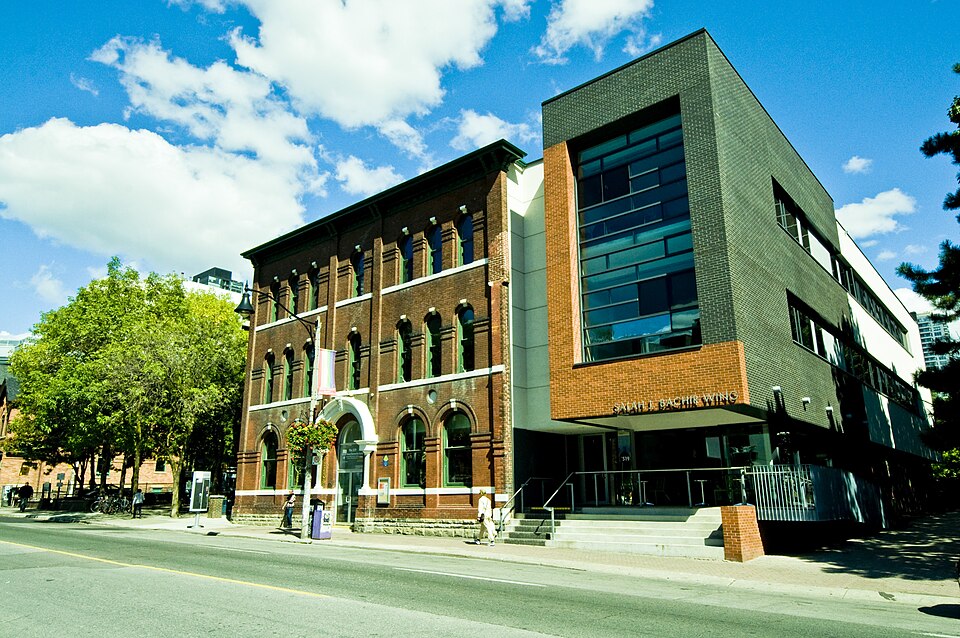
-
Article
The Carlu
The Carlu (Eaton Auditorium 1931-76). Concert hall and special events facility located on the top (seventh) floor of the former Eaton's College Street store in Toronto.
"https://thecanadianencyclopedia.ca/images/tce_placeholder.jpg?v=e9dca980c9bdb3aa11e832e7ea94f5d9" // resources/views/front/categories/view.blade.php
https://thecanadianencyclopedia.ca/images/tce_placeholder.jpg?v=e9dca980c9bdb3aa11e832e7ea94f5d9