
Browse "European Canadians"
-
Article
Maltese Canadians
The Republic of Malta is an archipelago comprised of seven islands located in the Mediterranean Sea, south of Sicily. Although waves of immigration occurred in 1840, around 1907, and between 1918 and 1920, there were few Maltese in Canada until after the Second World War (WWII). The 2016 Canadian census reported 41, 915 people of Maltese origin (12, 815 single and 29, 100 multiple responses).
"https://thecanadianencyclopedia.ca/images/tce_placeholder.jpg?v=e9dca980c9bdb3aa11e832e7ea94f5d9" // resources/views/front/categories/view.blade.php
https://thecanadianencyclopedia.ca/images/tce_placeholder.jpg?v=e9dca980c9bdb3aa11e832e7ea94f5d9
-
Article
Norwegian Music in Canada
It is believed that the Norse (Vikings) visited North America around the year 1000. However, people from modern Norway, the western kingdom of the Scandinavian peninsula, immigrated to Canada from the USA during the 1890s and moved into the Prairies and particularly to British Columbia, whose coastline so closely resembled that of their homeland. In 1986 there were 243,675 people of Norwegian origin living in Canada (191,000 in British Columbia, Alberta, and Saskatchewan). Those born in Canada numbered 224,000, and of the 20,000 immigrants 2,000 arrived in the period 1977-86.
"https://thecanadianencyclopedia.ca/images/tce_placeholder.jpg?v=e9dca980c9bdb3aa11e832e7ea94f5d9" // resources/views/front/categories/view.blade.php
https://thecanadianencyclopedia.ca/images/tce_placeholder.jpg?v=e9dca980c9bdb3aa11e832e7ea94f5d9
-
Article
Peter Vasilevich Verigin
Peter Vasilevich Verigin, Doukhobor leader (born 1859 in Slavianka, Russia; died October 1924 near Grand Forks, British Columbia). Exiled in Russia, Verigin immigrated to Canada in 1902. There, he became a powerful and controversial Doukhobor leader in Western Canada. Verigin died when the train in which he was travelling exploded, leading some to believe he was assassinated.
"https://d3d0lqu00lnqvz.cloudfront.net/PeterVeregin.jpg" // resources/views/front/categories/view.blade.php
https://d3d0lqu00lnqvz.cloudfront.net/PeterVeregin.jpg
-
Article
Polish Canadians
Polish immigrants began to arrive in Canada shortly after the First Partition of Poland in the late 1700s. According to the 2021 census, in Canada, 982,820 people claimed full or partial Polish ancestry, and 176,010 people speak Polish as a mother tongue language.
"https://d3d0lqu00lnqvz.cloudfront.net/media/media/cce4c6dc-8b1d-48bb-b285-3ebf65f0bad0.jpg" // resources/views/front/categories/view.blade.php
https://d3d0lqu00lnqvz.cloudfront.net/media/media/cce4c6dc-8b1d-48bb-b285-3ebf65f0bad0.jpg
-
Article
Portuguese Canadians
Portuguese explorers were among the first Europeans to lay eyes on what is now Canadian soil. Some early Portuguese settlers also lived on the Atlantic coast and in New France. In the 20th century, Portuguese immigration intensified in the 1950s and into the 1980s. In the 2021 Canadian census, 448,305 people reported being of Portuguese origin. In 2021, 266,555 people reported having Portuguese as their mother tongue language.
"https://d3d0lqu00lnqvz.cloudfront.net/media/new_article_images/PortugueseCanadians/Combined Portuguese_Canadian_Flag.jpg" // resources/views/front/categories/view.blade.php
https://d3d0lqu00lnqvz.cloudfront.net/media/new_article_images/PortugueseCanadians/Combined Portuguese_Canadian_Flag.jpg
-
Article
Russian Canadians
People from Russia have been in Canada since at least the late 18th century. Over time, more and more Russians immigrated and settled in Canada. In the 2021 census, 548,140 Canadians reported being of Russian origin.
"https://d3d0lqu00lnqvz.cloudfront.net/media/media/091bb7ea-83fe-43b5-be6b-4c2b8f321c7f.jpg" // resources/views/front/categories/view.blade.php
https://d3d0lqu00lnqvz.cloudfront.net/media/media/091bb7ea-83fe-43b5-be6b-4c2b8f321c7f.jpg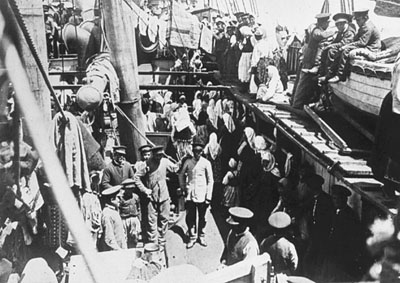
-
Article
Saint Patrick’s Basilica
Saint Patrick’s Basilica is a minor basilica located in Montreal. It was constructed between 1843–47 as a parish church for Montreal’s growing Irish Catholic population (see Irish Canadians; Catholicism in Canada). The church was elevated to the status of a minor basilica in 1989. In addition to playing a significant religious and cultural role for the city of Montreal’s Irish community, Saint Patrick’s Basilica is recognized as the mother church for English-speaking Catholics in the city (see Canadian English; Languages in use in Canada).
"https://d3d0lqu00lnqvz.cloudfront.net/stpatricksbasilica/stpatrickschurchbynotman-son.jpg" // resources/views/front/categories/view.blade.php
https://d3d0lqu00lnqvz.cloudfront.net/stpatricksbasilica/stpatrickschurchbynotman-son.jpg
-
Article
Scottish Canadians
Though often considered Anglo-Canadians, the Scots have always regarded themselves as a separate people. The Scots have immigrated to Canada in steady and substantial numbers for over 200 years, with the connection between Scotland and Canada stretching farther — to the 17th century. Scots have been involved in every aspect of Canada's development as explorers, educators, businessmen, politicians, writers and artists. The Scots are among the first Europeans to establish themselves in Canada and are the fourth largest ethnic group in the country. In the 2021 census, a total of 4,392,200 Canadians, or 12 per cent of the population, listed themselves as being of Scottish origin (single and multiple responses). The Scots and their descendants shaped place names and institutions, as well as the economic, political and cultural life of the country. Scots have been involved in every aspect of Canada's development. A few of the many well-known Canadians of Scottish descent include Sir Alexander Tilloch Galt, James Bruce (Lord Elgin), Donald Alexander Smith (Lord Strathcona), William Lyon Mackenzie, Harold Adams Innis, Sir William Mackenzie, Sir Hugh Allan, George Stephen, Maxwell Aitken (Lord Beaverbrook), Alexander Begg, William Lewis Morton, Blair Fraser, Norman Bethune, Farley Mowat, Charles William Gordon (pen name Ralph Connor), Douglas Campbell and Norman McLaren.
"https://d3d0lqu00lnqvz.cloudfront.net/media/media/4d323062-cb6e-4937-acd9-7666f7d8c449.jpg" // resources/views/front/categories/view.blade.php
https://d3d0lqu00lnqvz.cloudfront.net/media/media/4d323062-cb6e-4937-acd9-7666f7d8c449.jpg
-
Article
Serbian Music in Canada
Immigration to Canada by the peoples of this eastern portion of modern Yugoslavia began in significant numbers after World War II, and by 1986 some 12,970 Serbian-Canadians lived and worked in the industrial areas of southern Ontario. Others lived in Ottawa, Montreal, and Vancouver.
"https://thecanadianencyclopedia.ca/images/tce_placeholder.jpg?v=e9dca980c9bdb3aa11e832e7ea94f5d9" // resources/views/front/categories/view.blade.php
https://thecanadianencyclopedia.ca/images/tce_placeholder.jpg?v=e9dca980c9bdb3aa11e832e7ea94f5d9
-
Article
Slovak Canadians
Slovakia, the land of the Slovaks, is located in Central Europe and borders the Czech Republic and Austria to the west, Poland to the north, Ukraine to the east and Hungary to the south. Slovak Canadians are a deeply religious people, family oriented, and proud of their origin and language, always quick to correct those who refer to them as Czechs or Czechoslovaks. They have been coming to North America since the second half of the 19th century and have contributed significantly to the economic, social and cultural development of Canada. In the 2016 Census of population, 72,290 Canadians reported being of Slovak origin.
"https://d3d0lqu00lnqvz.cloudfront.net/media/media/ea04ca0b-a5b7-4332-9f16-e1bf860090e6.jpg" // resources/views/front/categories/view.blade.php
https://d3d0lqu00lnqvz.cloudfront.net/media/media/ea04ca0b-a5b7-4332-9f16-e1bf860090e6.jpg
-
Article
Slovenian Canadians
Slovenia is a country in central Europe. It is bordered by Croatia, Hungary, Austria, Italy, and the Adriatic Sea. In the 2016 Canadian census, 40, 475 people reported being of Slovenian origin (13, 690 single and 26, 785 multiple responses).
"https://thecanadianencyclopedia.ca/images/tce_placeholder.jpg?v=e9dca980c9bdb3aa11e832e7ea94f5d9" // resources/views/front/categories/view.blade.php
https://thecanadianencyclopedia.ca/images/tce_placeholder.jpg?v=e9dca980c9bdb3aa11e832e7ea94f5d9
-
Article
Slovenian Music in Canada
The first substantial Canadian immigration from Slovenia (the northwestern region of the Kingdom of Serbs, Croats, and Slovenes, which was renamed Yugoslavia in 1929) occurred 1918-29. Peasants and labourers moved to Ontario, many becoming farmers on the Niagara peninsula.
"https://thecanadianencyclopedia.ca/images/tce_placeholder.jpg?v=e9dca980c9bdb3aa11e832e7ea94f5d9" // resources/views/front/categories/view.blade.php
https://thecanadianencyclopedia.ca/images/tce_placeholder.jpg?v=e9dca980c9bdb3aa11e832e7ea94f5d9
-
Article
Spanish Canadians
Spanish presence on the land we now call Canada dates back several centuries to the voyages of Basque fishermen to the Atlantic coast, and to Spanish exploration of the Pacific coast (see also Spanish Exploration). Archaeologists have uncovered traces of a 16th century Basque whaling station at Red Bay, Labrador. However, significant Spanish settlement did not occur in Canada until the 20th century. The 2016 census reported 396, 460 people of Spanish origin in Canada (70,325 single and 326,130 multiple responses).
"https://thecanadianencyclopedia.ca/images/tce_placeholder.jpg?v=e9dca980c9bdb3aa11e832e7ea94f5d9" // resources/views/front/categories/view.blade.php
https://thecanadianencyclopedia.ca/images/tce_placeholder.jpg?v=e9dca980c9bdb3aa11e832e7ea94f5d9
-
Article
Swedish Canadians
Three Swedish names appeared among Lord Selkirk's group of settlers in the Red River Valley of Manitoba, the first evidence of Swedish settlers in Canada (see Red River Colony.) From 1868 to 1914, more than one million Swedes moved to the United States and Canada.
"https://d3d0lqu00lnqvz.cloudfront.net/media/media/1a1e92cb-180e-4d46-b329-83924dbf4493.jpg" // resources/views/front/categories/view.blade.php
https://d3d0lqu00lnqvz.cloudfront.net/media/media/1a1e92cb-180e-4d46-b329-83924dbf4493.jpg
-
Article
Swiss Canadians
Swiss immigration to the territory we now know as Canada began in the late 16th century. The 2016 census reported 155, 120 people of Swiss origin in Canada (25, 235 single responses and 129, 885 multiple responses).
"https://d3d0lqu00lnqvz.cloudfront.net/media/media/b09fdb7e-690e-4c0b-a4f5-ba1f4c334529.jpg" // resources/views/front/categories/view.blade.php
https://d3d0lqu00lnqvz.cloudfront.net/media/media/b09fdb7e-690e-4c0b-a4f5-ba1f4c334529.jpg