Share on Facebook
 Share on X
 Share by Email
 Share on Google Classroom
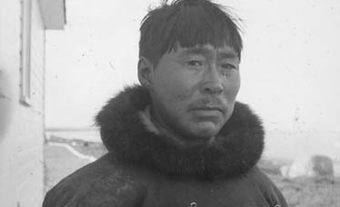
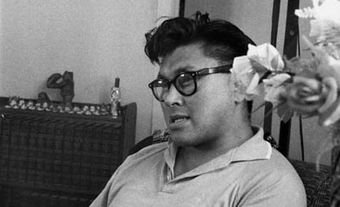
Simonie Michael, businessman, politician, advocate for Inuit self-determination, sculptor (born in 1933 on southern Baffin Island, NT [now NU]; died 14 November 2008 in Iqaluit, NU). Simonie Michael was the first Inuk elected to the Northwest Territories Council, the predecessor of the Legislative Assembly of the Northwest Territories (1966 to 1970). His outspoken criticism of Inuit disc numbers led to Project Surname and ultimately to the disc number system's end.
Early Years
Simonie Michael was born on the land between Kimmirut (formerly Lake Harbour) and Iqaluit (formerly Frobisher Bay), but he spent most of his life in the Iqaluit area. His family was among the original families who moved to Apex, a small community 5 km outside of Iqaluit.
Between 1942 and 1943, the United States military built an air base at Iqaluit. It employed the young Michael as a dishwasher. His dishwashing partner was Joe Tikivik. The head cook gave the two boys a box to stand on to help them reach the sink. Michael and Tikivik became lifelong friends and, later, business partners.
Michael continued at the base as a cook, stock boy, quartermaster and heavy equipment operator. He became proficient in English while working there. By the time he was 16, Michael was a skilled translator, with a reputation of being the only Inuk in Iqaluit able to translate between Inuktitut and English. He eventually worked as a translator for the federal government. His overall impression of the American military, however, was negative because it did not properly compensate its Inuit workers.
Michael became a carpenter, working on local construction projects as the town of Iqaluit rapidly expanded in the 1950s and 1960s. Seeing the cramped and poor housing provided to Inuit in the community, Michael became a strong advocate for improved housing. He founded a housing co-operative that built 15 new houses in Iqaluit. In 1956, he and his wife became the first Iqaluit residents to have an insulated house.
Michael, together with Joe Tikivik and Abraham Okpik, started Inuk Ltd., recognized as Canada's first Inuit-owned company. The business provided cleaning and janitorial services, a local taxi and bus service, and took on construction projects. At one point, it employed 64 people.
Politics
Simonie Michael’s community activism and involvement in the Inuit co-operative housing movement led to his being appointed to the Frobisher Bay Community Council (later the Iqaluit City Council).
In September 1966, at age 33, Michael was elected for four years to represent the Eastern Arctic on the Northwest Territories Council, the territories’ governing body. In September 1967, the Northwest Territories Council and administration were transferred from Ottawa to Yellowknife.
Michael described his role on the Council as “telling white people about the Eskimo.” His inaugural speech to the assembly, given in Inuktitut, lasted 90 minutes. After this, a rule was passed that all comments had to be given in English.
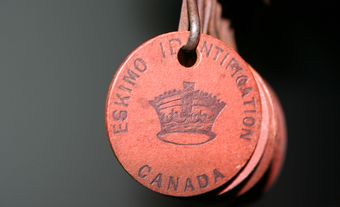
Michael refused to be identified by his disc number. In 1969, he gave a speech to the Council, explaining that his mail was sent to “Simonie E7-551,” his first name and disc number, rather than to Simonie Michael. He protested to Stuart Hodgson, commissioner of the Northwest Territories, that his mail should be addressed to his full name. Michael’s push for the elimination of disc numbers led to Project Surname in 1970. His speech to the Council is considered the catalyst that led to the ending of the Inuit disc number system.
Michael was concerned with infrastructure and health in Eastern Arctic communities. He pushed to make health care more available in Iqaluit. At the time, people who needed major medical care were flown to hospitals in the south. This meant sick people had to travel great distances and undergo treatment away from family and their community supports.
In 1969, he was involved in legislation to improve living conditions at Clyde River. That year, Michael toured the Belcher Islands with Commissioner Stuart Hodgson. They found the housing situation there one of the worst in the Northwest Territories. He petitioned the federal government for the construction of 20 new permanent houses there.
Michael continued as an advocate for Inuit well-being. In response to a rise in alcoholism during the 1960s, Michael prompted a referendum that restricted the availability of liquor in Iqaluit. As a result, no store sold alcohol in the community from 1976 until 2015, though it was still available at bars. The first store after the ban opened in 2017.
Community Involvement and Artist
Over the years, Simonie Michael served as president of the Apex Recreational Council and on the vestry council of St. Simon's church in Apex, where he lived.
Michael was one of the original planners of the first annual Toonik Tyme festivals, which started in 1965. Michael and Joe Tikivik created Toonik, the mascot.
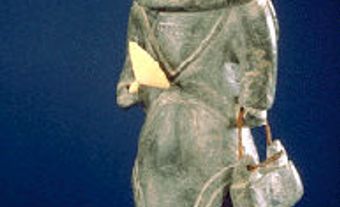
Michael was also a sculptor, mainly carving animals. The University of Lethbridge Art Gallery has several of his carvings in its collection.
In 1953, Michael was chosen as a Canadian representative to attend Queen Elizabeth II’s coronation. In 2002, 50 years later, he was awarded Queen Elizabeth II's Golden Jubilee Medal.
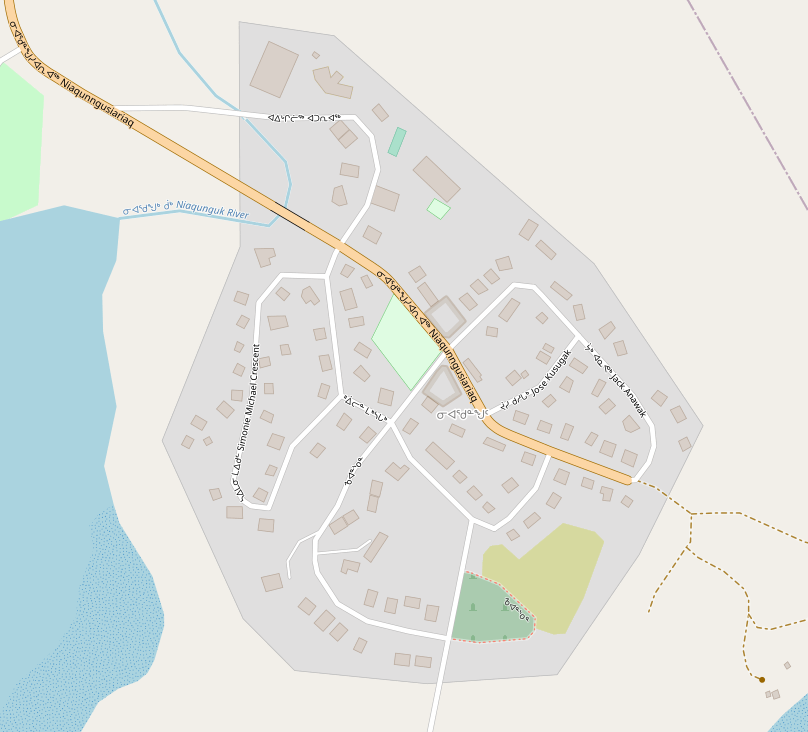
Simonie Michael Lane and Simonie Michael Crescent are two streets in Apex, Nunavut, named after him.