Share on Facebook
 Share on X
 Share by Email
 Share on Google Classroom
The Prince Edward Island Railway was constructed between 1871 and 1875. The railway’s financial difficulties persuaded Prince Edward Island to join Confederation in 1873 (see Prince Edward Island and Confederation). By 1919 the Prince Edward Island Railway was transferred to the Canadian National Railways. The Island’s railway ceased operations in 1989, and its roadbed became part of the Confederation Trail. Parks Canada designated the construction of the Prince Edward Island Railway as a national historic event in 2018.
This article was created in collaboration with Parks Canada. It is drawn from report number 2017-21, which was prepared to support the construction of the Prince Edward Island Railway as a national historic event.
Historical Context
Confederation
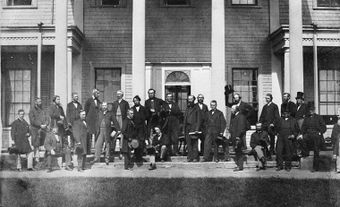
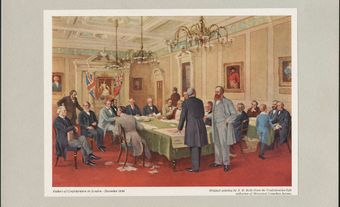
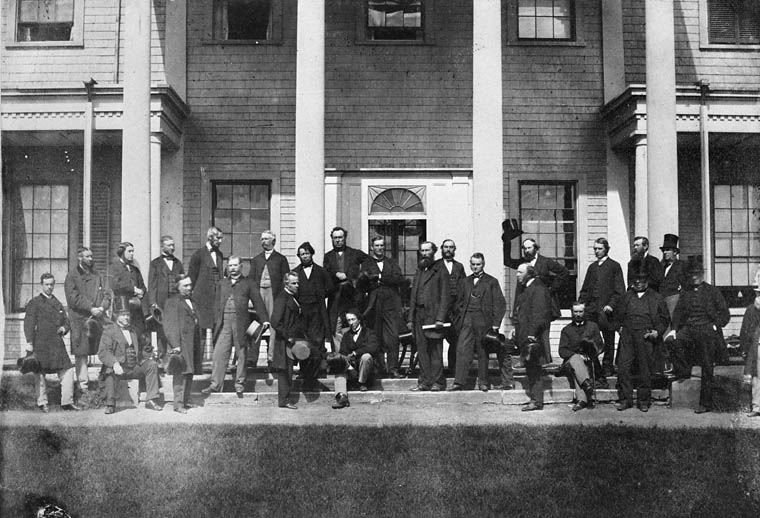
Prince Edward Island’s road to Confederation dates back to 1864 when Nova Scotia, New Brunswick and Prince Edward Island agreed to meet in Charlottetown to discuss the possibility of union ( see Charlottetown Conference). They were then joined by a contingent from the Province of Canada that wished to broaden the scope of discussions to include a union of all British North American colonies. At the time, Prince Edward Island saw little benefit to recommend such a union. (See also Prince Edward Island and Confederation.) The former premier of Prince Edward Island, Edward Palmer told the conference that the colony would be giving up autonomy and prosperity for what he feared would be an insignificant voice in parliament. Prince Edward Island nonetheless agreed to send a delegate to the next conference at Quebec City where interest in Confederation quickly waned (see Quebec Conference, 1864). The colony was concerned that union would lead to increased taxation and the possibility of conscription and bring an end to the Island legislature. In May 1866, the provincial legislature passed a “No Terms” resolution, rejecting the terms of the Quebec Conference and of Confederation. In the fall of that year, there was one more attempt to sway the Island towards union which included a renewed offer to purchase absentee landlord holdings with an $800,000 fund. Viewed by many as a bribe, the offer was rejected and Prince Edward Island did not join in Confederation on 1 July 1867.
Reciprocity
Prince Edward Island had a Reciprocity Agreement with the United States which expired in 1866 (see Reciprocity). In 1869, the new Dominion of Canada, worried about the possible forging of ties between Prince Edward Island and the US, presented the province with a deal called “Better Terms,” under which Canada offered to assume the Island’s debts, provide a steam ship service to connect it to the rest of the country and to pay $800,000 to buy absentee landlord holdings. The offer was declined in 1870.
Following Confederation, a small number of Island politicians expressed interest in joining Canada, but the majority of citizens remained steadfast against it. Meanwhile, Prime Minister John A. Macdonald continued to push for Prince Edward Island to join the Dominion. The Colonial Office, which had the same aim, dispatched William C. F. Robinson to the Island as Lieutenant-Governor with instructions to do whatever lay within his power to achieve union. Despite the pressure tactics of the two governments, Prince Edward Island might well have remained independent, however, the decision to build a railway forced the Island to join Confederation.
Construction
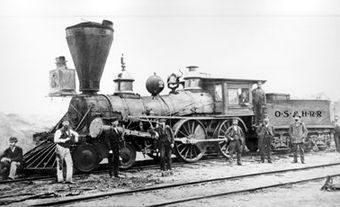
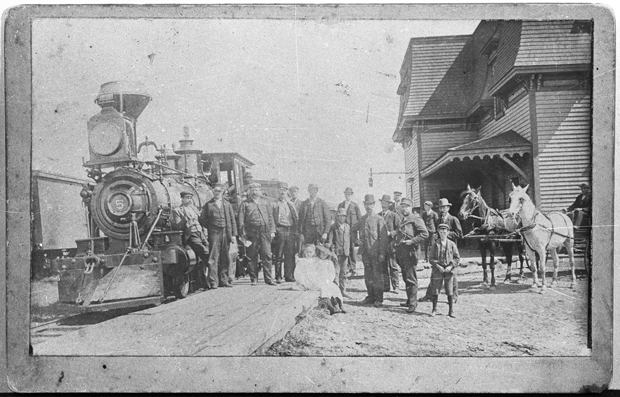
In 1871, Prince Edward Island began construction on a railway which it hoped would improve the Island’s economy and increase tourism. The Prince Edward Island Railway was a narrow (originally 1,067 mm) gauge railway, built under the supervision of Chief Engineer John Edward Boyd, which ran from Tignish in the west to Elmira in the east. Poorly planned from the outset, the project quickly overspent its budget and racked up a staggering debt-load. The government failed to stipulate either the length or route of the railway and as a result, lobbyists attempted to bribe politicians to locate stations within their own communities. The government had also agreed to pay a fixed cost per mile, but neglected to put a limit on the number of miles to be built. As the result, the contractors – not the government – had full control over construction. By 1872, the railway had put the colony on the verge of full economic collapse. In need of help, Prince Edward Island approached the Dominion government about joining Confederation. Discussions began in February of 1873, and a deal was soon reached. Canada assumed the Island’s railway debt, bought land from absentee landlords, and promised to maintain a year-round communication link with the Island. Prince Edward Island joined Canada on 1 July 1873 (see Prince Edward Island and Confederation).
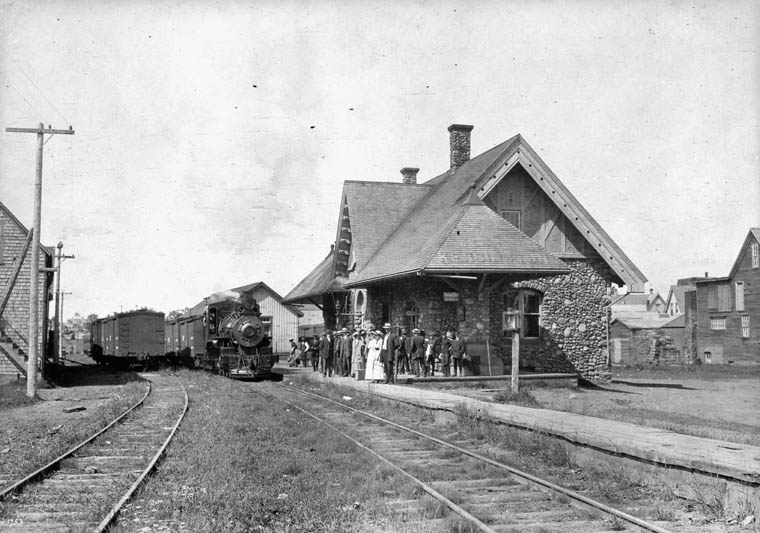
When the government inherited the Prince Edward Island Railway, it was already working on the Intercolonial Railway which would link Maritime ports with central Canada. From 1915 to1918, the Prince Edward Island Railway and the Intercolonial Railway were known collectively as the Canadian Government Railways, although each company maintained its own corporate identity and management. In 1918, management of the Canadian Government Railways, including the Prince Edward Island Railway was transferred to the Canadian Northern Railway and shortly thereafter to the Canadian National Railways. (See also Railway History in Canada.)
Closure
The Prince Edward Island Railway was heavily utilized during the Second World War, but thereafter saw declining use. The last passenger trains on the Island ceased in 1969 as rail transportation was gradually replaced by automobiles in the 1950s. Freight operations also gave way to trucks. In 1989, the system was abandoned. Equipment was removed and the infrastructure was dismantled in the early 1990s. In 1994, the railway lands were turned over to the province and, over the next decade, its Rails to Trails program resurrected the rail bed as a recreational pathway dubbed the Confederation Trail.