Share on Facebook
 Share on X
 Share by Email
 Share on Google Classroom
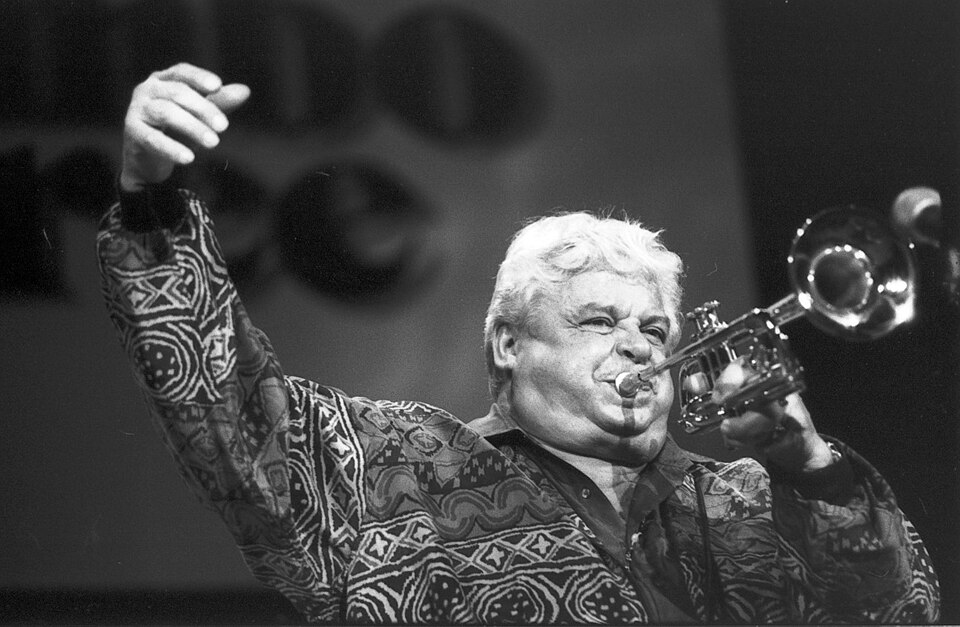
Maynard Ferguson, CM, jazz trumpeter, bandleader, flugelhornist, trombonist (born 4 May 1928 in Verdun, QC; died 23 August 2006 in Ventura, California). Maynard Ferguson stood second only to Oscar Peterson among the most popular Canadian jazz musicians. With a remarkable facility in the trumpet’s highest register as his trademark, Ferguson firmly established himself as a featured soloist. He made records under his own name starting in 1950 and won the Down Beat readers’ polls for trumpet three years in a row (1950–52). However, he was sometimes dismissed by critics due to his flamboyant playing and performance style. He was inducted into the Down Beat Hall of Fame and the Canadian Music Hall of Fame and was a Member of the Order of Canada.
Early Life and Career
Maynard Ferguson studied piano and violin, then trumpet, as a child in Montreal. He attended the Conservatoire de musique du Québec à Montréal from 1943 to 1948, and was playing with Stan Wood's dance band by age 14. He also played in bands led by Roland David and Johnny Holmes. Developing a remarkable facility in the trumpet's highest register — Ferguson's trademark throughout his career — he alternated between the Wood and Roland David orchestras until he formed his own big band in 1945. The Maynard Ferguson Orchestra appeared locally and travelled as far afield as Toronto and Crystal Beach (on Lake Erie) until 1948.
Ferguson was heard frequently on CBC radio. On one occasion, he played a Serenade for Trumpet in Jazz written for him by Morris Davis. While leading his own band in the Montreal area and in Toronto during the mid-1940s Ferguson came to the attention of US bandleaders. As Paul Bley recalled in the Montreal Gazette in October 1978: “Maynard would always open the show, and he played three octaves higher on trumpet than anyone else... you ought to have seen the jaws drop on the visiting musicians.”
Career Highlights
Maynard Ferguson went to New York in 1948, working in quick succession with the Boyd Raeburn, Jimmy Dorsey and Charlie Barnet orchestras. He then established his reputation firmly in the jazz world as a featured soloist with the Stan Kenton Orchestra from 1950 to 1953. It was during this time that Ferguson first received great public acclaim, winning the Down Beat readers’ polls for trumpet three years in a row (1950–52). He made his first records under his own name in 1950, for Capitol, leading the Kenton band of the day.
From 1953 to 1956, Ferguson worked in Hollywood studio orchestras. He recorded 46 film soundtracks under contract to Paramount while also recording with small groups, both his own and others.
He returned to jazz in New York with his Birdland Dreamband in 1956. He continued to lead a “small big band” — generally 13 or fewer musicians — for more almost 40 years. He took a hiatus from 1965 to 1970 and a period from 1987 to 1990 to front a seven-piece band, High Voltage, in the rock-influenced “fusion jazz” style. He returned to a larger ensemble in 1990 with the 10-man Big Bop Nouveau. Well-known US instrumentalists who were at one time members of a Ferguson band include Chick Corea and Chuck Mangione.
Ferguson spent a year in India studying meditation and lecturing on music, then moved in 1968 to England. It was with a 17-piece English band, which combined the orchestral conventions of jazz and the rhythmic vigour of rock, that he regained and even surpassed his former popularity. The band toured Europe and made its North American debut in 1971. Its recording of “MacArthur Park” was popular early in the decade.
With New York as his home base after 1973, Ferguson gradually replaced the English musicians with young US players, reducing the band again to 13. He also played solo trumpet in the opening ceremonies of the 1976 Montreal Olympics. His version of “Gonna Fly Now,” which was used as the theme for the film Rocky, was a major hit single (by the standard for pop instrumentals) in 1977–78. It also earned Ferguson one of his three Grammy Award nominations. It was followed by a second lesser hit in 1978, the theme from TV series Battlestar Galactica. His album Conquistador (1977) was certified gold in the US for exceeding 500,000 in sales.
Later Career
Maynard Ferguson was a compelling figure to younger musicians for his energy, his leadership and his willingness to stay abreast of new developments in popular music. He maintained a rigorous touring schedule, touring as much as eight months a year and travelling out of New York, London and, latterly, Ojai, California. He was also widely active in music education as a clinician.
Canadian Performances
Although based for several decades outside Canada, Ferguson made many Canadian appearances. He performed on such CBC TV shows as Parade and In the Mood. With his band, he played at the Stratford Festival (1958), in many concert halls (Massey Hall, Place des Arts, National Arts Centre, etc.), at Canadian Stage Band Festival (MusicFest Canada), regularly during the early 1980s at Ontario Place, and in 1982 and 1990 at the Festival international de jazz de Montréal (FIJM). The FIJM aside, the Ferguson band was rarely heard at the Canadian jazz festivals that flourished in the 1980s. However, he did appear at the 1999 Ottawa International Jazz Festival, as well as at Toronto Downtown Jazz in 2002.Several Canadians have been members of his bands: e.g., the singer Anne Marie Moss, the tenor saxophonist Georgie Auld, and the trombonists Rob McConnell and Phil Gray. Kenny Wheeler composed and arranged for Ferguson's English band.
Notable Recordings
Maynard Ferguson released more than 50 LPs and CDs, most notably Birdland Dreamband (1956), Message from Newport (1960), M.F Horn IV and V: Live at Jimmy's (1973), the best-selling Conquistador (1976), and One More Trip to Birdland (1996). All of Ferguson's LPs from 1958 to 1962 for the Roulette label are arguably the pinnacle of his work in jazz. They were reissued on 10 CDs by Mosaic in 1995. Two LPs made with Montreal musicians for the CBC at EXPO 67 were also reissued on CD by Justin Time in 1995. Several recordings originally released by Columbia Records have been reissued, including Conquistador and Chameleon (both in 2003).
Critical Reception
Maynard Ferguson's dramatic virtuosity in the extreme upper registers of the trumpet (extending with ease to double high C) and the bravado of his band took his popularity beyond the jazz world. But the emphatically exhibitionistic nature of his playing also brought him a certain amount of critical disdain. For example, his grandstanding high notes were often dismissed as mere “screeching,” while his use for many years of an aria from I Pagliacci as an encore led to accusations that he was more of a showman than a musician. Some reviewers remarked on a lack of shading or subtlety in his interpretations.Much of Ferguson’s work in the small-group context revealed a mature improviser whose high-note facility became a well-integrated aspect of an expressive and lyrical style. A natural leader, Ferguson showed the ability to form and mould an ensemble of young musicians, and to infuse it with his own considerable energy and enthusiasm.
Designer of Instruments
In addition to trumpet and flugelhorn, Ferguson played valve trombone, bass trombone, baritone horn, french horn, and soprano saxophone with his band. He also played two hybrid brass instruments — the Firebird (a combination slide and valve trumpet) and the Superbone (a combination slide and valve trombone) — which he designed for the US company Holton-Leblanc.Honours and Awards
Maynard Ferguson stood second only to Oscar Peterson among the most popular Canadian musicians in jazz. He was inducted into Down Beat's Hall of Fame in 1992 and the Canadian Music Hall of Fame in 1997. He received FIJM’s Prix Oscar-Peterson in 1999 and was made a Member of the Order of Canada in 2003. New Jersey's Rowan University Institute of Jazz Studies was named in his honour.