Share on Facebook
 Share on X
 Share by Email
 Share on Google Classroom
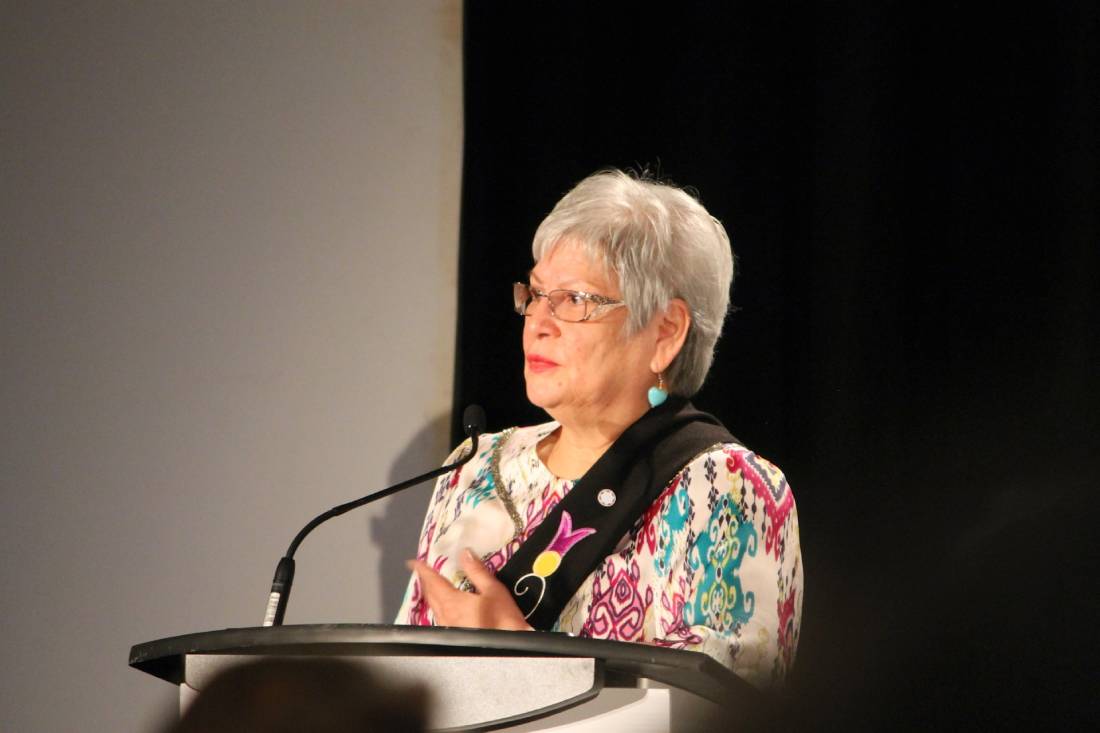
Marilyn Buffalo, leader, educator, advocate, Indigenous rights policy analyst (born in 1950 in Maskwacis, AB). A member of the Samson Cree Nation, Marilyn Buffalo became the first Indigenous person appointed Advisor on Native Affairs at the University of Alberta. She was also formerly the president of the Native Women’s Association of Canada (NWAC). Buffalo has been heavily involved in advocating for Indigenous rights her entire life, including her work on the Truth and Reconciliation Commission (TRC) and in advocating for Missing and Murdered Indigenous Women and Girls (MMIWG). One of her children is professional skateboarder Joe Buffalo.
Early Life & Education
Marilyn Buffalo is Cree and is the granddaughter of John Tootoosis and a descendant of Yellow Mud Blanket, brother of Chief Pitikwahanapiwiyin (Poundmaker). Additionally, she is related to First World War sniper Henry Norwest. Born in the community of Hobbema, Alberta, (now Maskwacis), she was one of 12 children.
In her words, Buffalo grew up “very poor, but never hungry.” She lived in a tent most summers and foraged for berries while her father hunted rabbits and other game for food. She had a strong connection to her great-grandmother, who practiced traditional Cree healing and instilled strong values in her, including the importance of women within Cree society and culture. In a 1977 interview, she recounted hiding in her grandmother’s shack when the local priest came by to register children of school age.
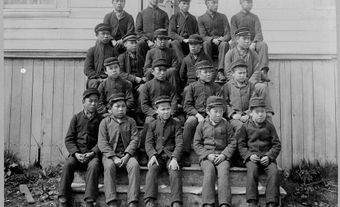
She attended school in Hobbema until grade 9. She was then sent to a residential school in Drumheller, Alberta, to complete high school. Buffalo hated residential school because it separated her from her mother and grandmother. She grew up speaking Cree, and she was punished for doing so while in residential school. She further recalled her teachers were often demeaning toward her, telling her she would not accomplish anything. She often felt that she was a prisoner at the school. Ultimately, she decided her escape would be through her own education.
Buffalo recalled the nuns and priests who were in charge of her education as a child expressed contempt for Indigenous cultures, saying only pagans would participate in events such as a Sun Dance. She also remembered Indigenous youth being forced into Christian marriages, unaware of what an Indigenous marriage might entail.
Early Work in Support of Indigenous Youth
Early in her career, Marilyn Buffalo worked in Edmonton’s inner city to help Indigenous youth, some of whom were her former classmates. She found working with Indigenous people afflicted with substance use disorder particularly challenging. Though she only did this work for a few months, she credited the experience as being “my own university.”
At age 25 in November 1975, Buffalo was appointed an advisor on Indigenous peoples at the University of Alberta, becoming the first Indigenous person in Canada to hold such a role. Her responsibilities included liaising with Indigenous students on campus, offering them help with whatever they needed and identifying Indigenous youth who wished to attend the university. She acted as a resource for faculty, First Nations governments and student committees.
This position ultimately led Buffalo to take an active role in the development of the University of Alberta’s School of Native Studies, as well as its Native Students Services. Buffalo is also the Founding Chair of the General Faculties Council Committee on Native Studies.
Native Women’s Association of Canada
From 1997 to 2000, Marilyn Buffalo was the president of the Native Women’s Association of Canada (NWAC), an organization dedicated to supporting the socioeconomic, political and cultural well-being of Indigenous women in Canada. It was during that time that she rejected a Statement of Reconciliation offered by Jane Stewart, then minister of Indian Affairs. The statement was offered as part of an early acknowledgement of the destructive effects of the residential school system as well as the broader negative consequences of the federal government’s policy toward Indigenous peoples in Canada since before Confederation. Buffalo’s argument was that the statement didn’t meet the standards of a formal apology. At the time, she was quoted as saying “the federal Government is insulting aboriginal people with this response.” The statement was also criticized by Métis and Inuit organizations.
Also during her presidency, Buffalo negotiated an agreement with Human Resources Development Canada, which provided $15 million of funding over five years to support employment and training initiatives for Indigenous women.
Later Career and Continued Advocacy
In 2000, Marilyn Buffalo contested the leadership of the Assembly of First Nations (AFN), vying to become the organization’s first female leader. Buffalo had previously worked as a policy advisor to the AFN.
Though she was not elected National Chief of the AFN, Buffalo nonetheless continued her advocacy for Indigenous peoples. From 2000 to 2005, she served as the Senior Policy Advisor to the Samson Cree Nation in Ottawa. Simultaneously, she provided communications and policy support to the legal team involved in the landmark breach of trust and treaty rights case, Victor Buffalo v. the Queen.
In the late 2010s, Buffalo was a member of the Indigenous Women's Circle, a federal government advisory body on Indigenous women.
In 2018, Buffalo was fired from her role as a senior adviser on Indigenous initiatives in the Office of the Provost of the University of Alberta. Her contract had been renewed for a two-year period less than one month before her termination. She had served in that role since December of 2016. Differences in approach to the subject of reconciliation were offered by the university as explanation for the abrupt termination.
Buffalo has served as the CEO of the Nechi Institute, an organization that trains 15,000 addiction counsellors. In 2022, Buffalo argued that Christian churches that had been involved in the residential schools should offer empty church buildings to Indigenous-led organizations. At that time, the Nechi Institute had been evicted by the government of Alberta. It was the second time the United Conservative Party government of Alberta had evicted the Nechi Institute from a building where they trained counsellors.