Share on Facebook
 Share on X
 Share by Email
 Share on Google Classroom
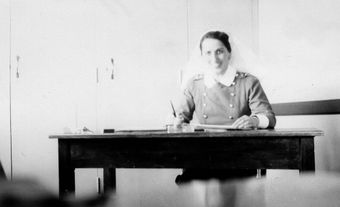
Marie-Anna Adèle Roy, author and historian (born in 1893 in Saint-Léon, Manitoba; died in 1998 in Saint-Vital, Manitoba). Marie-Anna Roy was the fifth of 11 children; her father was a merchant who later became a colonization agent, and her mother was a housewife. After studying at the Académie Saint-Joseph in Saint-Boniface, Manitoba and the Winnipeg Normal Institute, Marie-Anna tried teaching, but her assertive personality, sharpened by relationship and financial difficulties in her family, made her a woman ahead of her times, and she soon left the school where she had been working. For the next 35 years, she led a nomadic existence as a pioneering teacher, travelling across the prairies of Manitoba, Saskatchewan and Alberta. Often inadequately housed, she had to cope with rebellious pupils, rough-hewn parents, and intolerant priests and school boards. She changed schools some 20 times, finding solace only in studying, contemplating nature and observing the lives of the pioneers.
In 1934, by dint of arduous effort, she earned a bachelor of arts degree from the University of Alberta. But when a fire broke out where she was living, she suffered serious burns and had to give up her work. As a result, the following year, she received a land grant in Tangent, Alberta, and at the age of 50, set herself to clearing and farming it. At the same time, encouraged by the success of her famous youngest sister, Gabrielle, she began a long-range literary-historical project focused on two main themes: francophone life in Manitoba in 1885 and 1930-40 and her own family’s life in particular. In her first book, Le pain de chez nous (1954), she told the scarcely fictionalized story of the members of the Roy clan, trying to re-establish the actual truth in response to her younger sister’s “romantic imaginings”. Next came Valcourt ou La dernière étape, in 1958, a semi-autobiographical account of the life of a teacher who became a farmer in northern Alberta.
From 1959 to 1962, Marie-Anna lived in France, where she was warmly received in literary circles. When she returned to Canada, she settled in Montréal, where she wrote La Montagne Pembina au temps des colons (1969), Les visages du Vieux Saint-Boniface (1970) and Les Capucins de Toutes-Aides (1977). In 1979, she published her memoir, Le miroir du passé, which depicted her sister Gabrielle in an unflattering light and caused some scandal but received little positive response.
Marie-Anna Roy’s memories of her youth were the main subject of her later works: Cher visage (1988) and À l'ombre des chemins de l'enfance (1990). She eventually moved into a retirement home in Saint-Vital, Manitoba, where, despite blindness and motor difficulties, she continued to write until the age of 102. Paul Genuist of the University of Saskatoon published a biography of this exceptional woman: Marie-Anna Roy, une voix solitaire (Éditions des Plaines, 1992).
Roy was an extraordinary, erudite woman—a great lover of literature and a distinguished scholar of Latin who dreamed of building a Temple to La Francophonie. Her legacy to the Canadian West and the French language is a considerable body of writing whose documentary value is only beginning to be appreciated today. It includes novels, monographs, travel accounts, diaries, columns, correspondence, and countless unpublished works (Les deux sources d'inspiration: l'imagination et le cœur; À vol d'oiseau à travers le temps et l'espace; Les entraves; Otium cum dignitate; Voyages en Europe; Grains de sable et pépites d'or; Journal intime d'une âme solitaire: Reflets des ans dans le miroir du passé; Indulgence et pardon; Surgeons). In these works, she shares confidences that raise questions about the source of some of her sister Gabrielle’s writings, which Marie-Anna claimed Gabrielle had plagiarized from her.
Though Marie-Anna Roy had a gifted imagination and a definite feeling for psychology and description, she condemned any fiction or fantasy in literature and equated verisimilitude with reality. But her style, a mixture of classicism and romanticism, has great charm and no major flaws.
A superior mind, lost in a world that did not understand her, rebellious yet condemned to live in her sister’s shadow, this “damned” author suffered deeply from rejection by those around her, in particular certain academics from Saint-Boniface.