Share on Facebook
 Share on X
 Share by Email
 Share on Google Classroom
Treaty 8 is between the Crown and Indigenous peoples. It covers parts of what is now Alberta, Saskatchewan, British Columbia and the Northwest Territories. It was signed on 21 June 1899. Plans for this treaty started because of valuable resources in the north and the Klondike Gold Rush.
This article is a plain-language summary of Treaty 8. If you are interested in reading about this topic more in depth, please see our full-length entry, Treaty 8.
Historical Context
In the late 1800s and early 1900s, the government wanted land for settlement and development projects. It wanted Indigenous peoples to surrender their Aboriginal title (rights) to land through treaties. The government made treaties in regions like the Plains. But they didn’t want to make treaties in the north because the land wasn’t good for farming.
Some Indigenous peoples in the north wanted to sign treaties. They were starving and wanted help. The government gave some help but didn’t want a treaty. This changed in the 1890s when resources like oil and gold were found in the north. During the Klondike Gold Rush, there was conflict between white miners and Indigenous peoples. The government worried that it would get worse. They wanted to have a treaty to access resources and bring law and order to the region.
Negotiations and Signings, 1899
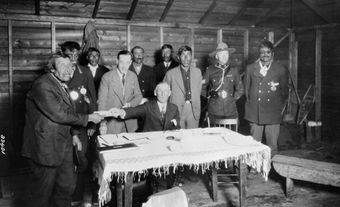
The government sent three commissioners to negotiate with Cree, Denesuline, Dane-zaa and other Indigenous peoples in the north. The first signing of Treaty 8 was on 21 June 1899. It included the commissioners and Cree representatives.
The commissioners expected it would be easy to get Treaty 8 signed. However, negotiations were difficult. Many people in the territory did not like the promises of the treaty. But Indigenous leaders agreed to the treaty based upon some oral promises. These promises included medical care. The commissioners also promised Indigenous leaders there would be no interference with their ways of life. The commissioners continued negotiating with other communities. But they didn’t reach every community. Some communities signed in following years.

Terms of Treaty 8
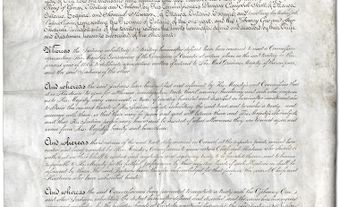
Treaty 8 was written before negotiations started. It was like previous Numbered Treaties. It included reserves, annual cash payments and other promises. It required surrender of Aboriginal title. Boundaries of the treaty were based upon mining areas, the presence of prospectors, transportation to the Klondike and peace between First Nations and settlers.
The written terms of the treaty promised hunting, trapping and fishing rights. However, the treaty also stated that these rights might be regulated in the future. It also excluded these rights from some territories used for settlement and development projects.
Reserves were based upon one square mile per family of five. The treaty also allowed individuals or families to live on 160 acres of land separately from the reserve. At signing, everyone received payments, with more money for chiefs and headmen. The government also promised annual payments of $5 for everyone and more for chiefs and headmen. The treaty included promises to pay teacher salaries.
The government promised to provide agricultural tools and livestock. It would also provide ammunition and fishing twine every year to Indigenous people who wanted to continue hunting and fishing.

Adhesions, Post-1899
After 1899, more communities signed the treaty. But the commissioners’ reports weren’t complete. Some First Nations signed Treaty 8 in the early 1900s. One First Nation even signed in 2000. Some Métis also joined the treaty in the 1930s. However, some First Nations in the Treaty 8 region did not sign the treaty.
Scrip Commission
Scrip was a method of paying Métis for their Aboriginal title. The Scrip Commission happened at the same time as Treaty 8. Métis could choose to join Treaty 8 or get scrip.
Problems
The government soon ran into problems providing treaty payments and supplies. It was difficult to get to annual treaty meetings. The government fell behind on annual payments. Some rations were also damaged or destroyed on the voyage.
There were disagreements about some of the oral promises made during treaty negotiations. Indigenous people wanted medical care and care for the old and poor. The commissioners said the government would help, but it could not provide frequent medical care or care for the old and poor. A doctor went to annual treaty meetings and year-round medical care was soon set up in Fort Smith. However, many people in Treaty 8 territory didn’t get medical care outside of the annual meeting.
There was also disagreement about hunting, trapping and fishing rights. Indigenous people wanted to protect these rights. They thought the government had promised they could hunt, trap and fish as usual. The treaty guaranteed their rights. But it also said that they would have to follow future regulations. Some, including interpreter Pierre Mercredi, claimed the original treaty didn’t say anything about regulations on Indigenous hunting and trapping.
In 1916, the government passed laws that restricted hunting and trapping. The laws allowed Indigenous peoples to continue hunting and trapping. But officials still charged Indigenous people with breaking the laws. First Nations protested these laws.
Land issues have been a long-term challenge in the Northwest Territories. Some First Nations have settled claims with the government. Others are still negotiating land, resources and self-government agreements.