Share on Facebook
 Share on X
 Share by Email
 Share on Google Classroom
The Saskatchewan Roughriders are a team that plays in the Western Conference of the Canadian Football League (CFL). They are the oldest continuously operating professional football club in Western Canada, and second only to the Toronto Argonauts of the Eastern Conference in length of history. One of only two community owned football teams in the CFL (the Winnipeg Blue Bombers are the other), they play their games in Regina, the least populated sports market in Canada. Only the Green Bay Packers of the National Football League are based in a smaller centre. Like the Packers, however, the Roughriders are famed for the intensity of their supporters, known as “Rider Nation,” many of whom live across the province and well beyond its borders. Even in losing seasons, sales of the team’s memorabilia make up more than half of all merchandise sold by CFL teams. The Roughriders have made 13 appearances in the Grey Cup and won the championship five times, most recently in 2025.
|
Quick Facts about the Saskatchewan Roughriders |
|
Date Founded: 1910 |
|
Venue: Mosaic Stadium |
|
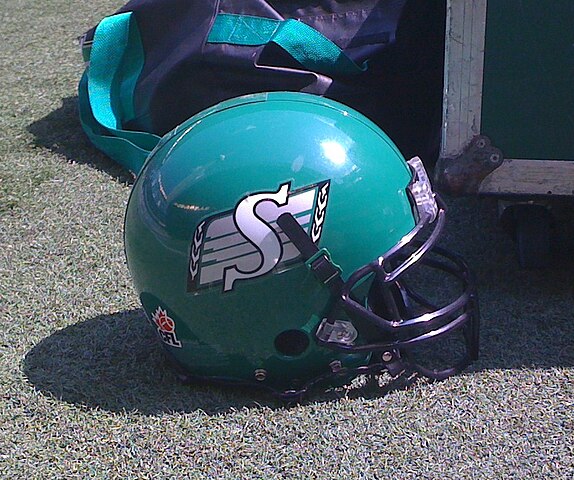
Team Colours: Green and white |
|
Grey Cup Victories: 5 |
Saskatchewan Roughriders: The Early Years (1910–45)
The Roughriders were created as the Regina Rugby Club at a meeting on 13 September 1910. Many of the players had been drawn to the economic boom in the West and wanted to play the North American rugby football they had known in Eastern Canada and the United States. City businessmen saw sporting success as a powerful advertisement for their growing community. They began the long tradition of providing financial support and organizational skill. Within two weeks they had created a four-team league, the Saskatchewan Rugby Football Union. The following year saw the formation of the Western Canadian Rugby Union (WCRU). It comprised teams from Edmonton, Calgary, Winnipeg, Moose Jaw, Saskatoon and Regina.
The Regina Rugby Club quickly became a formidable organization. it dominated Western Canadian football until the late 1930s. It won its first WCRU championship in 1912 and went on to claim 15 of the first 21 title games. In a seven-year stretch in the late 1920s, the Club was undefeated in western competition, outscoring the opposition 662 to 75. In the process, it held its opponents to an average of an astonishing two points a game. Its goal, however, was to beat the more experienced Eastern Canadian teams, and to win the Grey Cup, created in Ontario in 1909 to award national football supremacy. The Regina Rugby Club had played and lost to the touring Hamilton Tigers in several exhibition matches, the first occurring as early as 1913. By the 1920s, it was challenging for the Grey Cup.
Western teams faced a difficult struggle in Grey Cup games. The contest was always played in the East, usually on the home field of the Eastern team, and this meant a tiring two- or three-day train trip for the western champions. In addition, the match was conducted according to eastern rules enforced by eastern officials. The Regina Rugby Club discovered how difficult victory would be when it was beaten 54–0 by the students of Queen’s University in 1923. It then lost five consecutive championship matches from 1928 to 1932 and another in 1934. Such play improved the Rugby Club, and it even taught the eastern teams something: in the 1929 game, Regina players shocked everyone by throwing the first forward passes in Grey Cup history (in rugby, only backward passes are allowed). Within a year, eastern rules makers adopted what became the sport’s most exciting play.
Many observers considered the 1936 Regina Rugby Club to be the best team ever assembled in Western Canada. It might well have won its first Grey Cup had it not been for one of the many procedural wrangles that plagued early football competition. Winnipeg had won the West’s first Grey Cup in 1935 with seven players imported from the United States. But a year later the Canadian Rugby Union refused to allow Regina to play in the championship game with its own newly recruited five imports. When the Rugby Club refused to play under such conditions, the Grey Cup went uncontested and was awarded to the Sarnia Imperials, who had defeated the Ottawa Rough Riders 26–20 in the Eastern final. Within a year, import players were permitted to play in Grey Cup games. They became a key component of football teams across the country.
Saskatchewan Roughriders Name and Colours
The Second World War, like the Great War before it, halted all organized civilian football competition. However, as late as 1943, the Regina Rugby Club was continuing to play as the “All-Services Roughriders.” It comprised players from local army, navy, air force and RCMP units. The “Roughrider” name had been adopted years earlier. In 1924, the Ottawa team, named the “Rough Riders” after the lumberjacks who worked on the Ottawa River, abandoned the name in favour of the “Senators.” The Regina club quickly seized the opportunity to call itself the “Regina Roughriders.” (The term had been used to describe the rugged officers who broke the broncos for the RCMP.) By the 1931 season, Ottawa was again known as the “Rough Riders.” For the next 65 years, Canadian professional football had two teams with virtually the same name. The Ottawa franchise folded in 1996 and was resurrected briefly as the “Renegades.” When new owners were denied the right to use the “Rough Riders” name, they adopted “Redblacks” in 2013, a name that paid homage to the colours of the original Ottawa teams.
The Redblacks might well have been denied the right even to wear red-and-black had it not been for a quirk of fate. In the summer of 1948, a Roughrider executive on a business trip to Chicago wandered into a war surplus store selling sets of green-and-white nylon football sweaters at giveaway prices. Seeing a bargain, he took two sets back to Regina and, because they were superior to the tattered red-and-black uniforms left over from the pre-war years, the Club adopted the new look. There was surprisingly little objection from its fans, and the Roughriders have worn some form of green-and-white or green-and-black ever since.
The year 1948 saw a much more significant change to the Roughrider identity. Several years earlier, sportswriter Tom Melville had pointed out to Club executives that interest in their team had long ago spread far beyond Regina. It had attracted more provincial fans than any other football organization in the country. Realizing that a club explicitly identified with the province would attract even more supporters, the executives voted to change the name to the “Saskatchewan Roughriders.” The change was made with little fanfare. Indeed, it was many years before commentators adjusted to the new name.
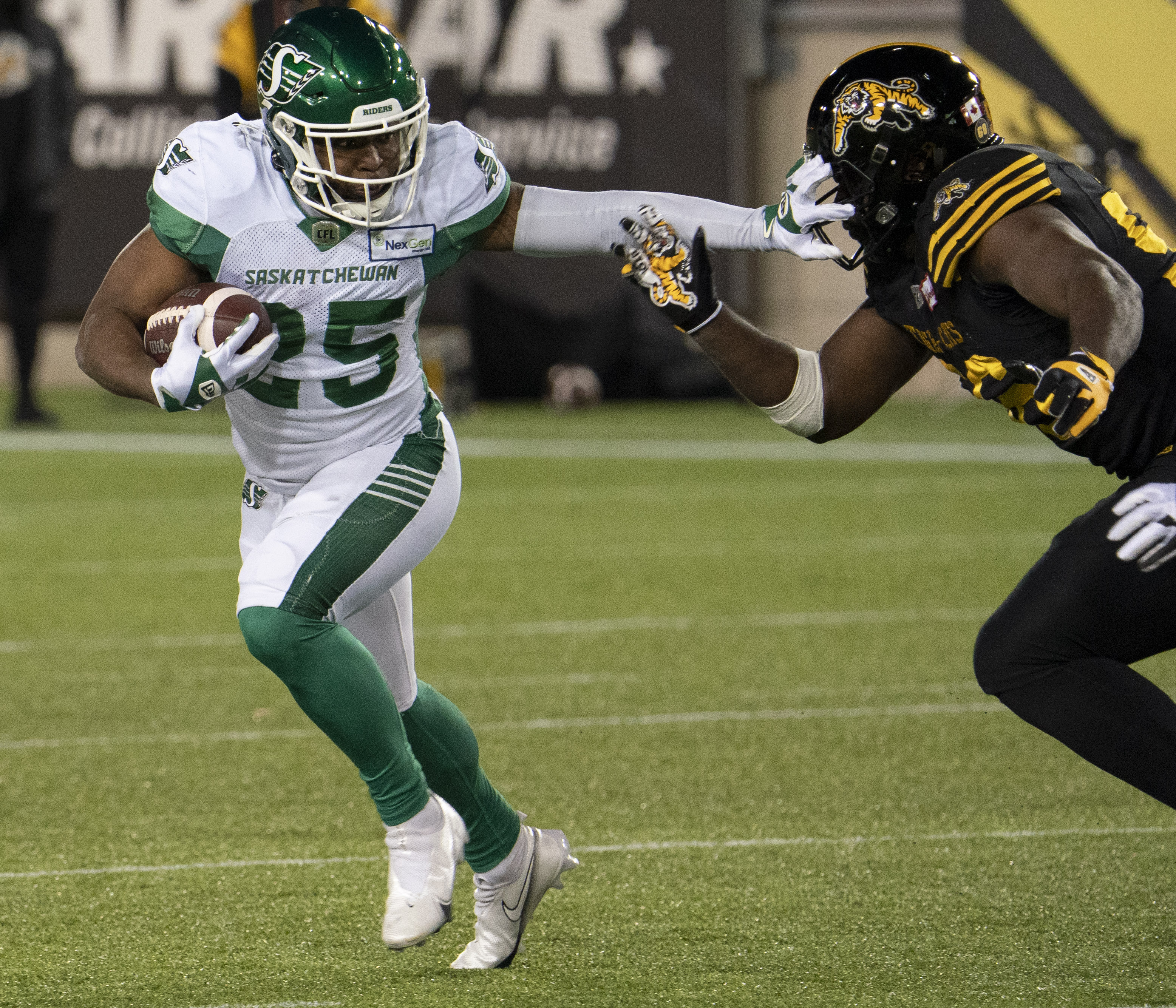
In the decades since 1948, the inclusive name and the large “S” on the Club’s logos have become iconic for Roughrider supporters. Roughrider jerseys and caps are proudly worn by fans in Saskatchewan and around the world, including on Mayan pyramids, London streets, and even at a remote outpost in Afghanistan. It is a sight that often evokes a cry of “Go Riders” from a bystander. Through a process of evolution, as well as skilful marketing in recent years, the green sportswear and the “S” have come to represent not just a sports team, but an entire province. So warmly have the Club’s followers embraced this phenomenon that, even in losing seasons, sales of its memorabilia make up more than half of all merchandise sold by CFL teams. In 2015, the Roughriders ranked as the third most popular sports brand in Canada, behind the Montreal Canadiens and Toronto Maple Leafs. After nearly a hundred years of being the league’s poor cousin, the Roughriders have become one of its most financially secure clubs.
Saskatchewan Roughriders: The Modern Era (1945–2000)
In the decades between the end of the Second World War and 2000, however, the loyalty of Roughrider followers was frequently tested. The creation of the Calgary Stampeders in 1945 and the Edmonton Eskimos (now Edmonton Elks) in 1949 provided increasingly stiff competition for western football supremacy. The Roughriders had to work hard to compete with the larger, more affluent centres. For a while they did so, getting to the 1951 Grey Cup game under the leadership of the charismatic Glenn Dobbs. Dobbs was an American star quarterback who turned down a contract with the Chicago Bears to play for Saskatchewan. However, a gruelling three-game Western final series against Edmonton had left the Roughriders battered and injured. They lost the championship game 21–14 to Ottawa.
The Roughriders continued to field competitive teams until disaster struck in 1956. Returning from the All-Star game in Vancouver, four of their best players were killed when their plane crashed into the side of a mountain in the Rockies. As if the heart of the club had been ripped out, the Roughriders went into a tailspin. They won only 13 games in the next four seasons. The lowest point — indeed, the worst season in franchise history — was reached in 1959, when they won only one of 16 games.
The Roughriders began to show the results of a rebuilding program in 1962. But it was the 1963 season that saw the most important recruiting in the club’s history. Its shrewd general manager, Ken Preston, acquired Ron Lancaster from Ottawa for $500 and recruited George Reed fresh out of Washington State University. Known as “the Little General,” Lancaster went on to become one of the CFL’s greatest quarterbacks over the next 16 seasons. Reed became arguably the best running back in the league’s history. Surrounded by skilled Canadian and imported players, Lancaster and Reed anchored a team that won more games in the decade between 1966 and 1976 than any other football club in North America.

This strength took the Roughriders to four Grey Cups. But it did not bring them as many championships as it should have. In 1966, they won the first Grey Cup in franchise history, beating the heavily favoured Ottawa Rough Riders 29–14. They lost their title to Hamilton the following year and were defeated by Ottawa in 1969. In 1970, they enjoyed their greatest regular season, winning 14 of their 16 games. But they failed to advance to the Cup when Calgary beat them 15–14 on a field goal in a blizzard on the last play of the third and deciding game of the Western final series. In the 1972 Grey Cup, the Roughriders seemed to be in control in the dying minutes, but they were beaten 13–10 when Hamilton kicked a 34-yard field goal on the last play. Even more painful was the conclusion to the 1976 Grey Cup, when Tony Gabriel got behind Saskatchewan defenders. With only seconds left, he caught a 24-yard touchdown pass to give Ottawa a 23–20 victory.
The Roughriders had been the favourites going into the 1976 Grey Cup, but 1977 was the first of 11 consecutive seasons out of the playoffs. It was the beginning, in fact, of more than two decades of futility. Reed had retired in 1975, and Lancaster followed in 1978. But the tam was probably more damaged when its formidable Canadian lineman Bill Baker played out his option and went to the BC Lions in 1974. This was the beginning of free agency in the CFL. In an age without a salary cap to level the playing field, Saskatchewan found it difficult to compete with wealthier clubs in Edmonton, Calgary and Vancouver.
The Roughriders, in fact, found it increasingly difficult even to survive as a club. They had always relied on extraordinary community support, from the initial call to form a club in 1910 to the public campaign to rebuild after the Great War to the massive Depression-era fundraising drive conducted under the newspaper headline “THE RIDERS NEED HELP!” As the losing seasons — and the club’s debts — mounted up in the 1970s and 1980s, management was forced to adopt desperate measures to stay alive.
In 1979, former Regina sportswriter John Robertson returned from Winnipeg to lead a fundraising campaign. In the process, he coined the enduring phrase “Rider Pride.” An annual Friends of the Riders lottery was created in 1985, contributing about $20 million to the coffers in the years since. In 1987, a province-wide telethon led by Lancaster, Reed and dozens of former players and coaches did well enough to enable the Club to continue to field a team.
Occasionally, the Roughriders offered their supporters reasons to remain faithful. Though there was little team success, numerous outstanding players donned the green-and-white uniforms, and on two occasions they made it to the Grey Cup. After a 9–9 season in 1989 put them in third place, they upset Calgary with a 33–26 come-from-behind victory in the dying minutes of the West Division semifinal. Their opponents in the Western final were the Edmonton Eskimos. With a 16–2 record, Edmonton was one of the best CFL team ever assembled, yet the Roughriders beat them 32–21 in Edmonton. A week later, Dave Ridgway kicked a field goal with two seconds left to give Saskatchewan a 43–40 victory in what most observers regard as the most exciting Grey Cup ever played to that point.
In 1997, the Roughriders followed the same route to the Grey Cup, though with a much less talented team. Finishing third in the West with a modest 8–10 record, they upset Calgary and Edmonton in the playoffs. They then lost the championship game 47–23 to a strong Toronto team led by such stars as Doug Flutie and Michael “Pinball” Clemons. A better gauge of the Roughriders’ strength was its 5–13 season the following year. In 1999, the team ended the century with a dismal 3–15 record.
Saskatchewan Roughriders: 2000–Present
The beginning of the new millennium was the start of a rebirth of Roughrider fortunes. But the years since then can best be described in Charles Dickens’ famous lines: “It was the best of times; it was the worst of times.” Between 2000 and 2025, Saskatchewan made the playoffs 18 times, appeared in five Grey Cups and won the championship three times. The team also missed the playoffs seven times. On several occasions — notably 2011, 2015 and 2016 — it endured very poor seasons. At the same time, win or lose, the Club has enjoyed a greater financial health than at any time in its history.
The Roughriders’ renewed competitiveness in the CFL is in part due to the introduction of a league-wide salary cap in 2007. It has leveled the playing field for both rich and financially weaker clubs. The Roughriders’ resurgence also resulted from some shrewd management, beginning with the appointment of Roy Shivers as manager late in 1999. A gifted recruiter, he quickly began rebuilding the team. By 2004, the Riders were in the Western final, losing to the BC Lions 27–25 in overtime. In 2007, the Riders were back in Vancouver for the final, this time with Eric Tillman as general manager, Kent Austin as coach and Kerry Joseph, a quarterback drafted from the defunct Ottawa Renegades. They defeated the Lions 26–17, and went on to win the Grey Cup 23–19 in a defensive struggle in Toronto.
In 2008, despite being crippled by an unprecedented seven broken legs across the team roster, the Roughriders took second place but lost to BC in the Western semifinal. In 2009, however, they won the West and faced the heavily favoured Montreal Alouettes in the Grey Cup in Calgary. For 48 minutes, Saskatchewan stymied the Montreal offence. Led by quarterback Darian Durant, they ran up a 16-point lead. The game completely turned around in the final 12 minutes, however, with the Roughriders unable to score and the defence surrendering 17 points. Saskatchewan had the lead when time expired, but a penalty on the final play gave Montreal a second chance at a winning field goal, and the Alouettes won 28–27. Roughrider fans filed out of McMahon Stadium in stunned silence as if leaving a funeral rather than a football game.
Saskatchewan had a chance to avenge this humiliation in the Grey Cup the following year. But they again lost to Montreal — this time 21–18. It wasn’t until 2013 that the nightmare in Calgary was somewhat exorcized. Quarterbacked by a ferociously determined Durant, the Roughriders beat BC and Calgary to win the West. They then faced Hamilton in the Grey Cup in Regina’s Mosaic Stadium. Nearly all of the approximately 45,000 spectators were Saskatchewan supporters, most of whom arrived an hour and a half before game time. The atmosphere was electric. Fielding perhaps the greatest team in franchise history — running back Kory Sheets set a new Grey Cup game record by rushing for 197 yards and Geroy Simon caught the last two touchdown passes of his illustrious career — Saskatchewan won 45–23. For most people, it was the greatest experience in a lifetime of following the Roughriders.
The following year, however, the Roughriders fell to Edmonton in the West semifinal. The next two seasons were among the worst in team history. In 2015, Saskatchewan missed the playoffs with an abysmal 3–15 season. They then scored something of a coup in the offseason when they poached Chris Jones from Edmonton only a week after he led them to a Grey Cup victory. Not only did Saskatchewan hire Jones as their new head coach, general manager and vice-president of football operations, they also hired eight of his assistant coaches away from Edmonton. Among them was special teams coordinator Craig Dickerson.
However, Jones proceeded to undertake a rebuild. He cut 19 players from the roster, including long-time fan favourites John Chick and Weston Dressler. The newly revamped club was almost as bad in 2016, when it went 5–13. The team seemed to turn a corner in 2017. They finished 10–8 and defeated the Ottawa Redblacks in the East semifinal before losing 25–21 to the Argonauts in the East final. The Roughriders improved on their regular season record in 2018, going 12–6 to finish second in the West. But they lost 23–18 to the Blue Bombers in the West semifinal.
After the 2018 season, Jones resigned from his three roles with the Roughriders to go and work with the NFL’s Cleveland Browns. Dickerson took over as head coach and in the 2019 season led the team to first place in the West with a 13–5 record. However, they lost 20–13 in the West final to Winnipeg, who went on to win the Grey Cup.
The CFL season was cancelled in 2020 and shortened in 2021 due to the COVID-19 pandemic. In 2021, Saskatchewan finished second in the West with a 9–5 record and beat Calgary 33–30 in a thrilling overtime victory in the West semifinal. But they were again defeated in the West final by Winnipeg, the eventual Grey Cup champions. Two forgettable seasons followed in 2022 and 2023, when Saskatchewan finished fourth with identical records of 6–12. In 2023, they were 6–5 through 11 games but lost the last seven in a row. The only bright spot was that the franchise again became profitable, thanks in part to revenue from hosting the 2022 Grey Cup. By the 2023 season, the franchise had replenished its stabilization fund back to pre-pandemic levels.
After the 2023 season, Dickerson was replaced as head coach by Corey Mace, the former defensive coordinator of the Toronto Argonauts. (Mace also became Saskatchewan’s defensive coordinator in 2024, in addition to head coach.) The team finished second in the West and defeated the BC Lions 28–19 before once again losing to archrivals Winnipeg in the West final by a score of 38–22.
However, in 2025, the Roughriders proved to be the class of the CFL, recording one of the best seasons in franchise history. The team muscled its way to a 10–2 record after 12 games, despite losing former 1000-yard receivers Samuel Emilus, Kian Schaffer-Baker and Shawn Bane to injuries. KeeSean Johnson and Dohnte Meyers more than capably filled the void, recording the first 1000-yard seasons of their careers. Veteran quarterback Trevor Harris finally stayed healthy, throwing for 4,549 passing yards in 16 starts, while running back A.J. Ouellette posted 1,222 yards and scored 8 touchdowns. The defence allowed a league-low 409 points. The team finished first in the West and first overall in the CFL and had a league-high nine CFL All-Stars — the most in franchise history. After a tough, tense, back-and-forth 24–21 victory over the BC Lions in the West final, the Roughriders outlasted a strong Montreal Alouettes team to win the fifth Grey Cup in franchise history by a score of 25–17. Harris was named Grey Cup MVP while receiver Sam Emilus won the Most Outstanding Canadian Award.
Saskatchewan Roughriders Stadium
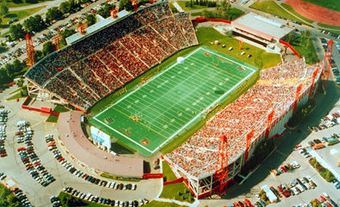
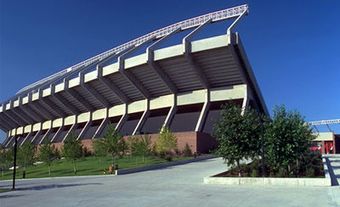
The Regina Rugby Club’s earliest home games were played at Dominion Park. It had been built for baseball and included a grandstand and bleachers, but it was demolished late in the First World War. From 1921 on, games took place on a soccer field called Park Hughes on the site of what became Mosaic Stadium. Initially fans stood around the dirt track, though some watched the games from the comfort of their automobiles parked along the sidelines. It was not until 1936 that the first stands were constructed. Football games were played on a dirt field until the 1947 season, when the first grass was laid down. That same year, the stadium was named Taylor Field after N.J. “Piffles” Taylor, a prominent club executive who had famously played quarterback in the 1920s despite having lost an eye during the First World War. None of the changes took away from the intimacy of the stadium. As late as the early 1970s, fans were permitted to sit within yards of the play along the sidelines and in the endzones. This made Taylor Field a difficult venue for visiting teams. Sportswriter Jim Kearney called it “the last stronghold of cannibalism.” BC Lions general manager Herb Capozzi once suggested that it should be listed under “outdoor insane asylums.”
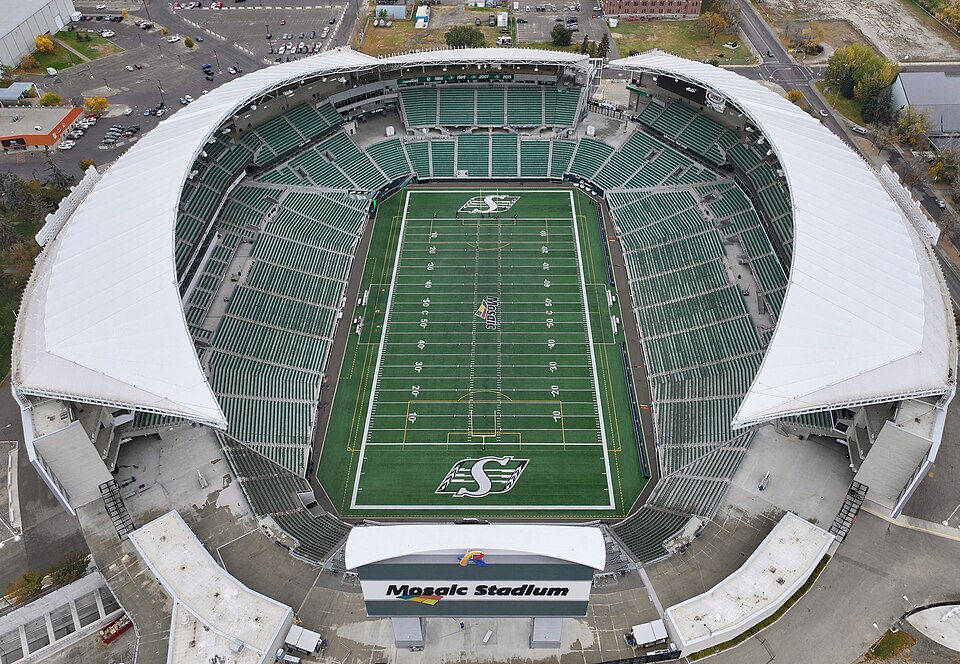
Taylor Field became known as Mosaic Stadium in 2006, when the Mosaic potash company bought the naming rights. A new state-of-the-art stadium under the same name was officially opened on 1 July 2017 when the Roughriders played their oldest rivals, the Winnipeg Blue Bombers.
Saskatchewan Roughriders in the Grey Cup
|
Year |
Won |
Lost |
Host City |
|
1923 |
Queen’s University 54 |
Regina 0 |
Toronto |
|
1928 |
Hamilton Tigers 30 |
Regina 0 |
Hamilton |
|
1929 |
Hamilton Tigers 14 |
Regina 3 |
Hamilton |
|
1930 |
Toronto Balmy Beach 11 |
Regina 6 |
Toronto |
|
1931 |
Montreal Winged Wheelers 22 |
Regina 0 |
Montréal |
|
1932 |
Hamilton Tigers 25 |
Regina 6 |
Hamilton |
|
1934 |
Sarnia Imperials 20 |
Regina 12 |
Toronto |
|
1951 |
Ottawa Rough Riders 21 |
Saskatchewan Roughriders 14 |
Toronto |
|
1966 |
Saskatchewan Roughriders 29 |
Ottawa Rough Riders 14 |
Vancouver |
|
1967 |
Hamilton Tiger-Cats 24 |
Saskatchewan Roughriders 1 |
Ottawa |
|
1969 |
Ottawa Rough Riders 29 |
Saskatchewan Roughriders 11 |
Montréal |
|
1972 |
Hamilton Tiger-Cats 13 |
Saskatchewan Roughriders 10 |
Hamilton |
|
1976 |
Ottawa Rough Riders 23 |
Saskatchewan Roughriders 20 |
Toronto |
|
1989 |
Saskatchewan Roughriders 43 |
Hamilton Tiger-Cats 40 |
Toronto |
|
1997 |
Toronto Argonauts 47 |
Saskatchewan Roughriders 23 |
Edmonton |
|
2007 |
Saskatchewan Roughriders 23 |
Winnipeg Blue Bombers 19 |
Toronto |
|
2009 |
Montreal Alouettes 28 |
Saskatchewan Roughriders 27 |
Calgary |
|
2010 |
Montreal Alouettes 21 |
Saskatchewan Roughriders 18 |
Edmonton |
|
2013 |
Saskatchewan Roughriders 45 |
Hamilton Tiger-Cats 23 |
Regina |
|
2025 |
Saskatchewan Roughriders 25 |
Montreal Alouettes 17 |
Winnipeg |
Saskatchewan Roughriders in the Canadian Football Hall of Fame
|
Name |
Position |
Year Inducted |
|
Jack Abendschan |
guard/placekicker |
2012 |
|
Roger Aldag |
offensive lineman |
2002 |
|
Ron Atchison |
centre/middle guard/defensive tackle |
1978 |
|
Bill Baker |
defensive end |
1994 |
|
Greg Battle |
linebacker |
2007 |
|
Al Benecick |
offensive lineman |
1996 |
|
Clyde Brock |
offensive tackle |
2020 |
|
Henry Burris |
quarterback |
2020 |
|
Ken Charlton |
running back/flying wing |
1992 |
|
Bill Clarke |
offensive tackle/defensive tackle |
1996 |
|
Tom Clements |
quarterback |
1994 |
|
Eddie Davis |
defensive back |
2015 |
|
Ray Elgaard |
slotback |
2002 |
|
Dean Griffing |
centre |
1965 |
|
Eddie James |
running back/defensive back/flying wing |
1963 |
|
Gerry James |
running back |
1981 |
|
Alondra Johnson |
linebacker |
2009 |
|
Will Johnson |
defensive lineman |
2021 |
|
Harvey “Tyrone” Jones |
linebacker |
2012 |
|
Bobby Jurasin |
defensive end |
2006 |
|
Eagle Keys |
head coach |
1990 |
|
Bob Kramer |
president |
1987 |
|
quarterback/head coach |
1982 |
|
|
Paul McCallum |
punter/kicker |
2022 |
|
Don McPherson |
president |
1983 |
|
Ed McQuarters |
defensive tackle |
1988 |
|
Gene Makowsky |
offensive tackle |
2015 |
|
Don Matthews |
head coach |
2011 |
|
Don Narcisse |
receiver |
2010 |
|
Willie Pless |
linebacker |
2005 |
|
running back |
1979 |
|
|
Dave Ridgway |
kicker |
2003 |
|
Al Ritchie |
head coach |
1963 |
|
Martin Ruby |
offensive tackle/defensive tackle |
1974 |
|
Tom Shepherd |
executive |
2008 |
|
Geroy Simon |
receiver |
2017 |
|
Brian Timmis |
defensive tackle |
1963 |
|
Harold Edward “Ted” Urness |
offensive lineman |
1989 |
|
Clair Warner |
executive/president |
1965 |