Share on Facebook
 Share on X
 Share by Email
 Share on Google Classroom
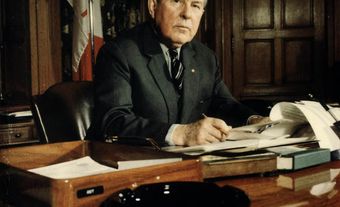
Roger Jean-Baptiste Joseph Camille Teillet, PC, banker, air force navigator, insurance agent, politician, pension commissioner (born 21 August 1912 in St. Vital, MB; died 1 May 2002 in Ottawa, ON). After leaving college, Roger Teillet took several jobs until he joined the air force in 1939 (see Royal Canadian Air Force). When his bomber was shot down, Teillet spent almost three years as a prisoner of war. After the Second World War, he successfully entered provincial and then federal politics. Teillet became Minister of Veterans Affairs and subsequently chair of the Canadian Pension Commission.
Early Life and Education
Roger Teillet was the son of Pierre Camille Teillet and Sara Riel, a niece of Louis Riel. He attended schools in St. Vital and St. Boniface. Teillet was later forced to leave the French-speaking St. Boniface College after only two years due to the Great Depression. He apprenticed as a bank manager, but when banks began closing because of the Depression, he took a variety of jobs. On 18 May 1940, Teillet married Jeanne Marie Boux, and they had two sons.
Military Service
Roger Teillet joined the Royal Canadian Air Force in late August 1939, just before Canada entered the Second World War on 10 September. He trained as an air navigator and joined the Royal Air Force’s 35 Squadron in 1942. The squadron was stationed at Graveley in Cambridgeshire in the United Kingdom and flew the Handley Page Halifax heavy bomber.
On his 25th night bombing raid on 23 August 1942, Flight Lieutenant Teillet’s Halifax was shot down over France, but he parachuted safely behind German lines. This qualified him for membership in the Caterpillar Club, an informal association of individuals whose lives have been saved by a parachute.
Teillet successfully evaded capture for 15 days until he was taken prisoner and sent to Stalag Luft III, a prison camp for officers in Poland. It was the site of the “Great Escape” of March 1944, made famous by the movie of the same name. Teillet was number 136 on the escape list, but only 76 got out before their escape tunnel was discovered. Of those who escaped, 73 were subsequently recaptured.
When Soviet forces entered Germany in January 1945, the Germans herded the prisoners back and forth, during which time many died. Teillet was finally liberated by the British on 6 May 1945, weighing only 57.6 kg. Back in Winnipeg after the war, he opened an insurance agency.
Provincial Politics
In 1953, Roger Teillet ran in the Manitoba provincial election as the Liberal-Progressive candidate for St. Boniface. He was elected as Member of the Legislative Assembly in the government of Premier Douglas Campbell (see also Politics in Manitoba). Teillet ran again in 1958 and was re-elected, although his party was defeated and did not form the next government. He did not run in the election of 1959 after the governing Progressive Conservatives were defeated in the legislature.
Federal Politics
In the federal election of June 1962, Roger Teillet was elected for the Liberals in St. Boniface. The election resulted in John Diefenbaker’s Progressive Conservatives going from majority to minority status (see also Conservative Party). As a result of the subsequent collapse of the Diefenbaker government over the issue of nuclear weapons, a new election followed in April 1963. The Liberals won enough seats to form a minority government under Lester B. Pearson.
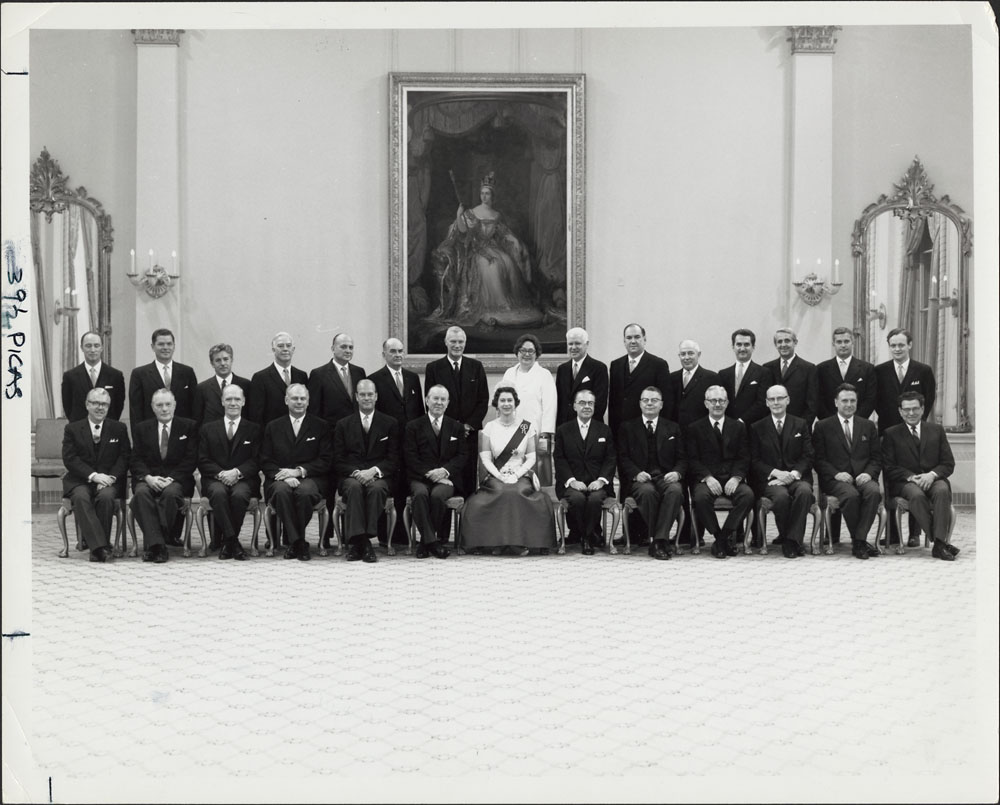
Teillet was re-elected and appointed as Minister of Veterans Affairs (MVA) by Pearson. He was the first self-identifying Métis cabinet minister. One of Pearson’s initiatives, a new, distinctive national flag to replace the Canadian Red Ensign, led to a prolonged debate in the country and Parliament (see also The Great Flag Debate). As MVA, Teillet sat as an ex-officio member on the 15-person strong New Flag Committee to select the flag. Although Pearson and his government supported the Maple Leaf Flag, the largest veterans’ organization in the country, the Royal Canadian Legion, was strongly opposed to it.
The topic provoked considerable national debate, which put Teillet in a difficult position. As a cabinet minister, he had to support the government, but as MVA he also had to support veterans. After further bitter debate in Parliament, the Maple Leaf Flag was finally proclaimed on 28 January 1965 (see National Flag of Canada).
In April 1968, a Liberal convention selected Pierre Elliott Trudeau to replace Pearson, who had announced his intention to retire. In the federal election of June, Trudeau won a landslide victory. Teillet lost the nomination for his own riding by 100 votes.
Trudeau subsequently made Teillet head of the Canadian Pension Commission, a federal agency responsible for managing disability and death benefits for veterans and their families. Trudeau gave Teillet the mandate to reform veterans’ pensions. He did so, and he always referred to this as his proudest accomplishment.
Retirement
Roger Teillet retired from the Canadian Pension Commission in 1980. Rather than return to Manitoba, he and his wife continued to reside in Ottawa. Jeanne died in 2000, two years before Teillet.