Share on Facebook
 Share on X
 Share by Email
 Share on Google Classroom
Quebec City’s Chinatown was an unofficial enclave and network of Chinese residents, businesses and institutions in Quebec City’s Saint-Roch neighbourhood. In the 1930s, the Chinatown was mainly concentrated along Rue Saint-Vallier Est and the Côte d’Abraham. Though, as it grew, its boundaries became unclear. Other notable streets of the area also included Rue du Pont, Rue de la Couronne and Boulevard Charest Est.
From the 1970s onward, factors like urban renewal projects and provincial policies contributed to a changing neighbourhood. These resulted in the slow dispersal of the Chinese community in Saint-Roch and the disappearance of Quebec City’s Chinatown. Today, there is little physical trace of the community’s existence.
History
The first recorded Chinese immigrants in Quebec City arrived during the 1890s and settled along the Côte d'Abraham. They opened small restaurants and laundry businesses in Saint-Roch. During this time, they were faced with hostility from the local population and business competitors. (See Anti-Asian Racism in Canada.)
Starting from about 1910, Quebec City’s Catholic clergy began missionary work with the Chinese population. They later established the Mission Chinoise Catholique de Québec. The mission operated a chapel, which relocated several times around Saint-Roch, to hold mass for Chinese Catholics.
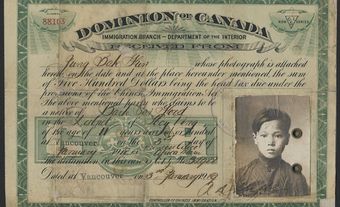
In 1923, the Chinese Exclusion Act was enacted. At around that time, the Chinese population was officially 98; however, the Chinese community estimated their population to be 450 to 500. (See also Anti-Chinese Immigration Policies in Canada.)
Development
The first official organization formed by the Chinese community was the Chinese National League Association. It was located at 140 Côte d’Abraham and appeared in the 1924 city directory. This association organized assemblies and provided social aid to the Chinese population. At this time, the population was mainly single male cooks and business owners. Local newspapers spoke of a “colonie chinoise” in reports of police raids and alleged gambling dens.
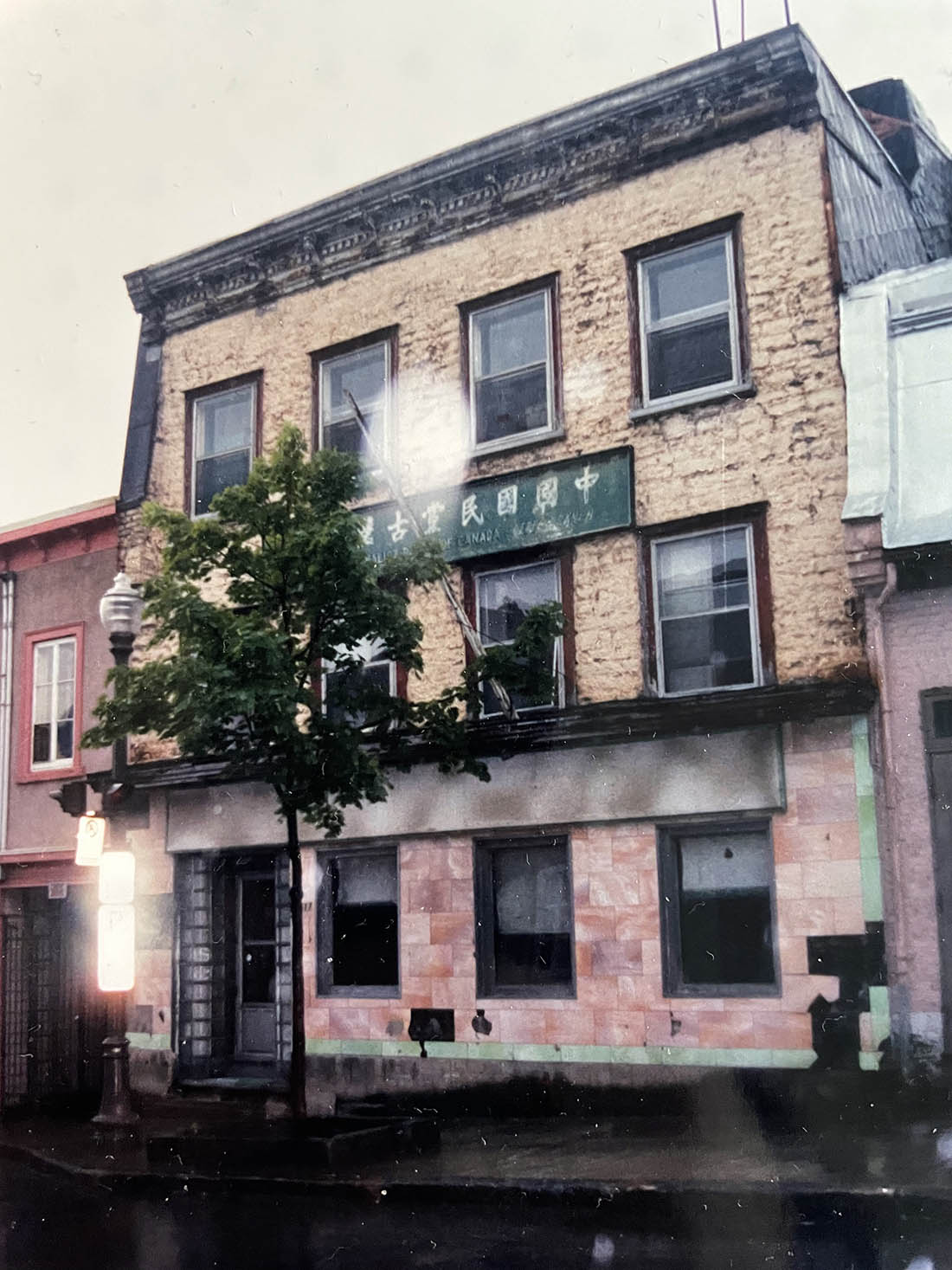
By the 1940s, Quebec City newspapers began referring to a “quartier chinois” located between Rue Saint-Vallier Est and Côte d’Abraham. In 1944, the Chinese National League Association moved operations to 319 (today 617) Rue Saint-Vallier Est ― a three-story building purchased by Chinese restaurateurs. Called the Centre Chinois, the building soon also housed the restaurant Canton Chop Suey House on the ground floor. Association members resided on the upper floors.
After the Second World War, in 1947, the Chinese Exclusion Act was repealed and anti-Chinese immigration policies started loosening up. As a result, Quebec City’s Chinese population grew to include women and children.
Community Life and Restaurants
Chinese restaurants were a vital aspect of Chinese daily life. In fact, most of the Chinese population in Quebec City was involved in the restaurant business. During the 1960s, approximately 20 Chinese restaurants were open around Saint-Roch. Due to their long opening hours, Chinese restaurants became important social spaces for the Chinese community. Chinese Canadians would visit other restaurants to meet and drink coffee or play mahjong with staff. The community would also hold large gatherings to celebrate Christmas and Lunar New Year. ( See Chinese Food in Canada.)
In 1970, the community officially inaugurated a new organization named le Centre Chinois de Québec at the Centre Chinois building. The organization was to be a continuation of the Mission Chinoise Catholique (which closed in 1964) and the Chinese National League Association. The centre was meant for Chinese families and provided recreational programming. It also provided social and financial aid to the Chinese population. Programs included Chinese language school, Kung Fu and Chinese dance classes. At around this time, Quebec City’s Chinese population was estimated to be 700.
Loss of Chinatown
From the 1970s to the 1980s, several urban renewal projects started in Saint-Roch. These projects resulted in the expropriation of numerous city blocks and properties. This greatly impacted the neighbourhood and Chinatown. Notable projects like the Autoroute Dufferin-Montmorency and the Grande Place ― a commercial development proposal that was eventually never built ― greatly affected Chinatown.
Chinese families and restaurants in the expropriation zones were forced to move out of the neighbourhood. Extended periods of demolition and construction in the neighbourhood also resulted in business losses for Chinese restaurants. As a result, many families moved to the Quebec suburbs including Charlesbourg, Sainte-Foy and L’Ancienne-Lorette. There, they opened new restaurants and businesses.
The Centre Chinois de Québec remained open during the periods of demolition. It continued its programming and support for its dispersed community. However, the centre eventually fell into disuse and halted operations in 1982. While the building remained under the ownership of the Association de bienfaisance chinoise de Québec, it no longer provided comparable social and recreational programs.
In 1988, the building was under threat of expropriation for the Grande Place project. Chinese community leaders publicly opposed this proposal. They argued that the building was an important part of Chinese Canadian history. Although the building was physically saved from expropriation, the Chinese community had already dispersed.
Families also moved to other Canadian cities with more robust Chinese communities, like Toronto and Montreal. ( See Toronto Chinatown; Montreal Chinatown) Another factor contributing to the Chinese population’s dispersal from Quebec City was the implementation of French language policies in the 1970s. These often required the everyday language to be French. However, many Chinese Canadians were not as proficient in French. By the 1990s, only two Chinese restaurants were open in Saint-Roch.
Chinatown Today
Today, little of Quebec City’s Chinatown physically remains. Along the key streets of the former Chinatown, many buildings that once housed Chinese residents and businesses were demolished to make way for newer developments. Other buildings have been renovated for other owners or repurposed for different uses.
The Centre Chinois de Québec building still stands as a residential building. As of May 2025, there is no indication to signify its historical significance within the Chinese community.
Notably, Wok n Roll restaurant (previously Woo’s House Restaurant) is still present as of May 2025. The restaurant is a multi-generational, family-operated business which initially opened in the late 1950s. It is regarded as the last vestige of Chinatown.
In 2006, a small portion of Rue des Prairies was renamed to Rue Xi’an, Quebec City’s sister city in China. Despite its name, there are no references to Chinese culture or history on the street. Other than Rue Xi’an, there is nothing present within the neighbourhood to acknowledge or commemorate the Chinese Canadian history of the neighbourhood.