Share on Facebook
 Share on X
 Share by Email
 Share on Google Classroom
Beginning in the late 1800s, Canada enacted policies intended to restrict Chinese immigration. The first was the “Chinese Head Tax” of 1885, which placed an entry tax on new Chinese immigrants. The 1923 Chinese Immigration Act stopped almost all new Chinese immigrants from coming to Canada until Parliament repealed it in 1947. Despite the repeal, Canada still limited family reunification for Chinese Canadians until 1967. As a result of these anti-Chinese policies, the Chinese community experienced many hardships.
Background
Chinese immigrants began coming to Canada in the mid-1800s. They were drawn by the Fraser River gold rush of 1858 as well as other gold rushes on the West Coast of North America. Though almost all failed to find gold, many stayed in Canada since they could make better wages than back home in China. In the 1800s and early 1900s, nearly all Chinese immigrants to Canada came from Cantonese-speaking Southern China. (See also Chinese Languages in Canada.) The region was mostly rural and poor. Moreover, the area was prone to flooding and had been affected by political upheaval and violent conflicts.
Between 1881 and 1885, over 15,000 Chinese labourers came to build the Canadian Pacific Railway. In British Columbia, a labour shortage made Chinese labour necessary to finish building the railway. The presence of Chinese immigrants fuelled racist fears across the country. Politicians believed that Chinese immigrants would reduce job opportunities for white Canadians and that they would never fit into Canadian society.

Chinese Head Tax (1885–1923)
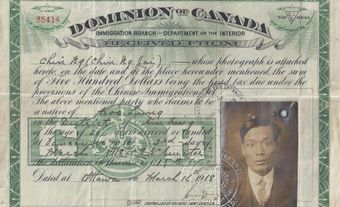
Racist fears prompted the federal government to limit Chinese immigration. In 1885, it passed the Chinese Immigration Act (1885), commonly known as the “head tax.” The Act required that each new Chinese immigrant pay a tax of $50 to enter Canada. It was the first immigration policy in Canadian history to restrict immigration on the basis of race. The head tax allowed merchants, students, diplomats, scientists and tourists to avoid the tax. A 1900 amendment allowed further exemptions for clergymen and their families.
The government increased the tax to $100 in 1900 and $500 in 1903. The tax was an enormous sum of money. At the time, $500 was equal to about two years of wages for the average Chinese labourer working in Canada.
Despite the head tax, Chinese workers in Canada could still make more money in Canada than in China. Hundreds of new Chinese immigrants arrived on Canadian shores each year. Most were unable to pay the head tax themselves. As such, families in China sometimes saved money for years to send one of their sons to Canada. Some borrowed money from wealthier merchants. Immigrants often had to work for years to pay back the loan, while sending significant portions of their wages to support their families back home.

Few Chinese women came to Canada. Most Chinese men did not earn enough in Canada to pay a second head tax to bring their wives and children to Canada. Patriarchal Chinese cultural norms further encouraged women to stay in their home villages in China. Women were expected to maintain their family home and lineage. Consequently, the Chinese population in Canada was a bachelor society. It was mostly made up of single men who had no family, or whose family remained in China. In 1924, there were only 1,350 adult women within the Chinese community of 55,982 people in Canada.
Chinese Exclusion Act (1923–47)
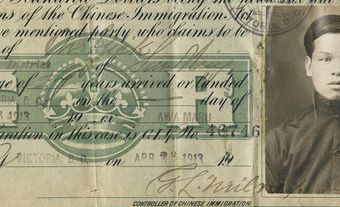
Despite the head tax, the Chinese population in Canada continued to increase. To stop further increase, politicians pushed for total exclusion. In 1923, the government passed a new law on Canada Day, 1923: the Chinese Immigration Act (1923). Also known as the “Chinese Exclusion Act,” the law barred nearly all forms of Chinese immigration. It also made every person of Chinese heritage register and carry with them documents known as C.I. (Chinese Immigration) Certificates. These papers were used to prove that they were allowed to remain in Canada.
The Chinese community strongly opposed the Act. Local Chinese associations called 1 July “Humiliation Day,” and organized protest activities in some cities. Activists lobbied politicians to stop the Act but were unsuccessful.
Did you know?
Technically, the 1923 law included exemptions for merchants, students, diplomats and clergymen ― similarly to the head tax. However, the new Act greatly restricted these exemptions. Consequently, by one government count, only 44 new Chinese immigrants were allowed into Canada between 1924 and 1947, when Canada repealed the Act.
The Chinese Exclusion Act lasted for 24 years. Without new immigrants arriving and few Chinese families because of the community’s gender imbalance, Canada’s Chinese population declined. The community’s population decreased from around 56,000 in 1924 to 32,528 in the 1951 census.
Community Impact
Life during the exclusion era was difficult. Job discrimination kept most Chinese labourers in low-paying jobs. Canada limited options for Chinese immigrants to become naturalized citizens. The government frequently rejected their naturalization applications.
Even children born in Canada of Chinese descent were excluded from full citizenship. Their legally required C.I. identity cards had a constant reminder of their place in Canadian society with the phrase “This certificate does not establish legal status in Canada” clearly inscribed at the bottom of each card.
The exclusion of Canadians of Chinese heritage from full citizenship denied them many rights. British Columbia barred them from voting federally and provincially, as did Saskatchewan. (See Right to Vote in Canada.) Additionally, in BC, Chinese people could not practice higher-paying professions like law or medicine. Chinese people in BC could not hold public office or own crown land either.
Discrimination was not limited to the federal and provincial governments. Cities and towns in Western Canadian provinces often restricted Chinese people from owning land or practicing specific professions in desirable areas.
Changing Attitudes
The Second World War helped change Canadian attitudes towards Chinese immigration. When the war broke out, authorities discouraged Chinese Canadians from serving in the military. The question of military service divided the Chinese Canadian community. Some saw the war as an opportunity to prove their loyalty to their country. However, others did not want to fight for a country that denied them equal treatment at home.
As the war went on, the armed forces became more desperate for troops. In 1944, Canada reversed its policy and let in Chinese recruits. By the end of the war in 1945, around 600 Chinese Canadians had served in the military. (See Chinese Canadians of Force 136.)
After coming home, many Chinese Canadian veterans formed veterans’ organizations to push for the repeal of the Chinese Exclusion Act and for equal rights. Positive press coverage of their military service also helped their advocacy. This led unions, other veteran groups and politicians to support their cause. Additionally, Canada and China had fought on the same side during the Second World War. The reduced tensions between the two countries helped improve portrayals of China in the news and popular media.
Canada’s reputation on the international stage also played a role. In 1945, Canada had just signed the new United Nations Charter of Human Rights. However, the existence of the Chinese Immigration Act meant that Canada was in contravention of the Charter. This made Canada look hypocritical.
Post-Repeal Restrictions (1947–67)
Due to these pressures, Canada repealed the Chinese Immigration Act in 1947. The repeal removed the near-total ban on Chinese immigration. That same year, Canada passed the Canadian Citizenship Act. The new law allowed Canadian residents to become citizens regardless of country of origin, paving the way for Chinese Canadians to become full citizens.
However, the repeal did not mean the removal of all restrictions on Chinese immigration. New Asian immigrants were still subject to Order-in-Council, P.C. 2115. This measure only allowed the spouses and unmarried children under the age of 18 of Canadian citizens of Asian descent to immigrate. Since only eight per cent of Chinese-born immigrants had been able to become citizens as of 1941, few Chinese Canadians could bring their families to join them. These restrictions only applied to Asian immigrants. (See Anti-Asian Racism in Canada.)
By this time, the Chinese community was mostly made up of ageing bachelor men who had families in China. Though the repeal of the Exclusion Act gave them hope that they would soon be able to bring their families to Canada, the continuing restrictions disappointed many. In order to enter the country, even families who met the criteria often had to go through long, stressful interviews and physical examinations. Sometimes, families even underwent blood testing to prove biological kinship. Many other applicants were simply rejected.
Restrictions on family reunification were not removed until 1967. That year, Canada reformed its immigration policy to remove restrictions on the basis of racial and national origins. The reforms paved the way for new cohorts of Chinese immigrants to arrive.
Legacy
Canada’s legacy of anti-Chinese discrimination left an enormous impact on the Chinese community that often had intergenerational impacts. (See also Anti-Asian Racism in Canada.) Bachelor men often lived lonely lives in rooming houses, separated from their families in China. For families split across oceans by the head tax and the Exclusion Act, these policies often prevented them from forming warm family bonds. As a result of discrimination, many Chinese Canadians grew up in poverty. These policies lasted from 1885 until 1967, a period of 82 years, and affected multiple successive generations.