Share on Facebook
 Share on X
 Share by Email
 Share on Google Classroom
Pituamkek National Park Reserve, located in northwestern Prince Edward Island, houses captivating landscapes like coastal sand dunes and old-growth forests. With its unique geography, this park has PEI’s only igneous rock incursion — a volcanic formation over 240 million years old. This land holds rich historical and cultural significance for the Mi'kmaq of Epekwitk (PEI), and the park was established in partnership with the Government of Canada, the Government of Prince Edward Island, and the Mi’kmaq governments of Lennox Island and Abegweit First Nations (see First Nations on Prince Edward Island). On 4 July 2024, Pituamkek National Park Reserve became the 48th national park in Canada.
Name
Pituamkek means “At the Long Sand Dune” in the Mi'kmaq language, and is known as Hog Island and the Sandhills in English.
Landscape and Wildlife
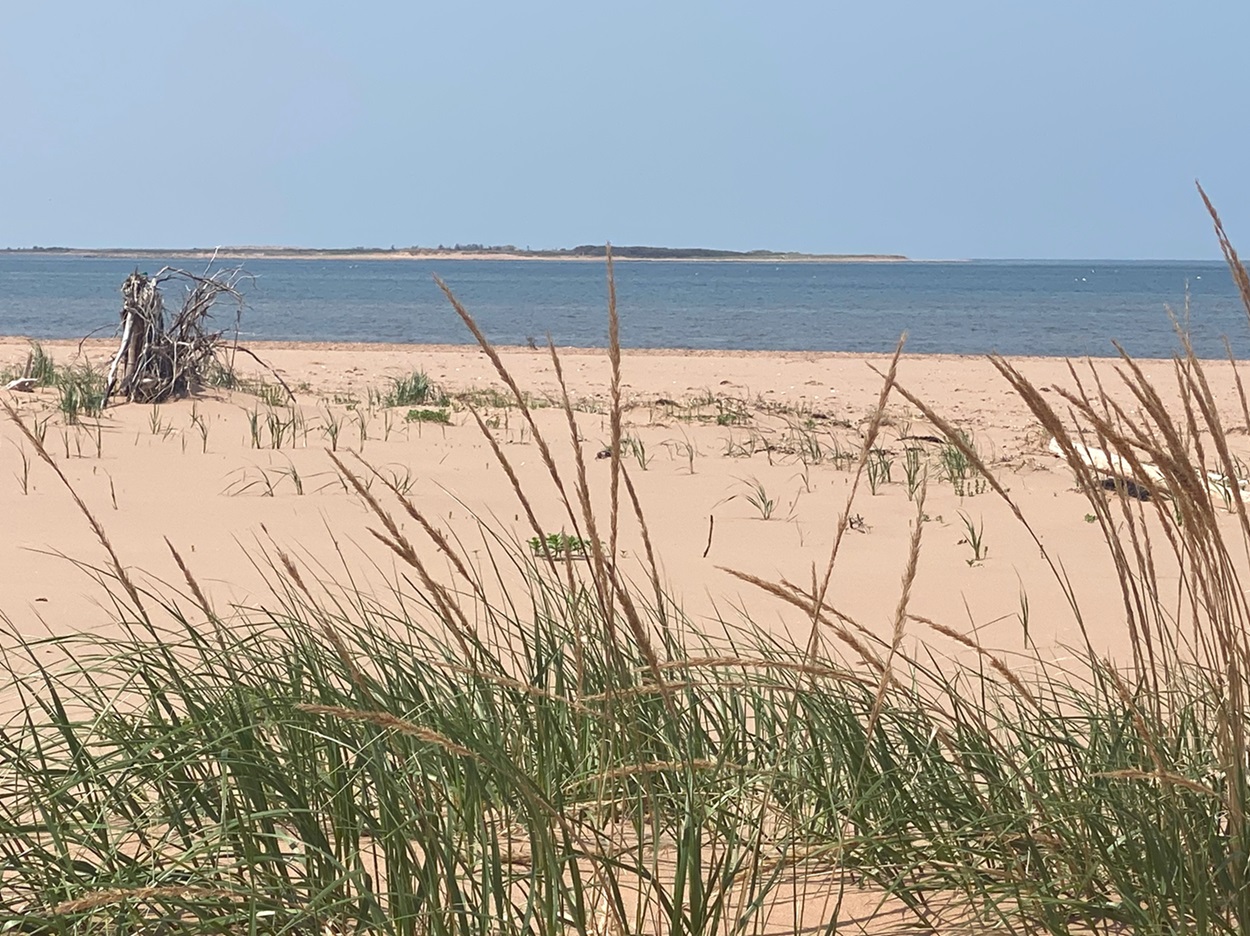
Pituamkek National Park Reserve is an ecologically diverse area that garners high conservation values. The 50-kilometre-long sand dunes that stretch across the islands create one of the most ecologically significant coastal dune ecosystems in the country, offering protection for the Malpeque and Cascumpec Bays. These bays are known for their rich fisheries and provide habitat for multiple coastal species. These barrier islands and dune systems also offer protection to coastal communities against harsh storm weather (see Living Shorelines).
The Iron Rock, named for the province's only igneous rock formation — a volcanic incursion more than 240 million years old — is found within the park (see Geological History of Canada).
The park is home to multiple delicate species, several of which are threatened or endangered, including the little brown bat, northern long-eared bat and piping plover (see Endangered Animals in Canada). Other plants and animals include goshawks, spruce trees and various grasses, mosses and lichens.
Did you know?
There is a difference between a national park and a national park reserve. A national park reserve is land that is managed like a national park but is subject to Indigenous land claims being negotiated between the federal, provincial/territorial and Indigenous governments. There are 11 national park reserves in Canada. If those land claims are resolved, the national park reserve may transition to being a national park.
Recreation
As a remote wilderness park, Pituamkek is known for peaceful recreation opportunities and the possibility to explore the narrow islands. The Mi'kmaq have used this land to camp, fish, and gather together for centuries, making it a place that holds cherished memories and cultural significance.
Park Management
The park is co-managed by the Government of Canada and the Mi’kmaq Epekwitnewaq Kapmntemuow (the Mi’kmaq Nation Government of PEI). Together, they have implemented a co-management governance model, guardian programs, community-based employment opportunities and commitments to sustainable infrastructure. Since the beginning of this process and partnership in 2006, the Mi’kmaq Epekwitnewaq Kapmntemuow has continuously advocated for the establishment of Pituamkek National Park Reserve. Other key partners, including the L’nuey, Parks Canada, Island Nature Trust, the Nature Conservancy of Canada, and the Province of Prince Edward Island, have significantly contributed to make this dream a reality.
Visitor Services
This remote park has no visitor services or infrastructure. The nearest community, Lennox Island, has multiple businesses and services for visitors to enjoy. Lennox Island First Nation has deep connections with Pituamkek National Park Reserve, as many of the archaeological sites indicate the presence of their ancestors dating back thousands of years.
As a newly designated national park reserve, management priorities lie in the conservation and research areas. As of fall 2024, Pituamkek National Park Reserve offers a modest visitor’s experience, as it is still in the process of development. As the park develops under co-management, more opportunities for visitor experiences will be created.
Indigenous Significance
The Mi'kmaq have had a relationship with this land for thousands of years. Several archaeological artifacts have been discovered on this site, ranging from arrow and spearheads, stone tools, clay pots and animal remains scattered throughout the islands, some dating back 3,000 years. The cultural, historical and spiritual connection the Mi’kmaq have to this land is embedded into the management of the park.
Pituamkek National Park Reserve has an Indigenous burial ground, making the islands a sacred place for the Mi’kmaq.
Did you know?
While Pituamkek National Park Reserve was designated a national park reserve in 2024, discussions to do so began in 2006. The Mi’kmaq Epekwitnewaq Kapmnteuow first submitted a proposal to create a co-managed national park reserve after discovering two archaeological sites significant to Mi'kmaq culture.