Share on Facebook
 Share on X
 Share by Email
 Share on Google Classroom
Mercantilism is two things. First, it is an economic theory. This theory is simple. It says that wealth is scarce. Wealth can come in the form of money and resources. Scarce means that there is not enough of something. Second, mercantilism is an economic policy. A policy is a set of rules or regulations to follow. Many nations practiced mercantilism. These nations were European imperialist powers. The two best known mercantilist nations were England (Great Britain) and France. They aimed to export more goods than they imported from their colonies. They hoped to make a lot of money and not spend much money. The Atlantic slave trade was mercantilist in nature. (See also Black Enslavement in Canada (Plain-Language Summary).)
This article is a plain-language summary of mercantilism. If you are interested in reading about this topic more in depth, please see our full-length entry, Mercantilism.
Mercantilism in New France
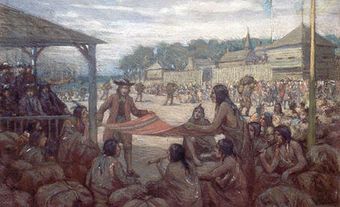
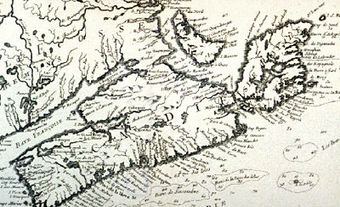
The economic relationship between France and its colony New France is an excellent example of mercantilism. France tried to take as many resources from New France without having to pay much for the resources. France was in complete control. It did not allow New France to sell its goods to any other nation. France sold much of the raw materials to other European nations. The economy of New France did not advance quickly because of mercantilism. France was simply uninterested in helping to advance it. France only wanted the resources. For instance, France did little to help the population of New France grow because it did not place much value on growing the economy of New France. (See also Population Settlement of New France.)
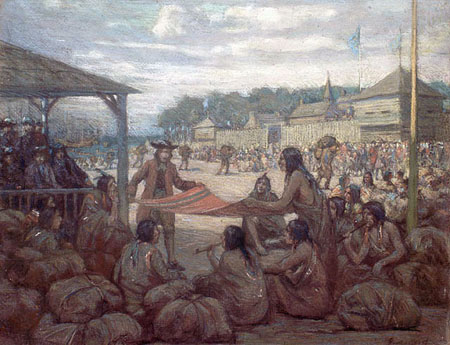
Often, population growth helps to make economies richer. The idea of mercantilism ultimately led to the growth of a monopoly in the fur trade. For a long time, the fur trade was the driving force of the economy of New France. The company that controlled the fur trade was called the Company of One Hundred Associates. It eventually failed. The economy of New France remained stagnant. Later on, in the history of New France, the economy began to diversify. But mercantilism never allowed it to diversify enough to experience any sort of growth.
British Mercantilism
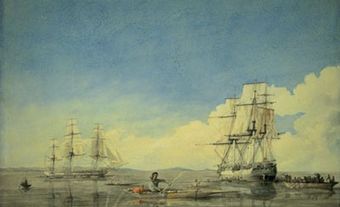
British mercantilism was like French mercantilism. But the British were not as strict. British mercantilist policies started in the early 1650s. The Navigation Acts were created to enforce mercantilism. They gave Britain a monopoly. British colonies could only trade with Britain. Raw materials were sent to Britain. Then, finished products were made from these materials in Britain. The British used mercantilist policies in New France too. They took control of it in 1759.
The goal of mercantilism was to make governments rich. But it also made some individuals rich. The richest individuals in British North America (formerly New France) were in the fur trade. Two of them were James McGill and Simon McTavish. They exported furs to England and imported goods from the Caribbean. The most important goods were sugar, rum and cotton. As with New France, mercantilism made the economy in British North America (Canada) grow slowly. Canada simply exported resources. The economy did not diversify. Local industry did not develop. Some claim that mercantilism led the economy to stagnate (not perform) well into the 19th century.
Hudson’s Bay Company
The Hudson’s Bay Company was like the Company of One Hundred Associates. It had a monopoly on the fur trade. It was founded in 1670. It controlled vast amounts of territory. The territory was called Rupert’s Land. The territory that was Rupert’s Land is now located in parts of Nunavut, Ontario, Quebec, Saskatchewan, Manitoba and Alberta. The Hudson’s Bay Company focused on the beaver pelt trade. It did not do much to develop the Canadian economy. It also held back settlement. The Hudson’s Bay Company did not want settlers. They would interfere with the fur trade.
Slavery
Europeans controlled much of the slave trade. The slave trade was a mercantilist enterprise. Europeans enslaved Africans. Then they forced enslaved people to work in the Americas. France and England were major players in the slave trade. Slaves worked on plantations. Many of the plantations were sugar plantations and cotton plantations. These goods were shipped to the home countries. There they were turned into products. These products were sold in Europe and around the world. Plantation slavery was not practiced in Canada, but Canada had slaves. (See also Black Enslavement in Canada (Plain-Language Summary).) Indigenous peoples were also enslaved. (See also Enslavement of Indigenous Peoples in Canada.) Many of the slaves worked in the fur trade or as servants.
End of Mercantilism
Mercantilism became less popular in the late 18th century and early 19th century. New economists began to criticize it. The most famous critic was Adam Smith. His most famous book is The Wealth of Nations (1776). Smith argued that mercantilism stopped competition. This was bad because, according to Smith, competition was needed for economic growth and prosperity. Also, in the 19th century, rapid economic changes forced economies like Canada’s to diversify and to industrialize. In these conditions, mercantilism could no longer compete. Ultimately, industrialization and the popularity of Adam Smith’s ideas helped to destroy mercantilism as an economic force.