Share on Facebook
 Share on X
 Share by Email
 Share on Google Classroom
Hurricanes are enormous, spiralling, tropical storms. The United Nations World Meteorological Organization estimates that in an average year, 80 such storms worldwide kill up to 15,000 people and cause $2 billion in property damage. In the Atlantic Ocean, hundreds of weather disturbances breed within 20° latitude of the equator in the easterly trade winds over the tropical ocean, though fewer than 10 a year are full-fledged tropical cyclones or hurricanes.
Formation
Many factors are involved in their creation. With the most intense sunlight, the ocean heats, which in turn warms the overriding air by convection. The heated air rises, carrying away evaporated water and producing an area of low pressure. The process quickens as more and more air and water spiral upwards, cool, condense and release the sun's energy stored in the evaporated water.
As the storm intensifies, the pressure in the centre column is further lowered, creating a partial vacuum. More ocean air is sucked in and sent higher into the atmosphere as the whirlpool-like vortex spins faster. Within a few days, the minor depression that began on a calm, humid day is transformed into an enormous whirling storm. One factor crucial to storm formation is the inward spiralling motion initiated by the Earth's rotation - a counterclockwise motion in the Northern Hemisphere and clockwise in the Southern Hemisphere.

Heart of the Storm
Adjacent to the storm's central column through the spiralling wall of cloud, the strongest winds swirl at more than 180 km/h accompanied by a constant deluge. At the heart of the storm exists a calm, dry centre known as the "eye." Many people have been lured from shelter when the eye passed deceptively overhead, only to be caught by more violent winds from the opposite side of the hurricane. The main system of cloud, rain and wind extends about 30–60 km out from the centre of the eye.
At some point, the young hurricane starts to move slowly, usually advancing at 15–25 km/h. Once the storm moves out of the tropical zone and into cooler northern latitudes, it quickly dies out — either starved for heat energy and moisture or because it encounters land and is dragged apart by ground friction. The farther north from the equator the storm gets, the more likely it is to get caught in the prevailing westerlies and eventually recurves to the north and northeast. That is the main reason hurricanes seldom strike with full force.
The average lifetime of a hurricane is nine days, but some may last from a few hours to a whole month. The North Atlantic hurricane season extends from June through November, although 84 per cent of the storms occur between August and October, reaching their greatest fury and frequency in September.
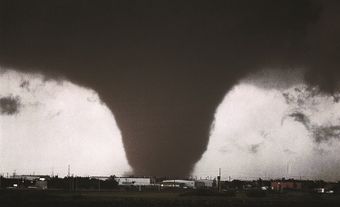
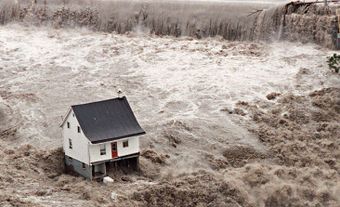
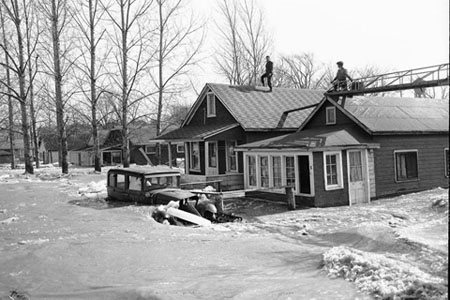
The most destructive elements of a hurricane are often the huge waves, storm tides and flooding it generates. For a day ahead of the storm, the ocean builds into a wall of water that comes crashing ashore. Sea levels are pushed up by as much as 5 m above normal tides, flooding low-lying coastal areas. Hurricanes frequently spawn tornadoes with even higher wind speeds.

Canadian Hurricanes
Of the 10 tropical cyclones that develop each year in the North Atlantic, only six will be hurricanes, and only one or two will enter the cool Canadian waters. The year 1995 was a notable exception, with nine tropical storms entering Canadian territory, of which five were hurricanes. Generally, the only regions affected in this country range from the Atlantic provinces through Quebec to Ontario east of Lake Superior.
Very seldom do hurricanes stray into Canadian Pacific waters (where they are called typhoons), which are too cold to sustain hurricane intensities. Typhoon Freda, or at least its remnants, struck the Pacific Northwest on 12 October 1962. In Victoria, where winds reached sustained speeds of 74 km/h with gusts to 145, there were seven storm-related deaths, and damage exceeded $10 million.
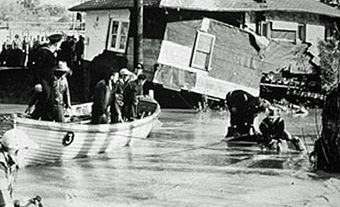
Hurricane Hazel is the most remembered storm in Canadian history, striking southern Ontario on Friday, 15 October 1954. In its wake, the storm left 81 dead and $100 million in damage. Hurricane Beth on 16 August 1971 produced more rain than Hazel, dumping 296 mm on Nova Scotia. The deadliest hurricanes ever to strike Canada were the cyclone that hit the Maritimes on 25 August 1873 (1,200 vessels lost) and the "Independence Hurricane" that struck Newfoundland on 9 September 1775, drowning several thousand British seamen.