Share on Facebook
 Share on X
 Share by Email
 Share on Google Classroom
El Niño is a pronounced warming of the Pacific Ocean current off the coast of South America. For centuries, Peruvian fishermen used the term El Niño — Spanish for"the boy child" or "the Christ-child" — to describe a weak, warm ocean current that arrived each year around Christmas, adversely affecting their catches. Some years, however, an unexplained reversal in atmospheric circulation over the southern Pacific and Indian oceans causes this current to warm even more — 2–5° C above the average maximum sea-surface temperature of 28° C — and expand to cover an area up to three times the size of Canada. Today, the term El Niño is primarily used to refer to this exceptional warming event.
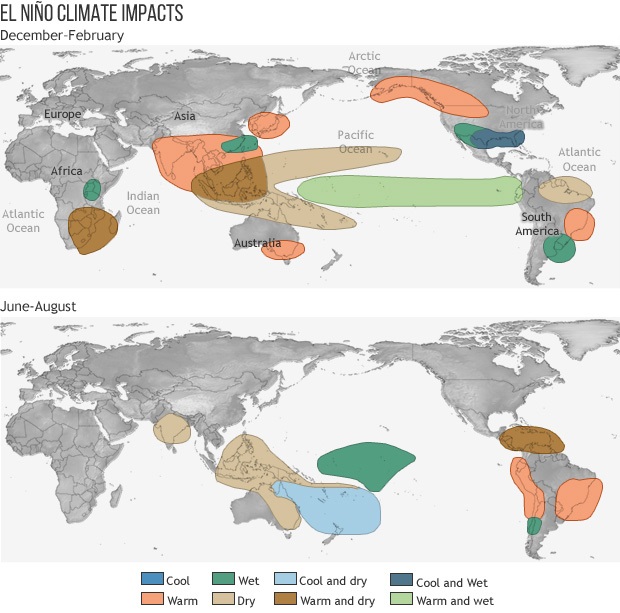
Description
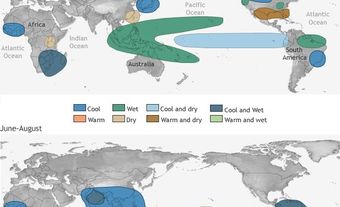
In Canada and the northern United States, the additional heat strengthens and alters the path of the jet stream — the high-altitude, fast-moving river of air that steers weather systems around the world. What happens to North American weather in the weeks following the onset of El Niño largely depends on whether the jet stream remains a single stream or splits into two. A single jet stream curving north over British Columbia, then plunging south through the centre of the continent, brings colder temperatures to the Great Lakes and eastern North America. At the same time, a high-pressure system stalls over the Rocky Mountains, preventing moist Pacific air from moving inland. Mild, dry weather then dominates western Canada and the northwestern United States. If the jet stream splits, its northernmost branch often produces storms in the Gulf of Alaska and warm temperatures in western Canada. The southern branch delivers more storms to California, Texas and Florida before moving up the east coast of North America.
It is difficult to predict what type of weather an El Niño will bring to North America, since each occurrence varies greatly in strength and impact. In the winter of 1982–83, very mild Pacific air penetrated eastward to the Great Lakes and beyond. Yet six years earlier, southern Ontario suffered a cold winter while the West experienced balmy temperatures during a weaker El Niño.
Impacts
For people who depend on the weather for their livelihood, El Niño has both good and bad side effects. For British Columbia salmon fishermen, it can be good news as Fraser River-bound sockeye opt for cooler waters, making them available only to Canadian fishermen. On the other hand, schools of hungry mackerel riding the El Niño wave may devour young sockeye stock. To Prairie farmers anxious to see soil moisture replenished, El Niño's usually snow-free winter is not welcome news. On the other hand, an El Niño year also correlates with a warmer, wetter spring, which increases spring wheat yields.
Historically, El Niño weather patterns have occasionally resulted in droughts and famines, causing significant loss of life.
El Niño and La Niña
The "opposite" of El Niño is La Niña, an extensive cooling of the waters in the tropical eastern Pacific Ocean. In the 20th century, there were around 25 El Niños and 18 La Niñas.
Recent El Niño events have occurred in 1982–83, 1997–98, 2014–16, and 2023–24. Another El Niño event is predicted to start in spring 2026.