Share on Facebook
 Share on X
 Share by Email
 Share on Google Classroom
Located on the Cumberland Peninsula of Baffin Island, Nunavut, Auyuittuq National Park (established 2001, 19,089 km2) was Canada's first national park located north of the Arctic Circle. It was first set up as a national park reserve in 1976 and established as a national park through the Nunavut Land Claims Agreement. Auyuittuq means "the land that never melts" in Inuktitut.

Landscape
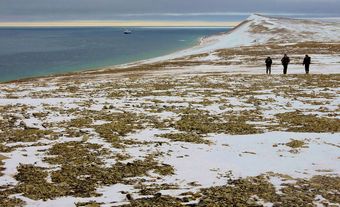
Auyuittuq National Park is a land of barrens, tundra, jagged mountain peaks, granite cliffs, deep fjords, glaciers and ice. The towering peaks of the Akshayuk Pass overlook a natural corridor through the landscape.
Over 50 per cent of the park is composed of tundra, barrens and exposed bedrock. With 800 km of coastline and coastal cliffs rising to 900 m, the park is also known for its marine landscape.
Glaciers and ice cover about 8,470 km2, or 40 per cent of the park's landscape, with Penny Ice Cap covering about 28 per cent of the park's landscape, though climate change is accelerating its melting. These glaciers and ice are a critical component of the landscape, regulating regional microclimate and water flow through the surrounding regions.
Wildlife
Vegetation is sparse, though in the brief Arctic summer, flowers such as white mountain avens, yellow Arctic poppy, and purple saxifrage colour the ground.
Land-based wildlife is not abundant; herbivores, including arctic hare, lemming, and a few barren-ground caribou, are preyed upon by wolves, arctic foxes, and weasels. The coastal waters on the north side of the park reserve, however, are teeming with life. The coast is home to millions of seabirds. Glaucous gulls, fulmars and black guillemots nest on sheer cliffs. Polar bears, seals, walrus, beluga and narwhals patrol the icy coastal waters.
Human History
The Dorset people lived here over 2,500 years ago. Norse explorers visited but did not linger (see Norse-Indigenous Contact; Norse Voyages). In the 12th century, ancestors of the present Inuit arrived. These Early Inuit (Thule) people hunted whales and caribou. English explorers arrived in 1585, but contact with European culture was not established until the mid-1800s, when whalers established shore stations along the coast of Baffin Island (see Whaling).
Park Management
Auyuittuq was first established as a national park reserve in 1976, and later became a national park in 2001 after the resolution of Indigenous Land Claims in the area through the Nunavut Land Claims Agreement and Inuit Impact and Benefit Agreement of Auyuittuq, Quttinirpaaq and Sirmilik National Parks, notably. Today, the park is under cooperative management between Parks Canada and Inuit people, through the Joint Inuit/Government Park Planning and Management Committee (Joint Park Management Committee). Since its inception in 2001, this committee meets twice yearly and is composed of six members, three appointed by the Government of Canada and three appointed by the Qikiqtani Inuit Association.
Did you know?
There is a difference between a national park and a national park reserve. A national park reserve is land that is managed like a national park but is subject to Indigenous land claims being negotiated between the federal, provincial/territorial and Indigenous governments. There are 11 national park reserves in Canada. If those land claims are resolved, the national park reserve may transition to being a national park.
Facilities
From April to July, the glacier-carved peaks and the Akshayuk Pass hiking route challenge wilderness enthusiasts. Access to the park reserve is by private outfitter's boat, snowmobile or by hiking or skiing from the communities of Pangnirtung or Qikiqtarjuaq.