
Browse "Things"
-
Article
Conductors and conducting
IntroductionConductors and conducting. The practice of beating time with hand, foot, stick, bow, or rolled-up sheet of paper to co-ordinate group performance is centuries old.
"https://thecanadianencyclopedia.ca/images/tce_placeholder.jpg?v=e9dca980c9bdb3aa11e832e7ea94f5d9" // resources/views/front/categories/view.blade.php
https://thecanadianencyclopedia.ca/images/tce_placeholder.jpg?v=e9dca980c9bdb3aa11e832e7ea94f5d9
-
Article
Conestoga Wagon
The Conestoga wagon was a large wagon, with broad wheels and a white hemp or canvas cover, used for the transportation of persons and goods across the North American continent prior to the introduction of the railway in the
"https://d3d0lqu00lnqvz.cloudfront.net/media/media/df744b29-90e4-40d3-b6dd-f7f6ec016776.jpg" // resources/views/front/categories/view.blade.php
https://d3d0lqu00lnqvz.cloudfront.net/media/media/df744b29-90e4-40d3-b6dd-f7f6ec016776.jpg
-
Article
Confectionery Industry
Confectionery Industry, a manufacturing sector made up of companies primarily involved in processing candies, chocolate and cocoa products and chewing gum. Confectionery manufacturing started to emerge as an important industry in the late 1800s.
"https://thecanadianencyclopedia.ca/images/tce_placeholder.jpg?v=e9dca980c9bdb3aa11e832e7ea94f5d9" // resources/views/front/categories/view.blade.php
https://thecanadianencyclopedia.ca/images/tce_placeholder.jpg?v=e9dca980c9bdb3aa11e832e7ea94f5d9
-
Article
Confederation
Confederation refers to the process of federal union in which the British North American colonies of Nova Scotia, New Brunswick and the Province of Canada joined together to form the Dominion of Canada. The term Confederation also stands for 1 July 1867, the date of the creation of the Dominion. (See also Canada Day.) Before Confederation, British North America also included Newfoundland, Prince Edward Island, British Columbia, and the vast territories of Rupert’s Land (the private domain of the Hudson’s Bay Company) and the North-Western Territory. Beginning in 1864, colonial politicians (now known as the Fathers of Confederation) met and negotiated the terms of Confederation at conferences in Charlottetown, Quebec City and London, England. Their work resulted in the British North America Act, Canada’s Constitution. It was passed by the British Parliament. At its creation in 1867, the Dominion of Canada included four provinces: Nova Scotia, New Brunswick, Quebec and Ontario. Between then and 1999, six more provinces and three territories joined Confederation. This article is a full-length entry about Confederation. For a plain-language summary, please see Confederation (Plain Language Summary).
"https://d3d0lqu00lnqvz.cloudfront.net/media/media/414967a2-a084-4398-bc84-85d98d595ee9.jpg" // resources/views/front/categories/view.blade.php
https://d3d0lqu00lnqvz.cloudfront.net/media/media/414967a2-a084-4398-bc84-85d98d595ee9.jpg
-
Timelines
Confederation
The Dominion of Canada wasn't born out of revolution, or a sweeping outburst of nationalism. Rather, it was created in a series of conferences and orderly negotiations, culminating in the terms of Confederation on 1 July 1867.
"https://d3d0lqu00lnqvz.cloudfront.net/media/media/a5ff3b8b-0174-4e95-a077-9422960edfbe.jpg" // resources/views/front/categories/view.blade.php
https://d3d0lqu00lnqvz.cloudfront.net/media/media/a5ff3b8b-0174-4e95-a077-9422960edfbe.jpg
-
Collection
Confederation
The Dominion of Canada wasn't born out of revolution, or a sweeping outburst of nationalism. Rather, it was created in a series of conferences and orderly negotiations, culminating in the terms of Confederation on 1 July 1867. This Collection brings together content related to the creation of Canada.
"https://d3d0lqu00lnqvz.cloudfront.net/media/media/f8f2bab3-d387-4165-9fbc-617c30019b95.jpg" // resources/views/front/categories/view.blade.php
https://d3d0lqu00lnqvz.cloudfront.net/media/media/f8f2bab3-d387-4165-9fbc-617c30019b95.jpg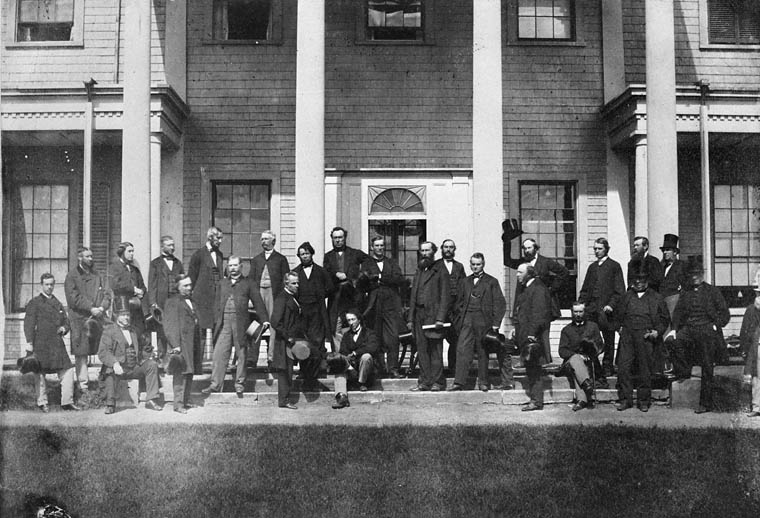
-
Article
Confederation and Music
Confederation and music. Confederation is the popular term for the federal union in 1867 of the provinces of Upper and Lower Canada (thereafter Ontario and Quebec), New Brunswick, and Nova Scotia under the name Dominion of Canada.
"https://thecanadianencyclopedia.ca/images/tce_placeholder.jpg?v=e9dca980c9bdb3aa11e832e7ea94f5d9" // resources/views/front/categories/view.blade.php
https://thecanadianencyclopedia.ca/images/tce_placeholder.jpg?v=e9dca980c9bdb3aa11e832e7ea94f5d9
-
Article
Confederation Centre of the Arts Choirs
Confederation Centre of the Arts choirs, Charlottetown. Two choirs that originated in the Confederation Choir, a mixed-voice group formed in 1963 from the nucleus of the Charlottetown Chorale, which had sung since 1951 under William Keith Rogers and Christopher Gledhill.
"https://thecanadianencyclopedia.ca/images/tce_placeholder.jpg?v=e9dca980c9bdb3aa11e832e7ea94f5d9" // resources/views/front/categories/view.blade.php
https://thecanadianencyclopedia.ca/images/tce_placeholder.jpg?v=e9dca980c9bdb3aa11e832e7ea94f5d9
-
Article
Confederation Centre of the Arts
The centre's design, by architect Dimitri Dimakopoulos and theatre designer George Izenour, was selected by a jury of internationally distinguished architects from among 47 submissions.
"https://d3d0lqu00lnqvz.cloudfront.net/media/media/eea03169-baa8-4fca-b07a-531c7bca9dba.jpg" // resources/views/front/categories/view.blade.php
https://d3d0lqu00lnqvz.cloudfront.net/media/media/eea03169-baa8-4fca-b07a-531c7bca9dba.jpg
-
Article
Confederation of Canadian Unions
Confederation of Canadian UnionsFounded in 1969 on the initiative of veteran labour organizers Kent ROWLEY and Madeleine PARENT, the Confederation of Canadian Unions (originally the Council of Canadian Unions 1969-73) is dedicated to the establishment of a democratic, independent Canadian labour movement free of the influence of American-based international unions. In 1994 the CCU contained approximately 20 000 members in 11 affiliated unions, in both the public and private sector. The CCU has been a...
"https://thecanadianencyclopedia.ca/images/tce_placeholder.jpg?v=e9dca980c9bdb3aa11e832e7ea94f5d9" // resources/views/front/categories/view.blade.php
https://thecanadianencyclopedia.ca/images/tce_placeholder.jpg?v=e9dca980c9bdb3aa11e832e7ea94f5d9
-
Article
Confederation of National Trade Unions
The Catholic unions were reorganized at the end of WWI, stressing protection of members' rights and interests as workers. Anxious to unite their forces, they jointly formed the Canadian Catholic Confederation of Labour in 1921 with about 17 600 members.
"https://d3d0lqu00lnqvz.cloudfront.net/media/media/aee50531-a98b-429d-b2c6-3dd787abde3f.jpg" // resources/views/front/categories/view.blade.php
https://d3d0lqu00lnqvz.cloudfront.net/media/media/aee50531-a98b-429d-b2c6-3dd787abde3f.jpg
-
Article
Conference Board of Canada
The Conference Board of Canada is a a major independent, not for profit, applied research organization. Its 500 member organizations include business, government and public-sector organizations. Its mandate is "to help our members anticipate and respond to the increasingly changing global economy...
"https://thecanadianencyclopedia.ca/images/tce_placeholder.jpg?v=e9dca980c9bdb3aa11e832e7ea94f5d9" // resources/views/front/categories/view.blade.php
https://thecanadianencyclopedia.ca/images/tce_placeholder.jpg?v=e9dca980c9bdb3aa11e832e7ea94f5d9
-
Article
Conferences and Congresses
Conferences and congresses. Canada has played host with increasing frequency to meetings of worldwide and North American musical organizations.
"https://thecanadianencyclopedia.ca/images/tce_placeholder.jpg?v=e9dca980c9bdb3aa11e832e7ea94f5d9" // resources/views/front/categories/view.blade.php
https://thecanadianencyclopedia.ca/images/tce_placeholder.jpg?v=e9dca980c9bdb3aa11e832e7ea94f5d9
-
Article
Confidentiality
The duty which requires physicians to keep the information they receive from their patients confidential is well established in Canadian common law, health care legislation and professional codes of conduct.
"https://thecanadianencyclopedia.ca/images/tce_placeholder.jpg?v=e9dca980c9bdb3aa11e832e7ea94f5d9" // resources/views/front/categories/view.blade.php
https://thecanadianencyclopedia.ca/images/tce_placeholder.jpg?v=e9dca980c9bdb3aa11e832e7ea94f5d9
-
Article
Conflict of Interest
Conflict of interest may be defined as a situation in which politicians and public servants have an actual or potential interest (usually financial) that may influence or appear to influence the conduct of their official duties (see PATRONAGE; CORRUPTION).
"https://thecanadianencyclopedia.ca/images/tce_placeholder.jpg?v=e9dca980c9bdb3aa11e832e7ea94f5d9" // resources/views/front/categories/view.blade.php
https://thecanadianencyclopedia.ca/images/tce_placeholder.jpg?v=e9dca980c9bdb3aa11e832e7ea94f5d9