
Browse "Arts & Culture"
-
Article
Indian Music in Canada
In 1986 in Canada there were approximately 280,000 people of Asian Indian origin, the majority of whom had arrived after 1968. Earlier immigrants from India were mostly Sikh labourers who arrived ca 1905-8 from the Punjab.
"https://thecanadianencyclopedia.ca/images/tce_placeholder.jpg?v=e9dca980c9bdb3aa11e832e7ea94f5d9" // resources/views/front/categories/view.blade.php
https://thecanadianencyclopedia.ca/images/tce_placeholder.jpg?v=e9dca980c9bdb3aa11e832e7ea94f5d9
-
Article
Classical Indian Dance
After long and persistent efforts on the part of Indian dancers living in Canada, Indian forms of dance came to be acknowledged as classical art by the arts councils and the Canadian dance audience at large.
"https://thecanadianencyclopedia.ca/images/tce_placeholder.jpg?v=e9dca980c9bdb3aa11e832e7ea94f5d9" // resources/views/front/categories/view.blade.php
https://thecanadianencyclopedia.ca/images/tce_placeholder.jpg?v=e9dca980c9bdb3aa11e832e7ea94f5d9
-
Article
Indian Horse
Indian Horse (2012) is the sixth novel by Ojibwe author Richard Wagamese. Set in Northern Ontario in the late 1950s and early 1960s, it follows protagonist Saul Indian Horse as he uses his extraordinary talent for ice hockey to try and escape his traumatic residential school experience. He achieves moderate success as a hockey player but is unable to escape his “Indian” identity or the trauma from his past. Indian Horse was a finalist on CBC’s Canada Reads in 2013, where it won the People’s Choice award. It was also the winner of the 2013–14 First Nation Communities Read Selection and the Burt Award for First Nations, Inuit and Métis Literature from the Canadian Organization for Development through Education (CODE). In 2017, Indian Horse was adapted into an award-winning film by writer Dennis Foon and director Stephen S. Campanelli.
"https://d3d0lqu00lnqvz.cloudfront.net/media/media/4d3d2720-3ba1-468f-a6a3-db37fc2ad176.jpg" // resources/views/front/categories/view.blade.php
https://d3d0lqu00lnqvz.cloudfront.net/media/media/4d3d2720-3ba1-468f-a6a3-db37fc2ad176.jpg
-
Article
Indians of Canada Pavilion
The Indians of Canada Pavilion was a part of Expo 67 in Montreal, Quebec. It was created by First Nations peoples from across Canada. They took advantage of the opportunity to share with Canada and the world provocative histories of colonial resistance. The pavilion was separate from other provincial and national pavilions at Expo 67. It displayed contemporary Indigenous issues and showcased contemporary art (see Contemporary Indigenous Art in Canada). Few traces of the Indians of Canada Pavilion remain beyond archival sources and photographs. It was dismantled along with many of the other pavilions created for the exposition. Kwakwaka’wakw artists Tony Hunt and Henry Hunt carved a totem pole for the exterior of the pavilion site. While nearly all of the pavilion was destroyed, the totem pole still stands in Montreal on Île Notre-Dame. The pavilion’s impact resonates today as a significant step towards change.
"https://d3d0lqu00lnqvz.cloudfront.net/IndiansOfCanadaPavilion/pavilion_edifice_resized.jpg" // resources/views/front/categories/view.blade.php
https://d3d0lqu00lnqvz.cloudfront.net/IndiansOfCanadaPavilion/pavilion_edifice_resized.jpg
-
Article
Indigenous Language Revitalization in Canada
Before European settlement in Canada, Indigenous peoples spoke a wide variety of languages. As a means of assimilating Indigenous peoples, colonial policies like the Indian Act and residential schools forbade the speaking of Indigenous languages. These restrictions have led to the ongoing endangerment of Indigenous languages in Canada. Indigenous communities and various educational institutions have taken measures to prevent more language loss and to preserve Indigenous languages.
"https://d3d0lqu00lnqvz.cloudfront.net/media/media/b6607b22-8c55-4f10-86dd-a72dfcb1b740.jpg" // resources/views/front/categories/view.blade.php
https://d3d0lqu00lnqvz.cloudfront.net/media/media/b6607b22-8c55-4f10-86dd-a72dfcb1b740.jpg
-
Article
Inuit Art
The history of Inuit cultures and the art of the various regions and times can only be understood if the myth of a homogeneous Inuit culture is discarded altogether. Though it has not been possible to determine the exact origin(s) of the Inuit, nor of the various Inuit cultures, five distinct cultures have been established in the Canadian area: Pre-Dorset , Dorset , Thule, Historic and Contemporary.
"https://d3d0lqu00lnqvz.cloudfront.net/media/media/4d37de3c-41d6-48db-bf9f-070d0882d77d.jpg" // resources/views/front/categories/view.blade.php
https://d3d0lqu00lnqvz.cloudfront.net/media/media/4d37de3c-41d6-48db-bf9f-070d0882d77d.jpg
-
Article
Inuksuk (Inukshuk)
Inuksuk (also spelled inukshuk, plural inuksuit) is a figure made of piled stones or boulders constructed to communicate with humans throughout the Arctic. Traditionally constructed by the Inuit, inuksuit are integral to Inuit culture and are often intertwined with representations of Canada and the North. A red inuksuk is found on the flag of Nunavut. In Inuktitut, the term inuksuk means "to act in the capacity of a human." It is an extension of the word inuk meaning "a human being." Inuksuit have been found close to archaeological sites dating from 2400 to 1800 BCE in the Mingo Lake region of southwest Baffin Island. (See also Prehistory.) While stone figures resembling human forms are often referred to as inuksuk, such figures are actually known as inunnguaq.
"https://d3d0lqu00lnqvz.cloudfront.net/media/media/fda0c3a3-c613-4196-ba0a-690925ca6c04.jpg" // resources/views/front/categories/view.blade.php
https://d3d0lqu00lnqvz.cloudfront.net/media/media/fda0c3a3-c613-4196-ba0a-690925ca6c04.jpg
-
Article
Irish Music in Canada
The Irish component in the population of Canada is the fourth largest (after English, French, and Scottish) and one of the oldest. Irish fishermen settled in Newfoundland in the early 17th century. By the mid-18th century that island had some 5000 Roman Catholic Irish inhabitants - about one-third of its population. There were Irish among those who founded Halifax in 1749. The United Empire Loyalists who moved to Nova Scotia and New Brunswick after 1776 included many of Irish descent. The famine in Ireland during the early 19th century sent thousands of Irish farmers to Upper Canada (Ontario). By 1871 the Irish were the second largest ethnic group in Canada (after the French); in 1950 there were 1,500,000 Irish, catholic and protestant. In the 1986 census there were 699,685 Canadians of single Irish descent and a further 2,922,605 with some Irish ancestry.
"https://d3d0lqu00lnqvz.cloudfront.net/dreamstime_xxl_22459850.jpg" // resources/views/front/categories/view.blade.php
https://d3d0lqu00lnqvz.cloudfront.net/dreamstime_xxl_22459850.jpg
-
Article
Israeli Music in Canada
By 1990 there had been little emigration from Israel to Canada, and that was mostly to Montreal and Toronto, with smaller numbers settling in Hamilton, Ottawa, and Vancouver. Groups such as the YMHA and YWHA, the Canada-Israel Cultural Foundation (established 1963), and various local organizations have worked to perpetuate and disseminate Israeli culture through classes, demonstrations, concerts, and lectures. In June 1978, in honour of Israel's 30th anniversary, Toronto's Ontario Place staged the first of...
"https://thecanadianencyclopedia.ca/images/tce_placeholder.jpg?v=e9dca980c9bdb3aa11e832e7ea94f5d9" // resources/views/front/categories/view.blade.php
https://thecanadianencyclopedia.ca/images/tce_placeholder.jpg?v=e9dca980c9bdb3aa11e832e7ea94f5d9
-
Article
Italian Music in Canada
Though a few Italians were associated with early European exploration in Canada (eg, John Cabot, b Giovanni Caboto), immigration did not begin in earnest until ca 1880, increasing dramatically in the early 20th century.
"https://thecanadianencyclopedia.ca/images/tce_placeholder.jpg?v=e9dca980c9bdb3aa11e832e7ea94f5d9" // resources/views/front/categories/view.blade.php
https://thecanadianencyclopedia.ca/images/tce_placeholder.jpg?v=e9dca980c9bdb3aa11e832e7ea94f5d9
-
Article
Jazz Festivals
Jazz festivals. Traditionally heard in nightclubs, jazz was first presented in a festival setting in France in the late 1940s and at Newport, RI, in 1954. The 'jazz festival' typically brings together several ensembles over a period of days in one or more venues.
"https://d3d0lqu00lnqvz.cloudfront.net/media/media/721c956f-72bf-4c8b-9f62-13dda94c4dd5.jpg" // resources/views/front/categories/view.blade.php
https://d3d0lqu00lnqvz.cloudfront.net/media/media/721c956f-72bf-4c8b-9f62-13dda94c4dd5.jpg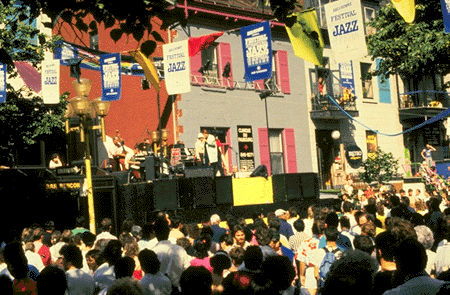
-
Article
Jewish Food in Canada
Jewish food in Canada was in large part shaped by the arrival of Eastern European Ashkenazi Jews in the late 1880s. Later Jewish immigration from North Africa and the Middle East also influenced the cuisine of Jewish Canadians, as they introduced new dishes and ingredients to the culinary landscape. Many foods remain distinctly Jewish, mainly being cooked and eaten by members of the Jewish community. However, some foods brought to Canada by Jews have also become popular foods enjoyed by Canadians of various backgrounds. Jewish food has become central to the culinary identity of Canada. (See Popular Jewish Dishes in Canada.)
"https://d3d0lqu00lnqvz.cloudfront.net/Jewish_dishes/challah.jpg" // resources/views/front/categories/view.blade.php
https://d3d0lqu00lnqvz.cloudfront.net/Jewish_dishes/challah.jpg
-
Article
Joual
Joual is the name given, in specific sociological and socio-historical situations, to the variety of French spoken in Québec.
"https://d3d0lqu00lnqvz.cloudfront.net/media/media/e535a1f6-a1dc-4d47-b4ff-63970250900d.JPG" // resources/views/front/categories/view.blade.php
https://d3d0lqu00lnqvz.cloudfront.net/media/media/e535a1f6-a1dc-4d47-b4ff-63970250900d.JPG
-
Article
Juno Awards
The Juno Awards are Canada’s music recording industry awards. They have been administered by the Canadian Academy of Recording Arts and Sciences (CARAS) since 1975, when the awards ceremony was first telecast. The gala’s popularity has grown significantly since 1995, when it was transformed from an industry function into a public event at an arena concert venue. In the early 2000s, the “Juno Week” ceremony was expanded to include public entertainment events; these include the Songwriters' Circle, JunoFest, Juno Fan Fare and the Juno Cup charity hockey game. The Juno Awards also encompass the Canadian Music Hall of Fame. It was founded by CARAS in 1978.
"https://d3d0lqu00lnqvz.cloudfront.net/media/media/d0852662-34f9-448b-9f0e-627e88814cdf.jpg" // resources/views/front/categories/view.blade.php
https://d3d0lqu00lnqvz.cloudfront.net/media/media/d0852662-34f9-448b-9f0e-627e88814cdf.jpg
-
Article
Kim’s Convenience
Kim’s Convenience (2016–21) is a CBC TV sitcom about a Korean Canadian family that runs a convenience store in Toronto. Based on a 2011 play by Ins Choi, it was the first Canadian comedy series to star a primarily Asian Canadian cast. The acclaimed comedy explores the generational tension between immigrant parents and their Canadian-born children and was inspired by Choi’s experience growing up in a Korean family in Toronto. The show was an instant hit when it premiered on CBC in fall 2016; its first season averaged 933,000 viewers per episode. The series won eight Canadian Screen Awards, including Best Comedy Series in 2018. It also gained an international audience that year when it was made available on Netflix.
"https://d3d0lqu00lnqvz.cloudfront.net/media/new_article_images/KimsConvenience/36356631241_bdd08db588_z.jpg" // resources/views/front/categories/view.blade.php
https://d3d0lqu00lnqvz.cloudfront.net/media/new_article_images/KimsConvenience/36356631241_bdd08db588_z.jpg