
Browse "History/Historical Figures"
-
Article
Clara Brett Martin
Martin finally achieved her goal on 2 February 1897, becoming the first woman lawyer in the British Empire. She went on to earn Bachelor of Civil Law (1897) and LLB (1899) degrees and to establish a successful Toronto practice.
"https://d3d0lqu00lnqvz.cloudfront.net/media/media/9fc740ed-105c-401a-a70b-bd77c8f53390.jpg" // resources/views/front/categories/view.blade.php
https://d3d0lqu00lnqvz.cloudfront.net/media/media/9fc740ed-105c-401a-a70b-bd77c8f53390.jpg
-
Editorial
Clara Brett Martin: Hero or Villain?
The following article is an editorial written by The Canadian Encyclopedia staff. Editorials are not usually updated. "This application to the Law Society of Upper Canada is refused. The governing statute regulating this body, not having been drafted under the advanced views of the day and specifically referring to the admission of persons, does not permit the interpretation of 'persons' to include women. This was the spirit of the reply to Clara Brett Martin's application to study law in 1891.
"https://thecanadianencyclopedia.ca/images/tce_placeholder.jpg?v=e9dca980c9bdb3aa11e832e7ea94f5d9" // resources/views/front/categories/view.blade.php
https://thecanadianencyclopedia.ca/images/tce_placeholder.jpg?v=e9dca980c9bdb3aa11e832e7ea94f5d9
-
Article
Clara Dennis
Clarissa Archibald Dennis, travel writer, photographer, motorist (born 24 November 1881 in Truro, NS; died 16 February 1958 in Halifax, NS). Beginning around 1930, Clara Dennis spent a decade travelling across Nova Scotia by car. She was one of the first travel writers from Nova Scotia to write about the province. Her books and photographs documented the people and places in the far corners of the area.
"https://d3d0lqu00lnqvz.cloudfront.net/ClaraDennis/ClaraDennisBoat.jpg" // resources/views/front/categories/view.blade.php
https://d3d0lqu00lnqvz.cloudfront.net/ClaraDennis/ClaraDennisBoat.jpg
-
Article
Claude Chauchetière
Claude Chauchetière, Jesuit missionary, painter, biographer, teacher (born on 6 September 1645 in St-Porchaire-de-Poitiers, France; died 17 April 1709 in Quebec City). Chauchetière was a missionary among the Haudenosaunee in what is now Kahnawà:ke, Quebec. He painted a portrait of Kateri Tekakwitha and is considered one of the pioneer painters of New France. Chauchetière later taught mathematics in Montreal.
"https://d3d0lqu00lnqvz.cloudfront.net/media/media/edd81f0b-a2fd-4103-bc0f-b5f75d16c8d3.jpg" // resources/views/front/categories/view.blade.php
https://d3d0lqu00lnqvz.cloudfront.net/media/media/edd81f0b-a2fd-4103-bc0f-b5f75d16c8d3.jpg
-
Article
Claude de Boutroue d'Aubigny
Claude de Boutroue d'Aubigny, chevalier, INTENDANT of New France 1668-70 (b at Paris, France 1620; d in France 1680). A Parisian judge and member of the noblesse de robe, Boutroue served as intendant of Canada between Jean TALON's first and second terms.
"https://thecanadianencyclopedia.ca/images/tce_placeholder.jpg?v=e9dca980c9bdb3aa11e832e7ea94f5d9" // resources/views/front/categories/view.blade.php
https://thecanadianencyclopedia.ca/images/tce_placeholder.jpg?v=e9dca980c9bdb3aa11e832e7ea94f5d9
-
Article
Claude de Ramezay
Claude de Ramezay, (born 15 June 1659 in La Gesse, France; died 31 July 1724 in Quebec City). Claude de Ramezay came to New France as an officer in the troupes de la marine. He served as governor of Trois-Rivières (1690–99), commander of Canadian troops (1699–1704), governor of Montreal (1704–24), and as acting governor general of New France (1714–16). Throughout his time in New France, he pursued fur trade and lumber interests. He is also remembered for his home, Château Ramezay. Built in 1705, it is now a museum and one of Montreal’s landmark historical buildings.
"https://d3d0lqu00lnqvz.cloudfront.net/media/new_article_images/ClaudedeRamezay/Claude_de_Ramezay.jpg" // resources/views/front/categories/view.blade.php
https://d3d0lqu00lnqvz.cloudfront.net/media/new_article_images/ClaudedeRamezay/Claude_de_Ramezay.jpg
-
Article
Claude-Thomas Dupuy
Claude-Thomas Dupuy, lawyer, intendant of NEW FRANCE 1725-28 (b at Paris, France 10 Dec 1678; d near Rennes, France 15 Sept 1738). From a bourgeois family Dupuy became a lawyer in the parlement of Paris and in 1720 purchased the office of maître des requêtes.
"https://thecanadianencyclopedia.ca/images/tce_placeholder.jpg?v=e9dca980c9bdb3aa11e832e7ea94f5d9" // resources/views/front/categories/view.blade.php
https://thecanadianencyclopedia.ca/images/tce_placeholder.jpg?v=e9dca980c9bdb3aa11e832e7ea94f5d9
-
Article
Clement Ligoure
Clement Courtenay Ligoure, physician (born 13 October 1887 in Trinidad; died 23 May 1922 Port of Spain, Trinidad). Dr. Ligoure was Halifax’s first Black doctor and an unsung hero of the Halifax Explosion, as he treated hundreds of patients free of charge in his home medical office. Dr. Ligoure was also instrumental in the formation of the No. 2 Construction Battalion, Canada’s first and only all-Black battalion (see Black Canadians; Caribbean Canadians).
"https://d3d0lqu00lnqvz.cloudfront.net/clementligoure/clementcourtenayligoure.jpg" // resources/views/front/categories/view.blade.php
https://d3d0lqu00lnqvz.cloudfront.net/clementligoure/clementcourtenayligoure.jpg
-
Article
Commission of Government
The Commission of Government in Newfoundland was established in response to an extraordinary set of circumstances.
"https://thecanadianencyclopedia.ca/images/tce_placeholder.jpg?v=e9dca980c9bdb3aa11e832e7ea94f5d9" // resources/views/front/categories/view.blade.php
https://thecanadianencyclopedia.ca/images/tce_placeholder.jpg?v=e9dca980c9bdb3aa11e832e7ea94f5d9
-
Article
Company of One Hundred Associates
The Company of New France, or Company of One Hundred Associates (Compagnie des Cent-Associés) as it was more commonly known, was formed in France in 1627. Its purpose was to increase New France’s population while enjoying a monopoly on almost all colonial trade. It took bold steps but suffered many setbacks. The company folded in 1663. It earned little return on its investment, though it helped establish New France as a viable colony.
"https://d3d0lqu00lnqvz.cloudfront.net/media/media/e4ec1e55-01c2-4b77-a220-f05a84fd4c9c.jpg" // resources/views/front/categories/view.blade.php
https://d3d0lqu00lnqvz.cloudfront.net/media/media/e4ec1e55-01c2-4b77-a220-f05a84fd4c9c.jpg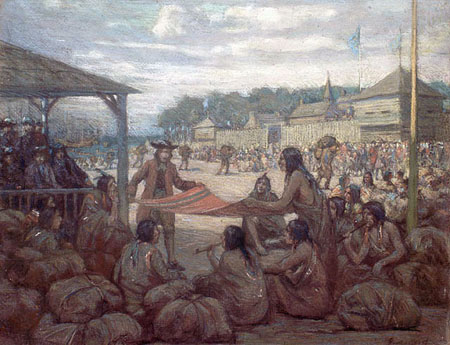
-
Article
Coureurs des bois
Coureurs des bois were itinerant, unlicenced fur traders from New France. They were known as “wood-runners” to the English on Hudson Bay and “bush-lopers” to the Anglo-Dutch of New York. Unlike voyageurs, who were licensed to transport goods to trading posts, coureurs des bois were considered outlaws of sorts because they did not have permits from colonial authorities. The independent coureurs des bois played an important role in the European exploration of the continent. They were also vital in establishing trading contacts with Indigenous peoples.
"https://d3d0lqu00lnqvz.cloudfront.net/media/media/2a01defb-42f2-4ad3-b7f1-cf7966378002.jpg" // resources/views/front/categories/view.blade.php
https://d3d0lqu00lnqvz.cloudfront.net/media/media/2a01defb-42f2-4ad3-b7f1-cf7966378002.jpg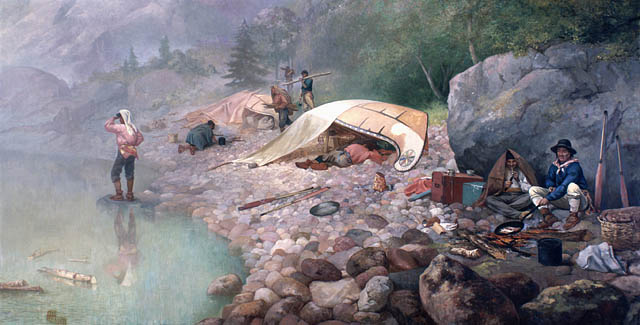
-
Article
Coureurs de côtes
The coureurs de côtes were itinerant traders in 18th-century French Canada.
"https://thecanadianencyclopedia.ca/images/tce_placeholder.jpg?v=e9dca980c9bdb3aa11e832e7ea94f5d9" // resources/views/front/categories/view.blade.php
https://thecanadianencyclopedia.ca/images/tce_placeholder.jpg?v=e9dca980c9bdb3aa11e832e7ea94f5d9
-
Article
Cowboys and Cowgirls in Canada
Cowboys and cowgirls are people employed to tend cattle or horses. The first cowboys to work on the Canadian prairies arrived in the 1870s. The traditional cowboy lifestyle has since given way to a more contained, corporate model of ranching. But the romanticized image of the cowboy on the “open range” lives on as a symbol of the prairies. Today, the terms cowboy and cowgirl can refer to ranch workers or rodeo competitors. Click here for definitions of key terms used in this article.
"https://d3d0lqu00lnqvz.cloudfront.net/media/new_article_images/CowboysandCowgirls/Branding_1959.jpg" // resources/views/front/categories/view.blade.php
https://d3d0lqu00lnqvz.cloudfront.net/media/new_article_images/CowboysandCowgirls/Branding_1959.jpg
-
Collection
Acadian Heritage
This collection explores the rich heritage of the Acadians through articles and exhibits, as well as quizzes on the arts, culture, history, politics, historical figures and places associated with the Acadian people.
"https://d3d0lqu00lnqvz.cloudfront.net/media/media/0988fc77-c4b5-410f-8147-ffcf8bb53fa6.jpg" // resources/views/front/categories/view.blade.php
https://d3d0lqu00lnqvz.cloudfront.net/media/media/0988fc77-c4b5-410f-8147-ffcf8bb53fa6.jpg
-
Article
Cuthbert Grant
Cuthbert Grant, fur trader, Métis leader (born circa 1793 in Fort de la Rivière Tremblante, SK; died 15 July 1854 in White Horse Plains, MB). Grant led the Métis to victory at Seven Oaks in 1816 and founded the Métis community Grantown (later St. François Xavier), Manitoba, in 1824. Today, Cuthbert Grant is hailed as a founder of the Métis nation. (See also Indigenous Peoples in Canada.)
"https://d3d0lqu00lnqvz.cloudfront.net/media/media/9707db63-926b-4e0f-acc4-a97b63a8c695.jpg" // resources/views/front/categories/view.blade.php
https://d3d0lqu00lnqvz.cloudfront.net/media/media/9707db63-926b-4e0f-acc4-a97b63a8c695.jpg