
Browse "Communities & Sociology"
-
Article
François-Xavier-Antoine Labelle
An ardent supporter of building the CPR in 1872, he was sent as an envoy to Europe by the Canadian government in 1885 and the Québec government in 1890. In 1888 Premier Honoré MERCIER appointed him deputy minister of agriculture and colonization.
"https://thecanadianencyclopedia.ca/images/tce_placeholder.jpg?v=e9dca980c9bdb3aa11e832e7ea94f5d9" // resources/views/front/categories/view.blade.php
https://thecanadianencyclopedia.ca/images/tce_placeholder.jpg?v=e9dca980c9bdb3aa11e832e7ea94f5d9
-
Article
François-Xavier Garneau
He excelled in primary school, but lack of money apparently barred his way to a classical education. His self-education and natural reserve explain the "proud independence" which impressed his contemporaries.
"https://d3d0lqu00lnqvz.cloudfront.net/media/media/a75df73a-e1e0-4b27-ba7a-76631cfc6a0e.jpg" // resources/views/front/categories/view.blade.php
https://d3d0lqu00lnqvz.cloudfront.net/media/media/a75df73a-e1e0-4b27-ba7a-76631cfc6a0e.jpg
-
Article
Françoise-Marie de Saint-Étienne de La Tour
Françoise-Marie de Saint-Étienne de La Tour, née Jacquelin, Acadian heroine (b in France 1602; d at Ft La Tour [NB] 1645). Civil war raged in Acadia in 1640 when she married Charles de Saint-Étienne de LA TOUR, one of 2 claimants to the colony's governorship.
"https://d3d0lqu00lnqvz.cloudfront.net/media/media/4fc6b68c-735c-4311-b452-cbbdfebe9ce7.jpg" // resources/views/front/categories/view.blade.php
https://d3d0lqu00lnqvz.cloudfront.net/media/media/4fc6b68c-735c-4311-b452-cbbdfebe9ce7.jpg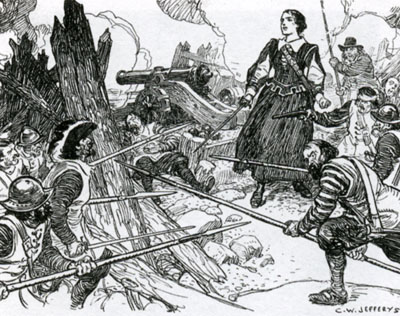
-
Article
Francophones of Alberta (Franco-Albertains)
In the Prairies, the names of rivers and trading posts bear the mark of explorers and voyagers who travelled the region during the 18th and 19th centuries. Agriculture and the petroleum industry attracted many migrants from Quebec, Acadia, Ontario and neighbouring provinces, but also from New-England, France and Belgium. In 2016, 418,000 Albertans (10.5 per cent of the population) were of French or French-Canadian origins (see: Francophone; Alberta; History of Settlement in the Canadian Prairies).
"https://d3d0lqu00lnqvz.cloudfront.net/media/new_article_images/francoalbertains/franco_albertan_flag_drapeau.jpg" // resources/views/front/categories/view.blade.php
https://d3d0lqu00lnqvz.cloudfront.net/media/new_article_images/francoalbertains/franco_albertan_flag_drapeau.jpg
-
Article
Francophones of British Columbia
The francophone presence in British Columbia has its origins in the colonization of the Pacific Northwest by Europeans at the turn of the 19th century.
"https://d3d0lqu00lnqvz.cloudfront.net/media/media/bfb65c27-6395-4d1f-b12b-84c6f760fb29.png" // resources/views/front/categories/view.blade.php
https://d3d0lqu00lnqvz.cloudfront.net/media/media/bfb65c27-6395-4d1f-b12b-84c6f760fb29.png
-
Article
Francophones of Saskatchewan (Fransaskois)
The Fransaskois are francophones living in Saskatchewan. According to the 2021 Canadian census, 1.5 per cent of the population (16,850 inhabitants) have French as their mother tongue and 1.1 per cent of the population (12,243 inhabitants) have French as their first official language. (See French language in Canada.)
"https://d3d0lqu00lnqvz.cloudfront.net/media/new_article_images/Fransaskois/Flag_Francophones_Saskatchewan_Fransaskois.png" // resources/views/front/categories/view.blade.php
https://d3d0lqu00lnqvz.cloudfront.net/media/new_article_images/Fransaskois/Flag_Francophones_Saskatchewan_Fransaskois.png
-
Article
Francophonie and Canada
The term francophonie has been in common use since the 1960s. It has several meanings. In its most general sense, it refers to all peoples and communities anywhere in the world that have French as their mother tongue or customary language. The term can also refer to the wider, more complex network of government agencies and non-government organizations that work to establish, maintain and strengthen the special ties among French-speaking people throughout the world. Lastly, the expression “La Francophonie” is increasingly used as shorthand for the Organisation internationale de la Francophonie (International Organisation of La Francophonie).
"https://d3d0lqu00lnqvz.cloudfront.net/media/media/5a849720-0aa9-4516-a19a-0b599bde2bc2.png" // resources/views/front/categories/view.blade.php
https://d3d0lqu00lnqvz.cloudfront.net/media/media/5a849720-0aa9-4516-a19a-0b599bde2bc2.png
-
Article
Frank Calder
Frank Arthur Calder, OC, Nisga’a politician, chief, businessman (born 3 August 1915, Nass Harbour, BC; died 4 November 2006 in Victoria, BC). Frank Calder was the first Indigenous member of the BC legislature, elected in 1949. Calder is best known for his role in the Nisga’a Tribal Council’s Supreme Court case against the province of British Columbia (commonly known as the Calder case), which demonstrated that Aboriginal title (i.e., ownership) to traditional lands exists in modern Canadian law.
"https://d3d0lqu00lnqvz.cloudfront.net/media/media/9722efec-c466-4256-b057-4d35a1e00a00.jpg" // resources/views/front/categories/view.blade.php
https://d3d0lqu00lnqvz.cloudfront.net/media/media/9722efec-c466-4256-b057-4d35a1e00a00.jpg
-
Article
Frank Henry Sherman
Frank Henry Sherman, trade unionist (b at Gloucester, Eng 10 May 1869; d at Fernie, BC 11 Oct 1909). A former chapel preacher and coal miner, he became an ardent socialist and candidate for the Alberta legislature or Parliament in 1905, 1906 and 1908.
"https://thecanadianencyclopedia.ca/images/tce_placeholder.jpg?v=e9dca980c9bdb3aa11e832e7ea94f5d9" // resources/views/front/categories/view.blade.php
https://thecanadianencyclopedia.ca/images/tce_placeholder.jpg?v=e9dca980c9bdb3aa11e832e7ea94f5d9
-
Article
Fraser Institute
The Fraser Institute is a nonprofit group established in 1974 under federal charter with offices in Vancouver (headquarters) and Toronto. The institute, which has been noted for its conservative views, operates as a research and educational organization that supports free enterprise.
"https://thecanadianencyclopedia.ca/images/tce_placeholder.jpg?v=e9dca980c9bdb3aa11e832e7ea94f5d9" // resources/views/front/categories/view.blade.php
https://thecanadianencyclopedia.ca/images/tce_placeholder.jpg?v=e9dca980c9bdb3aa11e832e7ea94f5d9
-
Article
Fred Bruemmer
Friedrich Karl von Bruemmer, CM, RCA, photographer, writer, researcher (born 26 June 1929 in Riga, Latvia; died 17 December 2013 in Montreal, QC). Latvian Canadian wildlife photographer Fred Bruemmer spent much of his professional career in the Arctic. He was famous for photographing the flora and fauna of the North and the lifestyle of the Inuit. Bruemmer was a prolific writer and researcher who wrote more than 1,000 articles and 27 books. His extensive work in the circumpolar world reached an international audience. He was described in a 1980 Maclean’s article as “one of the least-known world-famous men in Canada.” He was made a Member of the Order of Canada in 1983.
"https://d3d0lqu00lnqvz.cloudfront.net/Fred_Bruemmer.jpg" // resources/views/front/categories/view.blade.php
https://d3d0lqu00lnqvz.cloudfront.net/Fred_Bruemmer.jpg
-
Article
Fred Rose
Fred Rose, union organizer, politician (b Fred Rosenberg at Lublin, Poland 7 Dec 1907; d at Warsaw, Poland 16 Mar 1983). Rose moved with his parents to Montréal. In the 1930s, as a member of the Young Communist League, he organized unions of unemployed and unskilled workers.
"https://d3d0lqu00lnqvz.cloudfront.net/media/media/61299676-2265-417c-a7a2-eff255a2056a.jpg" // resources/views/front/categories/view.blade.php
https://d3d0lqu00lnqvz.cloudfront.net/media/media/61299676-2265-417c-a7a2-eff255a2056a.jpg
-
Article
Fred Sasakamoose
Frederick (Fred) George Sasakamoose, CM, hockey player, Elder, community leader (born 25 December 1933 at Whitefish Lake, now Big River First Nation, SK; died 24 November 2020 in Prince Albert, SK). Elder Fred Sasakamoose was one of the first Indigenous hockey players from Canada in the National Hockey League (NHL). A former student of St. Michael’s Indian Residential School in Duck Lake, Saskatchewan, he played 11 games for the Chicago Black Hawks in the 1953–54 NHL season. After his retirement from competitive hockey in 1961, he dedicated himself to encouraging youth through sports involvement. A Member of the Order of Canada, he was inducted into the Saskatchewan First Nations Sports Hall of Fame, the Saskatchewan Sports Hall of Fame, the Saskatchewan Hockey Hall of Fame, the Prince Albert Hall of Fame, the Canadian Native Hockey Hall of Fame and the North American Indigenous Athletics Hall of Fame.
"https://d3d0lqu00lnqvz.cloudfront.net/media/media/d0cdf660-e7b3-4841-b7fd-639dd2be70a0.jpg" // resources/views/front/categories/view.blade.php
https://d3d0lqu00lnqvz.cloudfront.net/media/media/d0cdf660-e7b3-4841-b7fd-639dd2be70a0.jpg
-
Article
Freda Ahenakew
Freda Ahenakew, OC, Cree scholar, author (born 11 February 1932 on Ahtahkakoop First Nation, SK; died 8 April 2011 at Muskeg Lake First Nation, SK). Ahenakew is recognized as a leader in the acknowledgment and revitalization of the Cree language in Canada. In her life, Ahenakew helped to preserve the oral traditions of the Cree people and share Cree traditions and stories with Indigenous and non-Indigenous peoples alike. (See also Indigenous Language Revitalization in Canada.)
"https://d3d0lqu00lnqvz.cloudfront.net/media/Twitter_Cards/Freda.jpg" // resources/views/front/categories/view.blade.php
https://d3d0lqu00lnqvz.cloudfront.net/media/Twitter_Cards/Freda.jpg
-
Article
Freda Diesing
Freda Diesing, Haida artist (born 2 June 1925 in Prince Rupert, BC; died there 3 December 2002). Diesing was best known for her contributions to reviving traditional Haida art forms, including wood carving, mask carving and totem carving. She was one of the few women carvers who mastered the medium, and was partly responsible for bringing the style to an international audience. Diesing worked to ensure the style and tradition of Haida art was passed on to new generations. (See also Northwest Coast Indigenous Art and Contemporary Indigenous Art in Canada.)
"https://d3d0lqu00lnqvz.cloudfront.net/FredaDiesing/FredaMask1.jpg" // resources/views/front/categories/view.blade.php
https://d3d0lqu00lnqvz.cloudfront.net/FredaDiesing/FredaMask1.jpg