Share on Facebook
 Share on X
 Share by Email
 Share on Google Classroom
Thomas "Tommy" Clement Douglas, CC, premier of Saskatchewan, first leader of the New Democratic Party, Baptist minister and politician (born 20 October 1904 in Falkirk, Scotland; died 24 February 1986 in Ottawa, Ontario). Tommy Douglas is known as the father of universal health care in Canada. He helped socialism enter mainstream Canadian politics and led the first socialist government in Canada. He also led the federal New Democratic Party (NDP) for 10 years.
This article is a plain-language summary of Tommy Douglas. If you are interested in reading about this topic more in depth, please see our full-length entry: Tommy Douglas.

Early Life and Education
Tommy Douglas was born in Scotland. He was one of three children of Annie (née Clement) and Thomas Douglas. His father was an iron moulder. His mother was the daughter of a Baptist preacher.
In 1911, the Douglas family moved to Canada. They settled in Winnipeg, Manitoba. However, before they left Scotland, six-year-old Tommy injured his knee. He got a rare but serious infection and spent a lot of time in the hospital. Doctors said his leg would have to be cut off. But a well-known surgeon offered to operate on Douglas for free. It inspired Douglas’s belief that everyone should have access to quality medical care.
Thomas Douglas enlisted in the First World War. The rest of the family lived with Annie’s parents in Scotland. Tommy attended high school in Glasgow. In 1918, he dropped out and found work at a cork factory.
In 1919, the Douglas family returned to Winnipeg. Tommy witnessed the Winnipeg General Strike. On 21 June 1919, Douglas watched as members of the North-West Mounted Police shot at protesters. This left a lasting impression on him.
During this period, Douglas also joined his mother’s Baptist church. He preached sermons there and felt he could make a difference as a pastor. In 1924, Douglas started going to Brandon College. By 1930, he had finished the full high school curriculum and qualified for the ministry. He also embraced the Social Gospel movement.
Personal Life and Family
In 1930, Tommy Douglas married Irma Dempsey. They had two daughters: actor Shirley Douglas and nurse Joan Douglas. Shirley Douglas was married to actor Donald Sutherland. Their son, actor Kiefer Sutherland, is Tommy Douglas’s grandson.
Ministry and Politics
Tommy Douglas became a minister in 1930. He and Irma Douglas moved to Weyburn, Saskatchewan. Douglas was dismayed by the suffering he saw there during the Great Depression. He tried to help by setting up classes in his church. He organized food and clothing drives. He worked with local union leaders to pressure the government over jobs and unemployment assistance. (See also Social Security.)
Further Education and Eugenics
In 1931, Tommy Douglas began a PhD in sociology at the University of Chicago. But he was more interested in direct action than ideas. Instead, he completed a master’s degree in sociology through McMaster University.
At this time, Douglas supported eugenic policies. (See Tommy Douglas and Eugenics.) But by the time he became premier of Saskatchewan in 1944, Douglas had abandoned eugenics.
CCF Member of Parliament
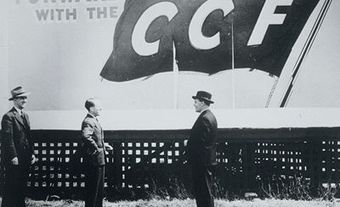
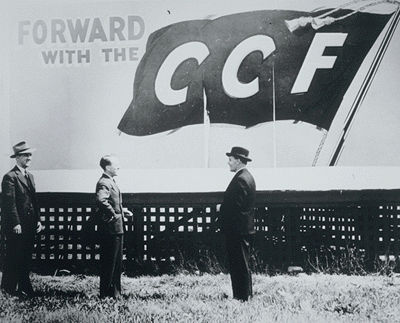
By the 1930s, Tommy Douglas was convinced that capitalism had failed Canadians. He saw socialism as the solution to poverty and inequity. In 1934, Douglas joined the Co-operative Commonwealth Federation (CCF). (See also Rise of the Co-operative Commonwealth Federation.)
Douglas ran in the 1934 Saskatchewan election but lost. He then ran for the CCF in the 1935 federal election and won. During his first two terms as an MP, Douglas became known as a skilful and witty debater. He also took unpopular stands in defence of civil liberties.
Premier of Saskatchewan
In 1944, Tommy Douglas resigned his federal seat. He then led the CCF to victory in the Saskatchewan election. The CCF won 47 of 53 seats. Douglas was premier of the province for the next 17 years. His government pioneered many socialist programs and passed the Saskatchewan Bill of Rights in 1947.
Health Insurance
Tommy Douglas introduced government-funded health insurance in Saskatchewan. In 1947, the Saskatchewan Hospital Services Plan became the first hospital insurance plan in Canada. By 1954, some 800,000 people in Saskatchewan were covered by the plan. This prompted the federal government to create a similar plan for the country.
Saskatchewan was also the first to have a system of full health insurance. In November 1961, the Saskatchewan Medical Care Insurance Act came into effect. Douglas played a lead role in the plan. In 1966, Ottawa followed suit with the Medical Care Act. ( See also Health Policy.)
Leader of the New Democratic Party
Tommy Douglas resigned as premier of Saskatchewan in 1961. He then became leader of the federal New Democratic Party (NDP). He was widely seen as the left’s most eloquent spokesman.
However, Douglas lost in the federal election of 1962. His defeat was largely due to the backlash against the introduction of Medicare. It had resulted in a long and bitter strike by the province’s doctors. (See Saskatchewan Doctors’ Strike.) However, Douglas won a seat in a by-election later that year in the BC riding of Burnaby– Coquitlam. He served as leader of the NDP until he resigned as leader in 1971. He retired from politics in 1979.
Honours and Awards
Tommy Douglas was made a Companion of the Order of Canada in 1981. He was voted the “Greatest Canadian” by a CBC TV poll in 2004.