Share on Facebook
 Share on X
 Share by Email
 Share on Google Classroom
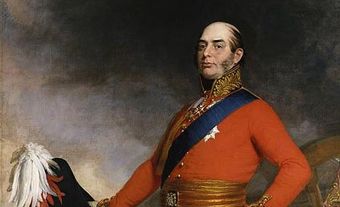
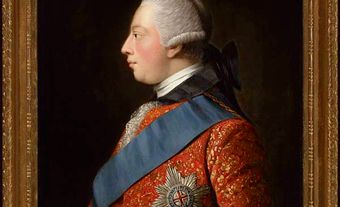
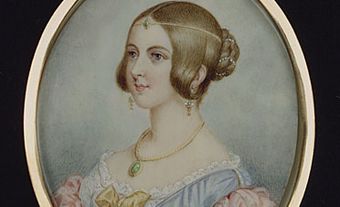
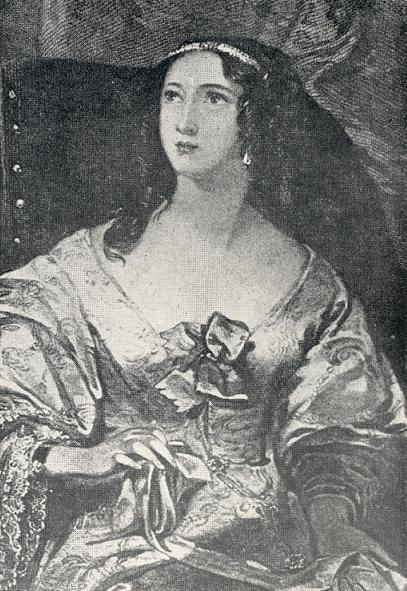
Alphonsine-Thérèse-Bernardine-Julie de Montgenêt, Baronne de Fortisson, Comtesse de Montgenêt (born 30 September 1760 in Besançon, France; died 8 August 1830 in Paris, France). Known as Julie Saint-Laurent, de Montgenêt was the long-term partner of King George III’s fourth son, Prince Edward, Duke of Kent and Strathearn (the father of Queen Victoria), and accompanied him to Quebec and Nova Scotia in the 1790s.
Early Life and Relationships
Julie Saint-Laurent was the daughter of Jean-Claude Montgenêt, a civil engineer, and Jeanne-Claude “Claudine” Pussot. In her 20s, she became the lover of Baron de Fortisson, later assuming the title of Baronne. By 1786, Julie Saint-Laurent was the mistress of Philippe Claude Auguste de Chouly, Marquis de Permangle. After the French Revolution, however, he was unable to support her financially.
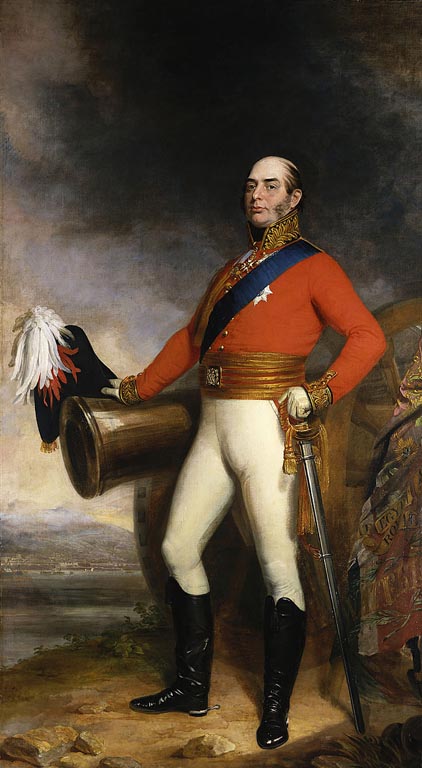
Prince Edward, Duke of Kent and Strathearn
In 1790, Julie Saint-Laurent met one of Prince Edward’s servants in Marseille, France. The servant had been commissioned to find “a young lady to be my companion and mistress of my house” during the prince’s military posting in Gibraltar. As Prince Edward wrote to his brother, the future King George IV, “There is one essential requisite toward rendering the life of a young soldier happy, in a solitary place like this, I mean, a partner for his leisure hours.”
Julie Saint-Laurent joined Prince Edward in Gibraltar in November 1790. Their relationship was a success, and he asked her to accompany him to his next posting in Quebec. Colonel Richard Symes, who disapproved of Prince Edward’s plan, offered Julie Saint-Laurent a bribe to leave the prince, but she refused.
Quebec
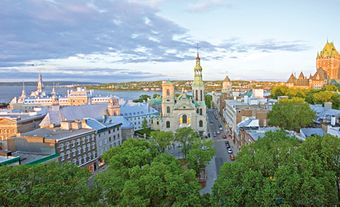
In the summer of 1791, Julie Saint-Laurent accompanied Prince Edward to Quebec, where he was colonel of the 7th Regiment of Foot (Royal Fusiliers). They arrived on 11 August and lived at the Duke of Kent House in Quebec City and Kent House at Montmorency Falls between 1791 and 1793.
Although Prince Edward and Julie Saint-Laurent never married, she acted as his hostess in Canada and accompanied him to social events. He later wrote to his brother Prince Frederick, Duke of York, that she “presides at my table, goes everywhere into company with me, and it is a rule with me never to accept of an invitation where there are ladies unless she is asked.” The couple enjoyed a lively social life in Quebec. Among their closest friends in Quebec were Ignace-Michel-Louis-Antoine and Françoise-Catherine d’Irumberry de Salaberry. In 1792, Prince Edward and Julie Saint-Laurent became the godparents of their youngest son, Édouard-Alphonse.
In January 1794, Prince Edward was stationed in Martinique in the Caribbean, while Julie Saint-Laurent sailed to England via New York and Halifax. The presence of his “laundress” in New York was the subject of satirical American press coverage.
Nova Scotia
On 10 May 1794, Prince Edward arrived in Halifax as commander of the British forces in Nova Scotia and New Brunswick. In August 1794, Julie Saint-Laurent joined him there, sailing from England aboard the Westmorland. Sir John Wentworth, lieutenant-governor of Nova Scotia, and his wife, Lady Frances Wentworth, offered Prince Edward and Julie Saint-Laurent a suite of rooms in Government House, as well as the use of a country house overlooking Bedford Basin, which became known as “Prince’s Lodge.”
Wentworth wrote to John King, the British undersecretary of state, saying that Julie Saint-Laurent was “an elegant, well bred, pleasing, sensible woman – far beyond most. During her residence here, her deportment has been judicious and most perfectly correct indeed. I find she has great influence over [Prince Edward] and that he is extremely attached to her. It is happy that she is so excellent a character.” Wentworth credited Julie Saint-Laurent with managing the prince’s finances, which had previously been in disarray. She had also reduced the household expenses by sewing all her own clothing. In Halifax, Prince Edward and Julie Saint-Laurent often attended the theatre and opera. Poetry praising the beauty of “Madame St. L------” was published in the Halifax Weekly Chronicle newspaper.
In October 1798, Prince Edward and Julie Saint-Laurent returned to England, where he was treated for a leg injury. The prince also purchased a house for her in London and set up a fund for her financial security. After their return to Halifax in September 1799, Prince Edward (as commander of the forces in British North America) and Julie Saint-Laurent received the first French royal visitors to what is now Canada: the future King Louis-Philippe I of France (1773-1850) and his two brothers, who were fleeing the French Revolutionary Wars. Louis-Philippe and Julie Saint-Laurent remained good friends until the end of her life.
Return to Britain
Prince Edward (now Duke of Kent and Strathearn) and Julie Saint-Laurent returned to the United Kingdom in 1800, living at Castle Hill Lodge in Ealing and his suite of rooms at Kensington Palace in London. They lived in Gibraltar in 1802–03 to, when Prince Edward served as governor. Their visitors in Britain included their godson Édouard-Alphonse de Salaberry and his three brothers.
In contrast to British North America, Prince Edward and Julie Saint-Laurent’s relationship was criticized in the United Kingdom. As Edward’s brother Frederick wrote to him, “You can have no idea how much the world talked of the public manner in which you went everywhere accompanied by [Saint-Laurent]. I am perfectly well aware that this may be done abroad, but you may depend on it that it cannot be done at home.”
Separation
Prince Edward and Julie Saint-Laurent moved to Brussels in 1816 to reduce their living expenses. They separated in March 1818. He returned to Britain to marry Princess Victoria of Saxe-Coburg-Saalfeld on 11 July 1818, and she moved to Paris with her sister, Jeanne-Beatrix de Jansac. Prince Edward provided Julie Saint-Laurent with an annuity, and King Louis XVIII of France granted her the title of Comtesse de Montgenêt. When Prince Edward died of pneumonia in 1820, nine months after the birth of his daughter, the future Queen Victoria, his widow sent Julie Saint-Laurent a personal message of condolence. Julie Saint-Laurent died in 1830 and is buried with her sister in Père-Lachaise Cemetery in Paris.
Legacy
Many Canadian families claim descent from Prince Edward and Julie Saint-Laurent, although there is no documentary evidence that they had children. In Halifax, Julie’s Pond in Hemlock Ravine Park and nearby street Saint Laurent Place are both named after her.