Share on Facebook
 Share on X
 Share by Email
 Share on Google Classroom
In 2026, for the first time, Canada co-hosted the FIFA World Cup in men’s soccer. It took place in North America, with the United States and Mexico also hosting games. This was 11 years after Canada welcomed the world for the 2015 FIFA Women’s World Cup. In all, there were 13 games played in Canada, seven in Vancouver and six in Toronto. Team Canada made it as far as the round of 16 and won their first two games in the history of the tournament. The 2026 FIFA World Cup came at a time when Canada’s federal government committed $9.8 million to the Canada Soccer National Training Centre.
FIFA 2026 World Cup ball display on Vancouver’s Science World
Aerial view of Science World featuring alternate panels that were installed to mimic the Adidas Trionda, the official match ball of the 2026 FIFA World Cup.
(photo by Elizabeth Ruiz Ruiz, courtesy Getty Images)
Bidding for the 2026 World Cup
There were two bids for the 2026 FIFA World Cup, one from North America and one from Morocco. The decision for the host site was made prior to the 2018 FIFA World Cup. The North American bid defeated Morocco by a vote of 134–65 at the 68th FIFA Congress.
The presidents of the United States Soccer Federation, Mexican Football Association and Canada Soccer travelled the world and met with all FIFA representatives who had a vote. The biggest obstacle the North American bid faced was global anti-American sentiment; the United States had bid for the 2022 World Cup but lost to Qatar.
This was only the second time that multiple countries co-hosted the World Cup. (Japan and South Korea were co-hosts in 2002.) After losing out on its bid for the 2026 World Cup, Morocco joined forces with Portugal and Spain and won the bid to co-host the 2030 World Cup.
Expanded Format
The 2026 FIFA World Cup was the largest ever. The number of teams taking part was expanded from 32 to 48, and the total number of games increased from 64 to 104. One reason for the expansion was centered around “global inclusion, giving more countries from every continent the opportunity to compete on football’s grandest stage,” according to Elizabeth Flores of USA Today. The other reason came down to economics. By expanding the schedule, there were more opportunities to generate revenue via ticket sales and advertising.
Hydration Breaks
For the first time, there was a hydration break at the midpoint of each half during the tournament, regardless of the temperature. The hydration breaks lasted three minutes and were put in place as part of FIFA’s commitment to player welfare. As a result, television networks were able to bring in significant advertising dollars. Fox reportedly made $250 million from six minutes of additional advertising per game.
Opening Ceremony in Toronto
There were three separate Opening Ceremonies, with a celebration in each host nation. The Canadian Opening Ceremony took place in Toronto on 12 June. The Canadian presenters included Michael Bublé, Alessia Cara, Jessie Reyez, Nora Fatehi, Will Arnett and William Prince. Alanis Morissette sang “O Canada.”
Controversy
Ghanaian midfielder Thomas Partey was not allowed into Canada after his visa application was refused by the Canadian government. Partey was denied entrance because he had claimed, when applying to enter Canada, that he had never been charged with a crime in any country. Partey had been charged with seven counts of rape and one count of sexual assault in England while playing for Arsenal and was set to go to trial in 2027. The Ghanaian government argued that the Canadian ruling was “extremely unfair” and that the charges were “unproven.” Ghana still defeated Panama 1–0 on 17 June in Toronto.
Team Canada’s Results
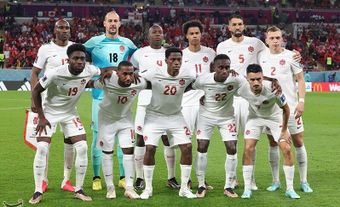
Canada’s first game of the 2026 FIFA World Cup came in Toronto on 12 June. Expectations were high for Canada (ranked No. 30 in the world) against Bosnia-Herzegovina (No. 65). However, Bosnia-Herzegovina had considerable momentum, since they had shockingly eliminated Italy in World Cup qualifying with a win on penalty kicks. In their game against Canada, Bosnia-Herzegovina took an early 1–0 lead in the 21st minute when Jovo Lukić became the first player to score a men’s World Cup goal in Canada. It took Canada 57 minutes to tie the game when Cyle Larin evened the score in the 78th minute. The final score of 1–1 earned Canada their first ever point at a men’s World Cup.
Team Canada then travelled to Vancouver for a game against Qatar on 18 June. In a dominant performance, Canada got its first-ever victory at the men’s World Cup by winning in a blowout, 6–0. It was the biggest margin of victory by a CONCACAF nation in men’s World Cup history. Canada had 33 total shot attempts compared with two by Qatar. Canada was the much more disciplined team; Qatar had two red cards. Jonathan David scored three goals to become only the second CONCACAF player ever to record a World Cup hat trick. The other two Canadian goal scorers were Larin and Nathan Saliba. Canada’s other goal came from a Qatar own goal.
Even though Canada won handily, they lost one of their key players. Midfielder Ismaël Koné broke his leg after being tackled by Qatar’s Assim Madibo, who received a red card.
With that win, Canada had a chance to finish in first place in Group B with a victory or draw against Switzerland in Vancouver on 24 June. However, Switzerland defeated Canada 2–1 on goals by Ruben Vargas and Johan Manzambi. Canada finished in second place in their Group and had to travel to Los Angeles for their next game.
Canada played South Africa on 28 June in the first scheduled knockout game of the World Cup. Canada came through with a 1–0 win on a goal by Stephen Eustáquio in the 92nd minute. On the pitch immediately after the game, head coach Jesse Marsch told Team Canada, “You guys are Canadian heroes … You should be so proud of who you are. You should be so proud of this game — you never lost belief.”
After winning their first ever knockout game in men’s World Cup history, Canada lost 3–0 to Morocco in the round of 16 in Houston. Canada outplayed Morocco in the first half but couldn’t convert multiple scoring chances against Montreal-born goalkeeper Yassine Bounou. Morocco’s talent and experience helped them score three goals in the second half to eliminate Canada from the tournament.
Alphonso Davies Injury
In addition to the injury to Koné, Canada dealt with a serious injury to Alphonso Davies. The Canadian captain and star defender injured his left hamstring in the UEFA Champions League semifinal while playing for Bayern Munich on May 6. As a result, he played only 15 minutes during the entire World Cup, in the match against South Africa.
Spain wins World Cup Final
On 19 July 2026 in East Rutherford, New Jersey, Spain defeated Argentina 1–0 to win the World Cup. Ferran Torres scored the only goal in the 106th minute. It was Spain’s second World Cup title after previously winning in 2010.
Canadian Representation
There were three Canadian officials during the 2026 FIFA World Cup. Drew Fischer of Calgary was named as one of the 52 referees, while Micheal Barwegen of Coaldale, Alberta and Lyes Arfa of Laval, Quebec were assistant referees.
At the World Cup Final, Canadian pop star Justin Bieber performed in the star-studded halftime show — the first ever at a World Cup. The show sparked intense global backlash for “Americanizing” the event. At the post-tournament award ceremonies, Prime Minister Mark Carney presented the Golden Glove Award (best goalkeeper of the World Cup) to Spain’s Unai Simon.
Team Canada Roster
|
Player |
Position |
Hometown |
|---|---|---|
|
Ali Ahmed |
Midfielder |
Toronto |
|
Moise Bombito |
Defender |
Montreal |
|
Tajon Buchanan |
Midfielder |
Brampton, ON |
|
Mathieu Choinière |
Midfielder |
Saint-Jean-sur-Richelieu, QC |
|
Derek Cornelius |
Defender |
Ajax, ON |
|
Maxime Crépeau |
Goalkeeper |
Greenfield Park, QC |
|
Forward |
Ottawa |
|
|
Promise David |
Forward |
Brampton, ON |
|
Alphonso Davies (captain) |
Defender |
Edmonton, AB |
|
*Marcelo Flores |
Midfielder |
Georgetown, ON |
|
**Luc de Fougerolles |
Defender |
London, England |
|
Stephen Eustáquio (vice-captain) |
Midfielder |
Leamington, ON |
|
Owen Goodman |
Goalkeeper |
Alliston, ON |
|
Alistair Johnston |
Defender |
Vancouver |
|
***Alfie Jones |
Defender |
Bristol, England |
|
Ismaël Koné |
Midfielder |
Montreal |
|
Forward |
Brampton, ON |
|
|
Richie Laryea |
Defender |
Toronto |
|
Liam Millar |
Midfielder |
Toronto |
|
Jayden Nelson |
Midfielder |
Brampton, ON |
|
Tani Oluwaseyi |
Forward |
Mississauga, ON |
|
Jonathan Osorio |
Midfielder |
Toronto |
|
Nathan Saliba |
Midfielder |
Longueuil, QC |
|
Jacob Shaffelburg |
Midfielder |
Kentville, NS |
|
Niko Sigur |
Defender |
Burnaby, BC |
|
Dayne St. Clair |
Goalkeeper |
Pickering, ON |
|
Joel Waterman |
Defender |
Surrey, BC |
*Marcelo Flores was named to the team before injuring his ACL in May. He did not play in the World Cup.
**Luc de Fougerolles holds Canadian citizenship through his father, who is from Montreal.
***Alfie Jones holds Canadian citizenship through his late grandmother, who was from Alberta.
World Cup Games in Canada
|
Teams |
Place |
Date |
Score |
|---|---|---|---|
|
Canada vs. Bosnia-Herzegovina |
Toronto |
June 12 |
1–1 |
|
Australia vs. Turkiye |
Vancouver |
June 13 |
2–0 Australia |
|
Ghana vs. Panama |
Toronto |
June 17 |
1–0 Ghana |
|
Canada vs. Qatar |
Vancouver |
June 18 |
6–0 Canada |
|
Germany vs. Côte d’Ivoire |
Toronto |
June 20 |
2–1 Germany |
|
New Zealand vs. Egypt |
Vancouver |
June 21 |
3–1 Egypt |
|
Croatia vs. Panama |
Toronto |
June 23 |
1–0 Croatia |
|
Canada vs. Switzerland |
Vancouver |
June 24 |
2–1 Switzerland |
|
Senegal vs. Iraq |
Toronto |
June 26 |
5–0 Senegal |
|
Belgium vs. New Zealand |
Vancouver |
June 26 |
5–1 Belgium |
|
Portugal vs. Croatia |
Toronto |
July 2 (Round of 32) |
2–1 Portugal |
|
Switzerland vs. Algeria |
Vancouver |
July 2 (Round of 32) |
2–0 Switzerland |
|
Switzerland vs. Colombia |
Vancouver |
July 7 (Round of 16) |
4–3 Switzerland on penalty kicks |