
Browse "Things"
-
Macleans
Newspaper War Hurts Globe
PHILLIP CRAWLEY came to Canada in 1998 with a simple mission: kill the upstart National Post.This article was originally published in Maclean's Magazine on November 1, 2004
"https://thecanadianencyclopedia.ca/images/tce_placeholder.jpg?v=e9dca980c9bdb3aa11e832e7ea94f5d9" // resources/views/front/categories/view.blade.php
https://thecanadianencyclopedia.ca/images/tce_placeholder.jpg?v=e9dca980c9bdb3aa11e832e7ea94f5d9
-
Article
Newspapers in Canada: 1800s–1900s
Independent newspapers were first established in Canada between about 1800 and 1850. During that period, printing presses became less expensive to establish and operate, and literacy rates and an appetite for news and views developed. Since publishers were less dependent on government subsidy than before, they were free to question and criticize the powers that be. As a result, an independent but not impartial journalism developed. From the mid-1800s to the early 1900s, newspapers became more profitable as populations and commerce expanded and reader and advertising revenues grew. During this time, mainstream newspapers represented the interests of political parties and cultural groups. This entry is part of a series on the history of the newspaper industry in Canada. See also First Newspapers in Canada.
"https://d3d0lqu00lnqvz.cloudfront.net/media/media/8997ef4b-babd-48d9-ba3c-a4e1e4b23780.jpg" // resources/views/front/categories/view.blade.php
https://d3d0lqu00lnqvz.cloudfront.net/media/media/8997ef4b-babd-48d9-ba3c-a4e1e4b23780.jpg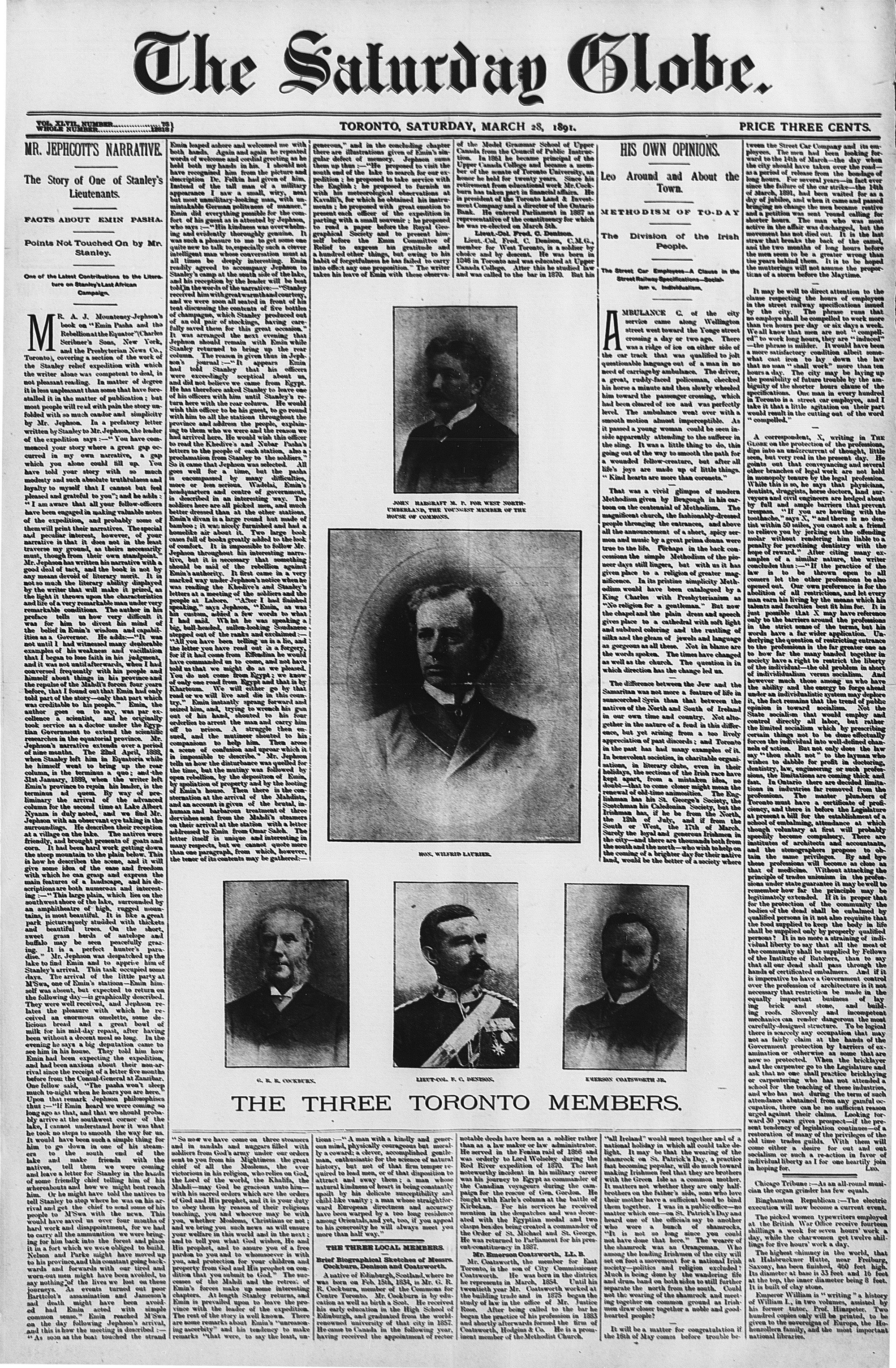
-
Article
Niagara Historic Frontier
The Niagara Historic Frontier, stretching 50 km along both sides of the Niagara River from Lake Ontario to Lake Erie, is dotted with historic sites and cairns.
"https://d3d0lqu00lnqvz.cloudfront.net/media/media/659c26df-741b-477d-8d28-b5a7c4212206.jpg" // resources/views/front/categories/view.blade.php
https://d3d0lqu00lnqvz.cloudfront.net/media/media/659c26df-741b-477d-8d28-b5a7c4212206.jpg
-
Article
Niagara Purchase
The Niagara Purchase of 1781, also known as Treaty 381, was one of the first land agreements between Indigenous peoples and British authorities in Upper Canada (later Ontario). It resulted in a six-and-a-half kilometre-wide strip along the west bank of the Niagara River, which connects Lake Erie and Lake Ontario, being made available for settlement by Loyalists who were displaced by the American Revolution. The Niagara Purchase was one of many agreements made in the 1700s and 1800s, which are collectively known as the Upper Canada Land Surrenders.
"https://d3d0lqu00lnqvz.cloudfront.net/NiagaraLate1700s.jpg" // resources/views/front/categories/view.blade.php
https://d3d0lqu00lnqvz.cloudfront.net/NiagaraLate1700s.jpg
-
Article
Nickel
The major contemporary use for nickel is as an alloying agent. Nickel is present in some 3000 different alloys that are used in more than 250 000 end-use applications. The most popular alloy in which nickel is used is stainless steel (seeIRON AND STEEL INDUSTRY).
"https://d3d0lqu00lnqvz.cloudfront.net/media/media/cfafc49e-d0f9-4512-ab8e-9ccdab8fbada.jpg" // resources/views/front/categories/view.blade.php
https://d3d0lqu00lnqvz.cloudfront.net/media/media/cfafc49e-d0f9-4512-ab8e-9ccdab8fbada.jpg
-
Article
Nickle Resolution
The Nickle Resolution, passed in 1919 by the House of Commons, directed that the practice of bestowing titles of honour by foreign governments on Canadians be discontinued. The policy was reaffirmed in 1968 by the government of Prime Minister Lester B.
"https://thecanadianencyclopedia.ca/images/tce_placeholder.jpg?v=e9dca980c9bdb3aa11e832e7ea94f5d9" // resources/views/front/categories/view.blade.php
https://thecanadianencyclopedia.ca/images/tce_placeholder.jpg?v=e9dca980c9bdb3aa11e832e7ea94f5d9
-
"https://d3d0lqu00lnqvz.cloudfront.net/birdclassification/common-nighthawk.jpg" // resources/views/front/categories/view.blade.php
https://d3d0lqu00lnqvz.cloudfront.net/birdclassification/common-nighthawk.jpg
-
Article
Nightshade
Eight species of Solanum occur in Canada, of which only S. carolinense (horse or ball nettle), found in southern Ontario, is native. The most familiar nightshade found across Canada is S. dulcamara (climbing nightshade or European bittersweet).
"https://thecanadianencyclopedia.ca/images/tce_placeholder.jpg?v=e9dca980c9bdb3aa11e832e7ea94f5d9" // resources/views/front/categories/view.blade.php
https://thecanadianencyclopedia.ca/images/tce_placeholder.jpg?v=e9dca980c9bdb3aa11e832e7ea94f5d9
-
Article
Nile Expedition
In March 1884, imperial entanglements resulted in British General Gordon becoming trapped in Khartoum, Sudan. When British General Wolseley was ordered to rescue Gordon, he requested approximately 300 Canadian boatmen for the expedition. Known as the “Nile Voyageurs,” these men handled wooden whaling boats that transported troops up the Nile River to Khartoum. The Nile Expedition (14 September 1884 to 17 April 1885) was the first time Canadians were involved in an international military mission.
"https://d3d0lqu00lnqvz.cloudfront.net/NileExpedition/NileExpedition-Collage.jpg" // resources/views/front/categories/view.blade.php
https://d3d0lqu00lnqvz.cloudfront.net/NileExpedition/NileExpedition-Collage.jpg
-
Article
Nine Hour Movement
The Nine Hour Movement was an international phenomenon, taking place in Canada between January and June 1872. The movement’s goal was to standardize shorter working days. Though this particular mandate was unsuccessful, the movement did have an impact, including setting the foundation for the Canadian Labor Union.
"https://d3d0lqu00lnqvz.cloudfront.net/media/media/74917b1f-8a36-49c3-99fd-4cf328a0bfa3.jpg" // resources/views/front/categories/view.blade.php
https://d3d0lqu00lnqvz.cloudfront.net/media/media/74917b1f-8a36-49c3-99fd-4cf328a0bfa3.jpg
-
Article
Niobe Day
Since 2014, Niobe Day has been celebrated every year on 21 October by the Royal Canadian Navy. It commemorates the entrance of HMCS Niobe, one of Canada’s first two warships, into Halifax Harbour on 21 October 1910. Niobe, which had been purchased from Britain, was the first Canadian warship to enter Canadian territorial waters. Before 2014, the Canadian navy marked Trafalgar Day every 21 October in commemoration of the British victory at the Battle of Trafalgar (1805).
"https://d3d0lqu00lnqvz.cloudfront.net/HMCSNiobe/HMCS Niobe entering Halifax on Trafalgar Day 1910.jpg" // resources/views/front/categories/view.blade.php
https://d3d0lqu00lnqvz.cloudfront.net/HMCSNiobe/HMCS Niobe entering Halifax on Trafalgar Day 1910.jpg
-
Article
No. 8 Company – Canadian Forestry Corps
No. 8 Company, Canadian Forestry Corps (CFC) was the second Black unit formed in the First World War, after No. 2 Construction Battalion. From November 1918 to March 1919, No. 8 Company improved and repaired airfields and roads in northern Belgium and Germany, providing valuable support to the Royal Air Force (RAF).
"https://d3d0lqu00lnqvz.cloudfront.net/No8CompanyCFC/No8-Co-CFC_WarDiary_Dec1918.jpg" // resources/views/front/categories/view.blade.php
https://d3d0lqu00lnqvz.cloudfront.net/No8CompanyCFC/No8-Co-CFC_WarDiary_Dec1918.jpg
-
Macleans
Nobel Peace Prize 1997
Jody Williams celebrated her 47th birthday last Thursday at her private retreat in Vermonts Green Mountains, a "beautiful, modern home with lots of glass," as she describes it. There is a beaver pond out back and wild turkeys in the surrounding woods.This article was originally published in Maclean's Magazine on October 20, 1997
"https://thecanadianencyclopedia.ca/images/tce_placeholder.jpg?v=e9dca980c9bdb3aa11e832e7ea94f5d9" // resources/views/front/categories/view.blade.php
https://thecanadianencyclopedia.ca/images/tce_placeholder.jpg?v=e9dca980c9bdb3aa11e832e7ea94f5d9
-
Article
Nobel Prizes and Canada
The Nobel Prizes are awarded annually for achievements that have significantly benefitted humankind. The prizes are among the highest international honours and are awarded in six categories: physics, chemistry, physiology or medicine, literature, peace, and economic sciences. They are administered by the Nobel Foundation and awarded by institutions in Sweden and Norway. Eighteen Canadians have won Nobel Prizes, excluding Canadian-born individuals who gave up their citizenship and members of organizations that have won the peace prize. (See also Canadian Nobel Laureates.)
"https://d3d0lqu00lnqvz.cloudfront.net/TCEImages/dreamstime_xl_127967744.jpg" // resources/views/front/categories/view.blade.php
https://d3d0lqu00lnqvz.cloudfront.net/TCEImages/dreamstime_xl_127967744.jpg
-
Macleans
Nobel Prizes
This article was originally published in Maclean’s magazine on October 26, 1998. Partner content is not updated. Relations between the two men are cool, bordering on icy, as could be expected between leaders who represent opposite sides in the religious and political struggle that has bathed Northern Ireland in blood for three decades.
"https://thecanadianencyclopedia.ca/images/tce_placeholder.jpg?v=e9dca980c9bdb3aa11e832e7ea94f5d9" // resources/views/front/categories/view.blade.php
https://thecanadianencyclopedia.ca/images/tce_placeholder.jpg?v=e9dca980c9bdb3aa11e832e7ea94f5d9