
Browse "Things"
-
Article
Hiawatha Play
In 1900, the first performance of the Hiawatha Play was undertaken at Kensington Point in Desbarats, Ontario by members of Garden River First Nation. The play was developed by the Canadian Pacific Railway’s colonization agent Louis Olivier Armstrong and Anishinaabe leader George Kaboosa. The Hiawatha Play was performed seasonally in Desbarats from 1900 to 1905. It was relocated to Wayagamug, Michigan, where it was performed from 1905 to 1917 by Anishinaabe, Haudenosaunee and Odawa actors. It also toured, taking the performers to various locales in Canada, the United States, Great Britain and the Netherlands. Performances of the original play by Garden River actors occurred periodically in Sault Ste Marie and at Garden River until at least 1966. Contemporary interpretations of the Hiawatha Play were performed in 2006, 2007 and 2008 at Garden River.
"https://d3d0lqu00lnqvz.cloudfront.net/LOArmstrong/c002685.jpg" // resources/views/front/categories/view.blade.php
https://d3d0lqu00lnqvz.cloudfront.net/LOArmstrong/c002685.jpg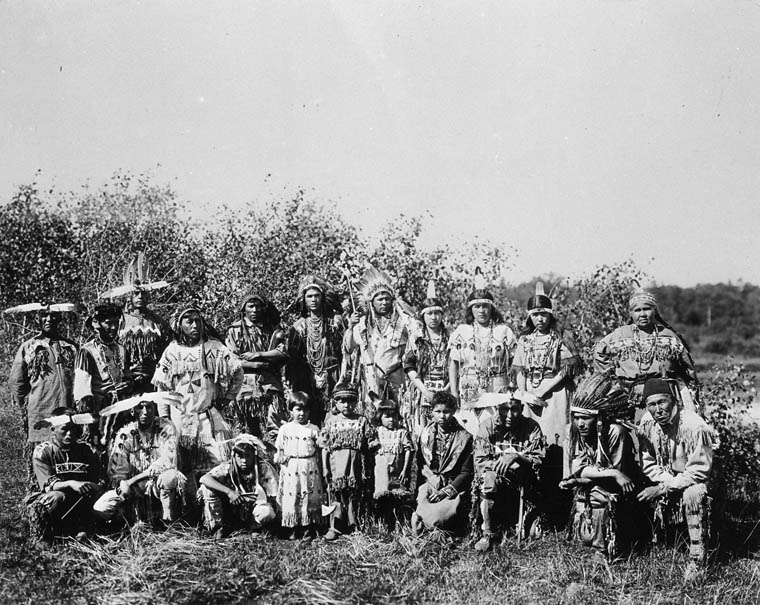
-
Article
Hibernia Case
On 19 May 1982 the governor-in-council asked the Supreme Court of Canada whether Canada (the federal government) or Newfoundland has the right to explore and exploit the mineral and other natural resources of the seabed and
"https://d3d0lqu00lnqvz.cloudfront.net/media/media/907d5cb9-10e4-4167-afe3-4f97dc6b39b2.jpg" // resources/views/front/categories/view.blade.php
https://d3d0lqu00lnqvz.cloudfront.net/media/media/907d5cb9-10e4-4167-afe3-4f97dc6b39b2.jpg
-
Macleans
Hibernia Rig Prepares to Drill
John Cabot could never have imagined anything like this. When the Anglo-Italian explorer arrived at the Grand Banks in 1497, the schools of codfish were so thick, they literally stopped his ships in the water.This article was originally published in Maclean's Magazine on March 3, 1997
"https://thecanadianencyclopedia.ca/images/tce_placeholder.jpg?v=e9dca980c9bdb3aa11e832e7ea94f5d9" // resources/views/front/categories/view.blade.php
https://thecanadianencyclopedia.ca/images/tce_placeholder.jpg?v=e9dca980c9bdb3aa11e832e7ea94f5d9
-
Article
High Arctic Weather Stations
High Arctic Weather Stations, managed by the Monitoring and Science Division, Prairie and Northern Region of Environment Canada, began as the Joint Arctic Weather Stations. The plan for a network of Arctic weather bases was approved by the US on 12 February 1946, and on 28 January 1947 Cabinet formally agreed to participate. Between 1947 and 1950, five sites were selected and built jointly by Canada and the US (at Eureka, Isachsen, Mould Bay, Resolute and Alert) to provide the data required for the understanding and prediction of meteorological phenomena on a hemispheric scale and, more specifically, to improve weather predictions for North America. The meteorological data collected is also used by forecasting offices, airlines, northern shipping, climatology studies and research.
"https://d3d0lqu00lnqvz.cloudfront.net/media/media/7d9ae9bd-0e9d-4d89-b8aa-b9c3b6f79d0c.jpg" // resources/views/front/categories/view.blade.php
https://d3d0lqu00lnqvz.cloudfront.net/media/media/7d9ae9bd-0e9d-4d89-b8aa-b9c3b6f79d0c.jpg
-
Macleans
High Cost of Healing
Despite how it may seem some days as the public tunes into the debate over health-care funding, governments in Canada have not turned off the tap. Canadians spent an estimated $76.6 billion on health care in 1997, up from $75.This article was originally published in Maclean's Magazine on June 15, 1998
"https://thecanadianencyclopedia.ca/images/tce_placeholder.jpg?v=e9dca980c9bdb3aa11e832e7ea94f5d9" // resources/views/front/categories/view.blade.php
https://thecanadianencyclopedia.ca/images/tce_placeholder.jpg?v=e9dca980c9bdb3aa11e832e7ea94f5d9
-
Article
High School (Secondary School)
The term "high school" applies to the academic institution that follows elementary school. The term "secondary school" is often used as an alternative term. High schools prepare students for post-secondary education and training or employment after graduation.
"https://thecanadianencyclopedia.ca/images/tce_placeholder.jpg?v=e9dca980c9bdb3aa11e832e7ea94f5d9" // resources/views/front/categories/view.blade.php
https://thecanadianencyclopedia.ca/images/tce_placeholder.jpg?v=e9dca980c9bdb3aa11e832e7ea94f5d9
-
Macleans
High-Tech Artificial Limbs
This article was originally published in Maclean’s magazine on March 13, 1995. Partner content is not updated. Adele Fifield was just 13 years old when a doctor told her that she had cancer in her knee - and that surgeons would have to amputate her left leg. "My initial reaction was disbelief," recalls Fifield. "For days, my ears seemed to ring from the shock.
"https://thecanadianencyclopedia.ca/images/tce_placeholder.jpg?v=e9dca980c9bdb3aa11e832e7ea94f5d9" // resources/views/front/categories/view.blade.php
https://thecanadianencyclopedia.ca/images/tce_placeholder.jpg?v=e9dca980c9bdb3aa11e832e7ea94f5d9
-
Article
High Technology
Technology, along with labour, capital, resources and management, is one of the essential components of industrial production. Most classes of industry require some technological input, but the amount varies widely among industrial sectors.
"https://thecanadianencyclopedia.ca/images/tce_placeholder.jpg?v=e9dca980c9bdb3aa11e832e7ea94f5d9" // resources/views/front/categories/view.blade.php
https://thecanadianencyclopedia.ca/images/tce_placeholder.jpg?v=e9dca980c9bdb3aa11e832e7ea94f5d9
-
Article
High Wines
Liquor adulterated for use in the fur trade. Fur traders who supplied liquor to the natives often diluted their brandy, rum, whisky, etc, with flavoured water. The term "high wines" is a misnomer, for the trade goods are not wines but spirits.
"https://thecanadianencyclopedia.ca/images/tce_placeholder.jpg?v=e9dca980c9bdb3aa11e832e7ea94f5d9" // resources/views/front/categories/view.blade.php
https://thecanadianencyclopedia.ca/images/tce_placeholder.jpg?v=e9dca980c9bdb3aa11e832e7ea94f5d9
-
Article
Higher Education
Higher education usually refers to education and training in universities, colleges and institutes of technology or art. It also refers to an academic field of studies, which has been advanced in Canada since 1969 with the establishment of a graduate unit at the UNIVERSITY OF TORONTO.
"https://thecanadianencyclopedia.ca/images/tce_placeholder.jpg?v=e9dca980c9bdb3aa11e832e7ea94f5d9" // resources/views/front/categories/view.blade.php
https://thecanadianencyclopedia.ca/images/tce_placeholder.jpg?v=e9dca980c9bdb3aa11e832e7ea94f5d9
-
Article
Highland Games
Highland Games originated among the Scots' Celtic ancestors and became a customary part of their life.
"https://d3d0lqu00lnqvz.cloudfront.net/media/media/6af05898-d0b3-4e4e-a2e2-6359756db881.jpg" // resources/views/front/categories/view.blade.php
https://d3d0lqu00lnqvz.cloudfront.net/media/media/6af05898-d0b3-4e4e-a2e2-6359756db881.jpg
-
Article
Highland Pipe Bands in Canada
As a musical unit, a pipe band usually consists of a bagpipe corps and a drum corps, the latter comprising side drums, a bass drum, and tenors (the last optional). The earliest organized pipe bands in Canada were probably those of Highland regiments made up of Scottish Canadians. Pipe Bands are most common among Armed Forces regiments and municipal police services. (See also Armed Forces Bands in Canada; Police Bands in Canada.)
"https://d3d0lqu00lnqvz.cloudfront.net/Edmonton-Police-08412.jpg" // resources/views/front/categories/view.blade.php
https://d3d0lqu00lnqvz.cloudfront.net/Edmonton-Police-08412.jpg
-
Article
Motor Vehicle Disasters in Canada
Numerous tragedies have unfolded on Canadian roads and highways, the deadliest being a bus crash that killed 44 people in Quebec in 1997. Despite the death toll in such headline-grabbing disasters, Canada’s motor vehicle fatality and injury rates are steadily declining, thanks to engineering improvements in vehicles, and the increasing promotion and awareness of safe driving practices.
"https://d3d0lqu00lnqvz.cloudfront.net/media/Twitter_Cards/humboldt-1.png" // resources/views/front/categories/view.blade.php
https://d3d0lqu00lnqvz.cloudfront.net/media/Twitter_Cards/humboldt-1.png
-
Article
Highway of Tears
The Highway of Tears refers to a 724 km length of Yellowhead Highway 16 in British Columbia where many women (mostly Indigenous) have disappeared or been found murdered. The Highway of Tears is part of a larger, national crisis of missing and murdered Indigenous women and girls. In 2015, the federal government launched a national inquiry into these cases. This article contains sensitive material that may not be suitable for all audiences.
"https://d3d0lqu00lnqvz.cloudfront.net/media/media/1f33c6d4-24d9-4dfa-9de4-11d8765e2ad3.jpg" // resources/views/front/categories/view.blade.php
https://d3d0lqu00lnqvz.cloudfront.net/media/media/1f33c6d4-24d9-4dfa-9de4-11d8765e2ad3.jpg
-
Article
Hiking
The most common form of hiking is that which takes place in our community or city parks and open spaces for a morning walk or a weekend family stroll. In this case it is more closely associated with walking (for pleasure), which remains the most popular activity participated in by Canadians.
"https://d3d0lqu00lnqvz.cloudfront.net/media/media/43ebcd4b-1783-4eab-a01a-7e6c0622b961.jpg" // resources/views/front/categories/view.blade.php
https://d3d0lqu00lnqvz.cloudfront.net/media/media/43ebcd4b-1783-4eab-a01a-7e6c0622b961.jpg