
Browse "Things"
-
Article
Fur Farming
Starting in the late 1880s a new industry developed in Canada, as animals of various species began to be bred in captivity for their fur. Foxes were first farmed on Prince Edward Island. In 1913, the Island counted 277 fox farms and by 1923, there were 448.
"https://thecanadianencyclopedia.ca/images/tce_placeholder.jpg?v=e9dca980c9bdb3aa11e832e7ea94f5d9" // resources/views/front/categories/view.blade.php
https://thecanadianencyclopedia.ca/images/tce_placeholder.jpg?v=e9dca980c9bdb3aa11e832e7ea94f5d9
-
Article
Fur Industry
The Canadian fur industry consists of companies that buy raw furs from trappers, dealers or fur-marketing companies (e.g., Hudson's Bay Company raw-fur auctions), send them to fur dressers and dyers in Toronto, match the skins and cut and sew them into garments. Most manufacturers make coats and most specialize in two or three types of fur only. Before the coat can be finished, it must go through a fur-cleaning process and some companies do only this. Some cleaners also maintain cold fur-storage vaults to house furs during the summer, but many retail furriers also have their own vaults. Fur factories are generally small, with 279 of the 280 factories employing fewer than 50 people; only one of the 280 operating factories employed more than 100 people in 1986. In that year there were 3,700 furriers in the manufacturing work force, with about 2950 in Quebec, 675 in Ontario and 75 in Manitoba. Almost all fur companies are Canadian owned; there is some foreign ownership, mainly American, in the retail sector and some Japanese investment in the manufacturing sector.
"https://d3d0lqu00lnqvz.cloudfront.net/media/media/a4d6e476-5e53-4126-9ee6-313b64235660.jpg" // resources/views/front/categories/view.blade.php
https://d3d0lqu00lnqvz.cloudfront.net/media/media/a4d6e476-5e53-4126-9ee6-313b64235660.jpg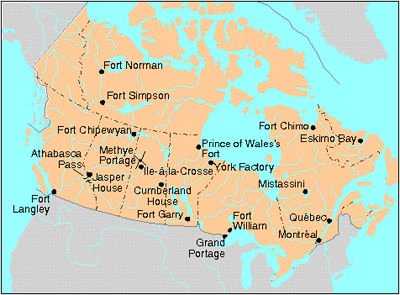
-
Article
Fur Trade in Canada
The fur trade was a vast commercial enterprise across the wild, forested expanse of what is now Canada. It was at its peak for nearly 250 years, from the early 17th to the mid-19th centuries. It was sustained primarily by the trapping of beavers to satisfy the European demand for felt hats. The intensely competitive trade opened the continent to exploration and settlement. It financed missionary work, established social, economic and colonial relationships between Europeans and Indigenous people, and played a formative role in the creation and development of Canada.This article is a full-length entry about the fur trade. For a plain-language summary, please see Fur Trade in Canada (Plain-Language Summary).
"https://d3d0lqu00lnqvz.cloudfront.net/media/media/e4ec1e55-01c2-4b77-a220-f05a84fd4c9c.jpg" // resources/views/front/categories/view.blade.php
https://d3d0lqu00lnqvz.cloudfront.net/media/media/e4ec1e55-01c2-4b77-a220-f05a84fd4c9c.jpg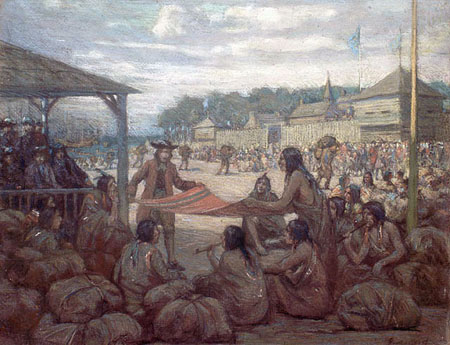
-
Collection
Fur Trade in Canada
The fur trade was a vast commercial enterprise across the wild, forested expanse of what is now Canada. It was at its peak for nearly 250 years, from the early 17th to the mid-19th centuries. It was sustained primarily by the trapping of beavers to satisfy the European demand for felt hats. The intensely competitive trade opened the continent to exploration and settlement. It financed missionary work, established social, economic and colonial relationships between Europeans...
"https://d3d0lqu00lnqvz.cloudfront.net/media/media/e4ec1e55-01c2-4b77-a220-f05a84fd4c9c.jpg" // resources/views/front/categories/view.blade.php
https://d3d0lqu00lnqvz.cloudfront.net/media/media/e4ec1e55-01c2-4b77-a220-f05a84fd4c9c.jpg
-
Article
Fur Trade in Canada (Plain-Language Summary)
The fur trade began in the 1600s in what is now Canada. It continued for more than 250 years. Europeans traded with Indigenous people for beaver pelts. The demand for felt hats in Europe drove this business. The fur trade was one of the main reasons that Europeans explored and colonized Canada. It built relationships between Europeans and Indigenous peoples. This article is a plain-language summary of the fur trade. If you are interested in reading about this topic more in depth, please see our full-length entry, Fur Trade in Canada.
"https://d3d0lqu00lnqvz.cloudfront.net/media/article_files/fur-trade/c002771k.jpg" // resources/views/front/categories/view.blade.php
https://d3d0lqu00lnqvz.cloudfront.net/media/article_files/fur-trade/c002771k.jpg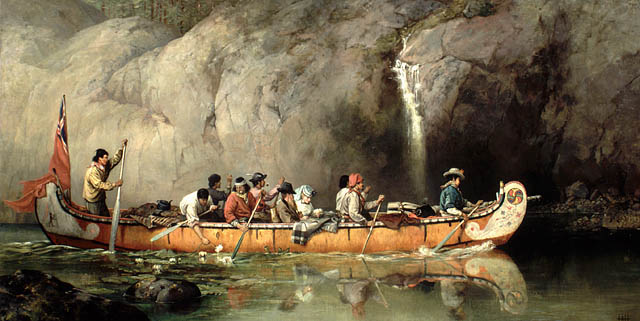
-
Article
Fur Trade Route Networks
Throughout the period of the historical fur trade (early 17th to the mid-19th century), water routes were the natural “highways” of First Nations trappers and European fur traders. Water trading networks connected Indigenous societies from the Atlantic Ocean, along the St. Lawrence River to the Great Lakes, and then on towards the Hudson Bay watershed. North America’s waterborne geography facilitated intracontinental travel, enabled European expansion and settlement into Indigenous North America, and shaped the contours of Euro-Indigenous relations in the context of the fur trade. These extensive and interconnected systems of rivers, lakes and overland trails criss-crossed Indigenous territories and had been used for generations. At the height of the fur trade, the principal canoe route extended westward from the Island of Montreal through the Great Lakes, and from the northwestern shore of Lake Superior over the height of land into the Hudson Bay watershed. From the Lake Winnipeg basin, Indigenous trappers and European traders fanned out towards the Western Prairies via the Assiniboine, Qu’Appelle and Souris rivers, towards the foothills of the Rocky Mountains via the North and South branches of the Saskatchewan River, and finally towards the Athabasca Country via the Sturgeon-weir River and the Methye Portage.
"https://d3d0lqu00lnqvz.cloudfront.net/media/media/6a52818a-3f78-427a-a201-5e6bc9c5d874.jpg" // resources/views/front/categories/view.blade.php
https://d3d0lqu00lnqvz.cloudfront.net/media/media/6a52818a-3f78-427a-a201-5e6bc9c5d874.jpg
-
Article
Fur Trapping
The trapping of animals for fur occurs in almost every country of the world. In Canada, trapping is done primarily for the cultivation of animal pelts, though some may trap for food.
"https://thecanadianencyclopedia.ca/images/tce_placeholder.jpg?v=e9dca980c9bdb3aa11e832e7ea94f5d9" // resources/views/front/categories/view.blade.php
https://thecanadianencyclopedia.ca/images/tce_placeholder.jpg?v=e9dca980c9bdb3aa11e832e7ea94f5d9
-
Article
Furniture Industry
Canadian furniture originated with the first settlers and consisted of simple, handmade, utilitarian products. Later, local carpenters made furniture for others. The first Canadian furniture company was established in Berlin [Kitchener], Ontario, in 1830; the next, in Toronto in 1834.
"https://thecanadianencyclopedia.ca/images/tce_placeholder.jpg?v=e9dca980c9bdb3aa11e832e7ea94f5d9" // resources/views/front/categories/view.blade.php
https://thecanadianencyclopedia.ca/images/tce_placeholder.jpg?v=e9dca980c9bdb3aa11e832e7ea94f5d9
-
Macleans
Fuss Over Ontario Salaries
The meeting of hospital administrators last week in Toronto was overshadowed by a very personal issue: the participants' salaries.This article was originally published in Maclean's Magazine on April 15, 1996
"https://thecanadianencyclopedia.ca/images/tce_placeholder.jpg?v=e9dca980c9bdb3aa11e832e7ea94f5d9" // resources/views/front/categories/view.blade.php
https://thecanadianencyclopedia.ca/images/tce_placeholder.jpg?v=e9dca980c9bdb3aa11e832e7ea94f5d9
-
Article
G. Ricordi & Co. Ltd.
G. Ricordi & Co. (Canada) Ltd. Canadian branch of the Italian firm which was established in Milan in 1808 and became the publisher of Rossini, Donizetti, Bellini, Verdi, and Puccini. Gordon Wry acted as Ricordi's Canadian agent early in the 1950s.
"https://thecanadianencyclopedia.ca/images/tce_placeholder.jpg?v=e9dca980c9bdb3aa11e832e7ea94f5d9" // resources/views/front/categories/view.blade.php
https://thecanadianencyclopedia.ca/images/tce_placeholder.jpg?v=e9dca980c9bdb3aa11e832e7ea94f5d9
-
Article
Canada and the G7 (Group of Seven)
The G7, or Group of Seven, is an international group comprising the governments of the world’s largest economies: Germany, France, Italy, Japan, the United Kingdom, the United States and Canada. It was founded as the G6 in 1975 and became the G7 with the addition of Canada in 1976. The Group is an informal bloc; it has no treaty or constitution and no permanent offices, staff, or secretariat. The leaders of the member states meet at annual summits to discuss issues of mutual concern and to coordinate actions to address them. The meeting location and the organization’s presidency rotates among the members. The European Union is also a non-enumerated member, though it never assumes the rotating presidency.
"https://d3d0lqu00lnqvz.cloudfront.net/media/new_article_images/G7/G7_summit_at_Shimakan.jpg" // resources/views/front/categories/view.blade.php
https://d3d0lqu00lnqvz.cloudfront.net/media/new_article_images/G7/G7_summit_at_Shimakan.jpg
-
Editorial
Canada and the G-8
The following article is an editorial written by The Canadian Encyclopedia staff. Editorials are not usually updated. Eight statesmen, scores of aides, hundreds of press, and thousands of security personnel will all descend on Kananaskis, Alberta, in late June 2002. For the fourth time since 1976, but the first time in Western Canada, a Canadian prime minister will be hosting the G-8 leaders summit.
"https://d3d0lqu00lnqvz.cloudfront.net/media/media/6a141c7c-00aa-499d-ba22-e1f9f0d9d0d1.jpg" // resources/views/front/categories/view.blade.php
https://d3d0lqu00lnqvz.cloudfront.net/media/media/6a141c7c-00aa-499d-ba22-e1f9f0d9d0d1.jpg
-
Article
Galaxy
Galaxies are clusters of stars, dust, dark matter, gas and assorted matter which are bound together by gravity. The word galaxy originated from the Greek word galaxias, meaning “milky.” This is in reference to the Milky Way, the galaxy within which the Earth and its solar system is located.
"https://d3d0lqu00lnqvz.cloudfront.net/galaxy/galaxy1.jpg" // resources/views/front/categories/view.blade.php
https://d3d0lqu00lnqvz.cloudfront.net/galaxy/galaxy1.jpg
-
Article
Gallicanism
Gallicanism is a doctrine which originated in France in the Middle Ages and sought to regulate the relationship between the Catholic Church and the state. It underlined the independence of the French Church in terms of papal authority, but also its subordination to the royal power. It thus confirmed the supremacy of the state in public life, unlike Ultramontanism, which supported the submission of the Churches and kingdoms to the papacy.
"https://thecanadianencyclopedia.ca/images/tce_placeholder.jpg?v=e9dca980c9bdb3aa11e832e7ea94f5d9" // resources/views/front/categories/view.blade.php
https://thecanadianencyclopedia.ca/images/tce_placeholder.jpg?v=e9dca980c9bdb3aa11e832e7ea94f5d9
-
Article
Gallinule
Gallinule is a common name for some marsh-dwelling birds of the rail family (Rallidae), now also known as moorhens.
"https://d3d0lqu00lnqvz.cloudfront.net/media/media/7a9dff00-31fa-400c-910d-dbc148c48f73.jpg" // resources/views/front/categories/view.blade.php
https://d3d0lqu00lnqvz.cloudfront.net/media/media/7a9dff00-31fa-400c-910d-dbc148c48f73.jpg