
Browse "Politics & Law"
-
Article
Provincial Government in Canada
Under Canada’s federal system, the powers of government are shared between the federal government and 10 provincial governments. The Constitution Act, 1867 granted specific jurisdiction to the provinces in 16 areas, compared to 29 for the federal government. However, provincial powers have expanded since then. Provinces can levy direct taxation and derive most of their non-tax revenue from the use of public lands and natural resources. Provincial governments in Canada are modelled on the British Westminster parliamentary tradition and reflect the principles of responsible government. They comprise an elected legislative assembly, from which a governing cabinet is selected by the premier. The lieutenant-governor assents to legislation as the representative of the Crown.
"https://d3d0lqu00lnqvz.cloudfront.net/media/media/b71f52d6-44fe-46cd-9248-27a0ae355508.jpg" // resources/views/front/categories/view.blade.php
https://d3d0lqu00lnqvz.cloudfront.net/media/media/b71f52d6-44fe-46cd-9248-27a0ae355508.jpg
-
Article
Provincial Orders
On 9 May 1991 Provincial Orders were incorporated into the Order of Precedence for Canadian Orders, Declarations and Medals through Order in Council approved by the government of Canada.
"https://thecanadianencyclopedia.ca/images/tce_placeholder.jpg?v=e9dca980c9bdb3aa11e832e7ea94f5d9" // resources/views/front/categories/view.blade.php
https://thecanadianencyclopedia.ca/images/tce_placeholder.jpg?v=e9dca980c9bdb3aa11e832e7ea94f5d9
-
Article
Provincial Organizations Research
Research, Provincial Organizations All provinces except Newfoundland and PEI have provincial research organizations functioning to promote economic development through the application of modern TECHNOLOGY to regional INDUSTRY.
"https://thecanadianencyclopedia.ca/images/tce_placeholder.jpg?v=e9dca980c9bdb3aa11e832e7ea94f5d9" // resources/views/front/categories/view.blade.php
https://thecanadianencyclopedia.ca/images/tce_placeholder.jpg?v=e9dca980c9bdb3aa11e832e7ea94f5d9
-
Article
Public Administration
Public administration has no generally accepted definition. The scope of the subject is so great and so debatable that it is easier to explain than define. Public administration is both a field of study, or a discipline, and a field of practice, or an occupation.
"https://thecanadianencyclopedia.ca/images/tce_placeholder.jpg?v=e9dca980c9bdb3aa11e832e7ea94f5d9" // resources/views/front/categories/view.blade.php
https://thecanadianencyclopedia.ca/images/tce_placeholder.jpg?v=e9dca980c9bdb3aa11e832e7ea94f5d9
-
Article
Public Debt
Public debt is any financial liability held by a government. Governments undertake these debts in any period when their spending exceeds their revenues. To make up the difference — or deficit — they will sell IOUs to the general public. These IOUs — or bonds — oblige the government to repay the loan with interest. In Canada, financial borrowing is a regular part of fiscal policy at the federal and provincial levels. Municipalities, however, are constitutionally bound to balance their budgets. They can only take on long-term debt for capital projects.
"https://d3d0lqu00lnqvz.cloudfront.net/Fig1.png" // resources/views/front/categories/view.blade.php
https://d3d0lqu00lnqvz.cloudfront.net/Fig1.png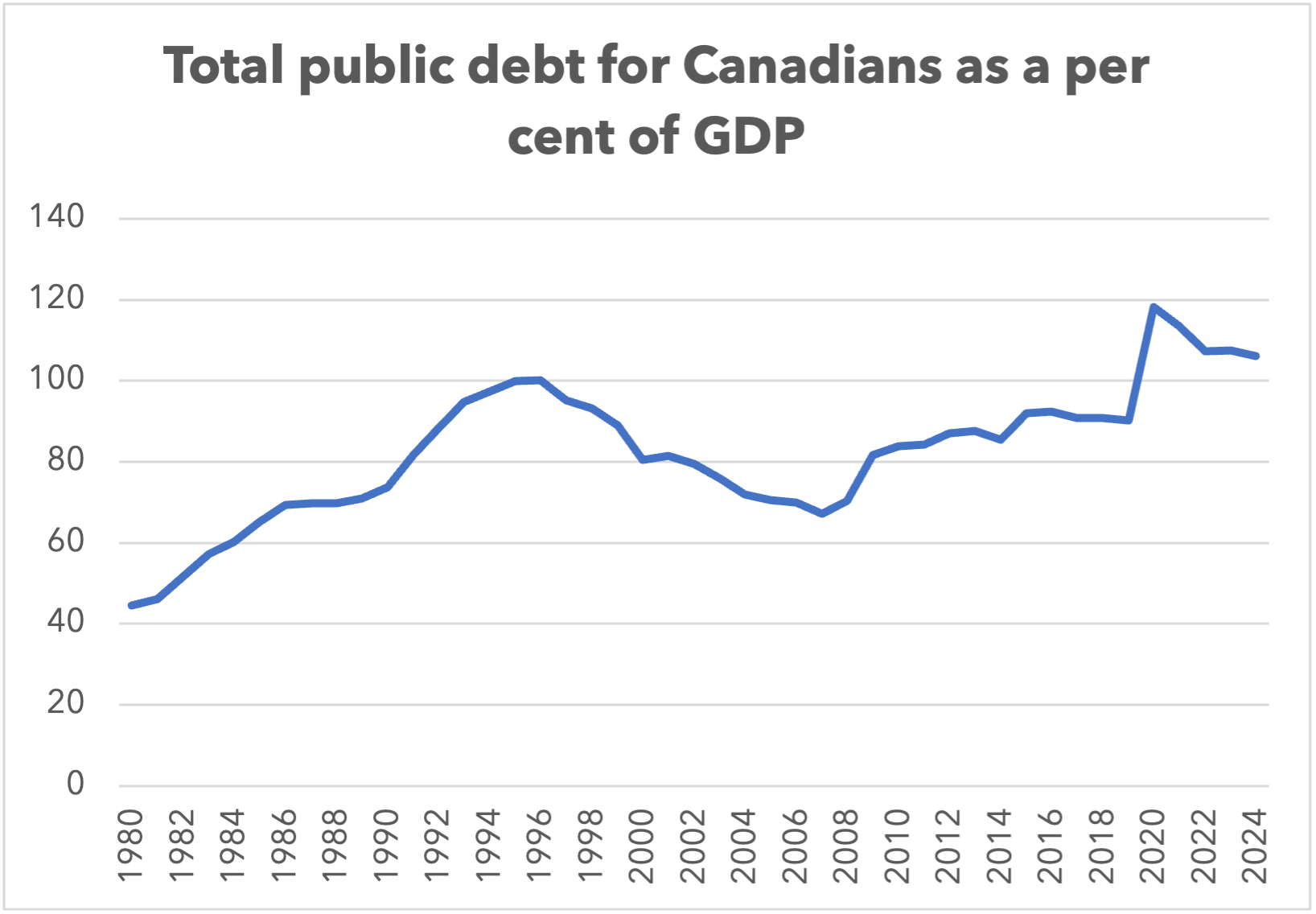
-
Article
Public Expenditure
For many economic purposes, however, the total size of government expenditures is less significant than the components of these expenditures.
"https://d3d0lqu00lnqvz.cloudfront.net/media/media/c824ad23-8456-4358-ab46-7ccd00b6d5c8.jpg" // resources/views/front/categories/view.blade.php
https://d3d0lqu00lnqvz.cloudfront.net/media/media/c824ad23-8456-4358-ab46-7ccd00b6d5c8.jpg
-
Article
Public Finance
The relative importance of government expenditures in the Canadian economy has risen dramatically over the past 70 years, from 15% of the Gross Domestic Product (GDP) in the late 1920s to 40% of GDP in 1980 and 50% in the early 1990s.
"https://d3d0lqu00lnqvz.cloudfront.net/media/media/9dd1c1a6-6a3d-438f-ae21-feb4a339a61b.jpg" // resources/views/front/categories/view.blade.php
https://d3d0lqu00lnqvz.cloudfront.net/media/media/9dd1c1a6-6a3d-438f-ae21-feb4a339a61b.jpg
-
Article
Public Health in Canada
Illness and disease are communal problems. While individual interventions can have an impact, they are less effective than measures that can be done at a community level. Preventing disease and promoting health among individuals and the population at large is the purpose of public health. Public health is managed by local, regional, national and international public health authorities. Public health interventions include research, prevention, education and emergency preparedness. The most important public health interventions for reducing mortality over the past 150 years have included cleaning the water and air, making roads safer and immunizing against infectious diseases. Ironically, as is often said by public health practitioners, success in public health is often invisible when measures are working. In Canada, the rapid emergence, urgency, severity, global scope and long persistence of the COVID-19 pandemic has put all aspects of public health in the public and political spotlight to a greater degree than ever before. For some Canadians, this has resulted in a loss of confidence in public health authorities, while others have realized the importance of maintaining and funding public health. This is the full-length entry about Public Health in Canada. For a plain-language summary, please see Public Health in Canada (Plain-Language Summary).
"https://d3d0lqu00lnqvz.cloudfront.net/e002504596.jpg" // resources/views/front/categories/view.blade.php
https://d3d0lqu00lnqvz.cloudfront.net/e002504596.jpg
-
Article
Public Interest Advocacy Centre
The Public Interest Advocacy Centre, a non-profit Ottawa based organization, was founded in 1976. PIAC is primarily concerned with the delivery of important public utilities and services to Canadian consumers and, in particular, vulnerable consumers.
"https://thecanadianencyclopedia.ca/images/tce_placeholder.jpg?v=e9dca980c9bdb3aa11e832e7ea94f5d9" // resources/views/front/categories/view.blade.php
https://thecanadianencyclopedia.ca/images/tce_placeholder.jpg?v=e9dca980c9bdb3aa11e832e7ea94f5d9
-
Article
Public Ownership
Public ownership refers to government provision of goods and services; the commercial or business activities of the STATE.
"https://thecanadianencyclopedia.ca/images/tce_placeholder.jpg?v=e9dca980c9bdb3aa11e832e7ea94f5d9" // resources/views/front/categories/view.blade.php
https://thecanadianencyclopedia.ca/images/tce_placeholder.jpg?v=e9dca980c9bdb3aa11e832e7ea94f5d9
-
Article
Public Policy
Public Policy generally denotes both the general purpose of government action and the views on the best or preferred means of carrying it out; more specifically it refers to government actions designed to achieve one or more objectives.
"https://thecanadianencyclopedia.ca/images/tce_placeholder.jpg?v=e9dca980c9bdb3aa11e832e7ea94f5d9" // resources/views/front/categories/view.blade.php
https://thecanadianencyclopedia.ca/images/tce_placeholder.jpg?v=e9dca980c9bdb3aa11e832e7ea94f5d9
-
Article
Public Service
The public service, also known as the civil service, is the public bureaucracy comprising, in Canada, departmental organizations that support the political executive in the development, implementation and enforcement of government policies.
"https://thecanadianencyclopedia.ca/images/tce_placeholder.jpg?v=e9dca980c9bdb3aa11e832e7ea94f5d9" // resources/views/front/categories/view.blade.php
https://thecanadianencyclopedia.ca/images/tce_placeholder.jpg?v=e9dca980c9bdb3aa11e832e7ea94f5d9
-
Article
Public-Service Unions
The public sector is highly unionized in Canada. Approximately 80% of those public-sector employees eligible for collective bargaining are covered by collective agreements, compared with only 25% in the private sector.
"https://thecanadianencyclopedia.ca/images/tce_placeholder.jpg?v=e9dca980c9bdb3aa11e832e7ea94f5d9" // resources/views/front/categories/view.blade.php
https://thecanadianencyclopedia.ca/images/tce_placeholder.jpg?v=e9dca980c9bdb3aa11e832e7ea94f5d9
-
Article
Public Services and Procurement Canada
Public Services and Procurement Canada (formerly Public Works Canada) has been the builder and custodian of the federal government's real property assets since before Confederation. Originally created in 1841, it is also one of the largest departments, assuming the role of the federal government's chief purchasing agent.
"https://thecanadianencyclopedia.ca/images/tce_placeholder.jpg?v=e9dca980c9bdb3aa11e832e7ea94f5d9" // resources/views/front/categories/view.blade.php
https://thecanadianencyclopedia.ca/images/tce_placeholder.jpg?v=e9dca980c9bdb3aa11e832e7ea94f5d9
-
Macleans
Pugwash Wins Nobel Prize
Vivian Godfree had just cleared the morning dishes at her Pugwash, N.S., home when her mother called from the British city of Bristol with surprising news - the 1995 Nobel Peace Prize had been awarded to an antiwar movement spawned in the tiny Nova Scotia village where she lives.This article was originally published in Maclean's Magazine on October 23, 1995
"https://thecanadianencyclopedia.ca/images/tce_placeholder.jpg?v=e9dca980c9bdb3aa11e832e7ea94f5d9" // resources/views/front/categories/view.blade.php
https://thecanadianencyclopedia.ca/images/tce_placeholder.jpg?v=e9dca980c9bdb3aa11e832e7ea94f5d9