Browse "History"
-
Article
Origins of Ice Hockey
The origins of ice hockey have long been debated. In 2008, the International Ice Hockey Federation (IIHF) officially declared that the first game of organized ice hockey was played in Montreal in 1875. Many also consider ice hockey’s first rules to have been published by the Montreal Gazette in 1877. However, research reveals that organized ice hockey/bandy games were first played on skates in England and that the earliest rules were also published in England. Canada made important contributions to the game from the 1870s on. By the early 20th century, “Canadian rules” had reshaped the sport.
"https://d3d0lqu00lnqvz.cloudfront.net/media/new_article_images/OriginsofHockey/Victoria-rink-1893.jpg" // resources/views/front/categories/view.blade.php
https://d3d0lqu00lnqvz.cloudfront.net/media/new_article_images/OriginsofHockey/Victoria-rink-1893.jpg
-
Article
Oshawa Strike
Two of Hepburn's Cabinet colleagues who opposed his actions, Minister of Labour David Croll and Attorney General Arthur Roebuck, were persuaded to resign.
"https://d3d0lqu00lnqvz.cloudfront.net/media/media/13cef129-bb89-4686-97b1-a512f5d675f1.jpg" // resources/views/front/categories/view.blade.php
https://d3d0lqu00lnqvz.cloudfront.net/media/media/13cef129-bb89-4686-97b1-a512f5d675f1.jpg
-
Macleans
Ottawa Massacre
This article was originally published in Maclean’s magazine on April 19, 1999. Partner content is not updated. Like many of his colleagues at Ottawa-Carleton's public transit company, Grant Harrison wore his grief openly.
"https://thecanadianencyclopedia.ca/images/tce_placeholder.jpg?v=e9dca980c9bdb3aa11e832e7ea94f5d9" // resources/views/front/categories/view.blade.php
https://thecanadianencyclopedia.ca/images/tce_placeholder.jpg?v=e9dca980c9bdb3aa11e832e7ea94f5d9
-
Article
Overlanders of 1862
The Overlanders of 1862 were a group of some 150 settlers who travelled from Fort Garry (now Winnipeg, Manitoba) to the interior of British Columbia, following the Cariboo Gold Rush. They were led by Thomas McMicking of Stamford Township, Welland County, Canada West [Ontario].
"https://d3d0lqu00lnqvz.cloudfront.net/media/new_article_images/CatherineSchubert/Tales_Campfire_Hind.jpg" // resources/views/front/categories/view.blade.php
https://d3d0lqu00lnqvz.cloudfront.net/media/new_article_images/CatherineSchubert/Tales_Campfire_Hind.jpg
-
Article
Patriation of the Constitution
In 1982, Canada “patriated” its Constitution. It transferred the country’s highest law, the British North America Act (which was renamed the Constitution Act, 1867), from the authority of the British Parliament to Canada’s federal and provincial legislatures. The Constitution was also updated with a new amending formula and a Charter of Rights and Freedoms. These changes occurred after a fierce, 18-month political and legal struggle that dominated headlines and the agendas of every government in the country.
"https://thecanadianencyclopedia.ca/images/tce_placeholder.jpg?v=e9dca980c9bdb3aa11e832e7ea94f5d9" // resources/views/front/categories/view.blade.php
https://thecanadianencyclopedia.ca/images/tce_placeholder.jpg?v=e9dca980c9bdb3aa11e832e7ea94f5d9
-
Editorial
Editorial: The Canadian Constitution Comes Home
The following article is an editorial written by The Canadian Encyclopedia staff. Editorials are not usually updated. In April 1982, as an Ottawa winter turned to spring, Queen Elizabeth II made her eleventh visit to Canada. She had come to make it official. After more than a half-century of trying, Canada would have its own constitution. A Canadian-made constitution was unfinished business from the country’s colonial past. The British North America Act in 1867 set out the jurisdictions of the federal and provincial governments and created the Dominion of Canada. It was, however, a law of the British Parliament, and it could only be amended (changed) by the British.
"https://d3d0lqu00lnqvz.cloudfront.net/media/media/231555c5-c09f-428e-8a64-bbd73e0e0c0a.jpg" // resources/views/front/categories/view.blade.php
https://d3d0lqu00lnqvz.cloudfront.net/media/media/231555c5-c09f-428e-8a64-bbd73e0e0c0a.jpg
-
Article
Pays d'en Haut
Pays d'en Haut [French "up country" or "upper country"] was an expression used in the fur trade to refer to the area to which the voyageurs travelled to trade.
"https://d3d0lqu00lnqvz.cloudfront.net/GreatLakesNewFrance.jpg" // resources/views/front/categories/view.blade.php
https://d3d0lqu00lnqvz.cloudfront.net/GreatLakesNewFrance.jpg
-
Article
Great Peace of Montreal, 1701
On 4 August 1701, the French concluded a peace agreement with the Five Nations Haudenosaunee (Iroquois). This brought to an end almost a century of hostilities marked by atrocities on both sides. The Haudenosaunee were permitted to trade freely and to obtain goods from the French at a reduced cost. In exchange, they pledged to allow French settlement at Detroit and to remain neutral in the event of a war between England and France. The accord assured New France superiority in dealing with issues related to the region’s First Nations. It also gave the French the freedom to expand militarily over the next half century.
"https://d3d0lqu00lnqvz.cloudfront.net/media/new_article_images/GreatPeaceOfMontreal/640px-Grande_Paix_Montreal.jpg" // resources/views/front/categories/view.blade.php
https://d3d0lqu00lnqvz.cloudfront.net/media/new_article_images/GreatPeaceOfMontreal/640px-Grande_Paix_Montreal.jpg
-
Article
Peace, Order and Good Government
“Peace, order and good government” is a phrase that is used in section 91 of the British North America Act of 1867 (now called the Constitution Act, 1867). It offers a vague and broad definition of the Canadian Parliament’s lawmaking authority over provincial matters. Since Confederation, it has caused tensions between federal and provincial governments over the distribution of powers. The phrase has also taken on a value of its own with Canadians beyond its constitutional purpose. It has come to be seen as the Canadian counterpart to the American “life, liberty and the pursuit of happiness” and the French “liberty, equality, fraternity.”
"https://d3d0lqu00lnqvz.cloudfront.net/media/media/143f8587-f938-4cf1-bdc2-c441d02dc962.jpg" // resources/views/front/categories/view.blade.php
https://d3d0lqu00lnqvz.cloudfront.net/media/media/143f8587-f938-4cf1-bdc2-c441d02dc962.jpg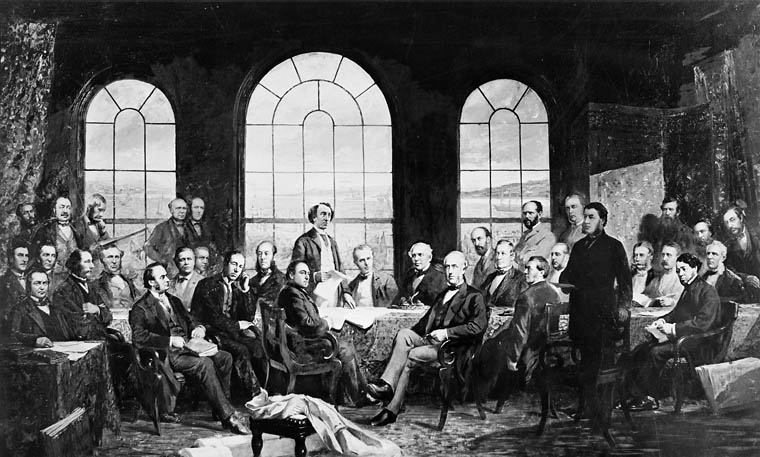
-
Article
Pedlar
Pedlar is a derogatory term used in the days of the Fur Trade by Hudson's Bay Company men to describe any trader from Québec, and later any trader from the North West Company, who "peddled" his goods to the Indigenous peoples by taking them to their encampments.
"https://thecanadianencyclopedia.ca/images/tce_placeholder.jpg?v=e9dca980c9bdb3aa11e832e7ea94f5d9" // resources/views/front/categories/view.blade.php
https://thecanadianencyclopedia.ca/images/tce_placeholder.jpg?v=e9dca980c9bdb3aa11e832e7ea94f5d9
-
Article
Penetanguishene Treaty (No. 5)
The Penetanguishene Treaty of 1798 (also known as Treaty 5 in the Upper Canada treaties numbering system) was an early land agreement between First Nations and British authorities in Upper Canada (later Ontario). It was one of a series of Upper Canada Land Surrenders. The Penetanguishene Treaty encompasses land on Georgian Bay at the northern tip of the peninsula at present-day Penetanguishene, as well as an island in Penetanguishene harbour. The British wanted to establish a naval presence on Lake Huron before the Americans could and the purchase of land at Penetanguishene would allow this. The British also realized that they might have to evacuate their post at Michilimackinac some day and wanted an alternative location.
"https://d3d0lqu00lnqvz.cloudfront.net/PenetangTreaty5.jpg" // resources/views/front/categories/view.blade.php
https://d3d0lqu00lnqvz.cloudfront.net/PenetangTreaty5.jpg
-
Article
Persons Case (Plain-Language Summary)
The Persons Case was a constitutional ruling. It established the right of women to serve in the Senate. The case was started by the Famous Five. They were a group of women activists. In 1928, they objected to a Supreme Court of Canada ruling that women were not “persons.” As such, they were not allowed to serve in the Senate. The Famous Five challenged the law. In 1929, the decision was reversed. As a result, women were legally recognized as “persons.” They could no longer be denied rights based on a narrow reading of the law. (This article is a plain-language summary of the Persons Case. If you are interested in reading about this topic in more depth, please see the full-length entry.)
"https://d3d0lqu00lnqvz.cloudfront.net/media/media/65699b89-06c0-4518-aa06-4eea43f2ec74.jpg" // resources/views/front/categories/view.blade.php
https://d3d0lqu00lnqvz.cloudfront.net/media/media/65699b89-06c0-4518-aa06-4eea43f2ec74.jpg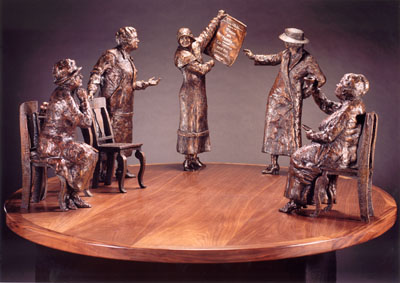
-
Article
Petitioning in Canada
Petitioning is one of the most common tools of political protest accessible to the local population. Limited during the era of New France, the practice of collectively petitioning political authorities became much more frequent in the years following the Conquest by the British. Sanctioned in the 1689 Bill of Rights, petitioning had been a common practice in Britain for centuries, and ever since 1763, Canadians have been sending petitions to their governments (colonial, imperial, federal, provincial, and municipal) for a variety of reasons. With the recent introduction of e-petition, Canadians, more than ever, can have their voices heard in government.
"https://d3d0lqu00lnqvz.cloudfront.net/media/media/7770f93e-7f5e-4cb8-b6ad-57df24227db6.jpg" // resources/views/front/categories/view.blade.php
https://d3d0lqu00lnqvz.cloudfront.net/media/media/7770f93e-7f5e-4cb8-b6ad-57df24227db6.jpg
-
Article
Population Settlement of New France
Throughout the history of New France, soldiers and hired labourers (“engagés”) who crossed the Atlantic were the primary settlers in Canada. Those young servicemen and artisans, as well as the immigrant women who wished to get married, mainly hailed from the coastal and urban regions of France. Most of the colonists arrived before 1670 during the migratory flow which varied in times of war and prosperity. Afterwards, the population grew through Canadian births. On average, Canadian families had seven or eight children in the 17th century, and four to six children in the 18th century. As a result, the population of New France was 70,000 strong by the end of the French regime.
"https://d3d0lqu00lnqvz.cloudfront.net/media/media/d698c031-e790-4c17-906a-5b880e71e24d.jpg" // resources/views/front/categories/view.blade.php
https://d3d0lqu00lnqvz.cloudfront.net/media/media/d698c031-e790-4c17-906a-5b880e71e24d.jpg
-
Article
Pictographs and Petroglyphs
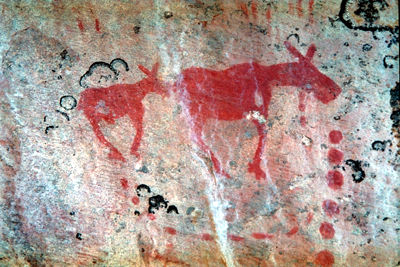
Rock art is generally divided in two categories: carving sites (petroglyphs) and paintings sites (pictographs). Pictographs are paintings that were made by applying red ochre or, less commonly, black, white or yellow dye. Although the majority of the images were traced with the finger, some could be executed with brushes made of animal or vegetal fibres. Petroglyphs are carvings that are incised, abraded or ground by means of stone tools upon cliff walls, boulders and flat bedrock surfaces.
"https://d3d0lqu00lnqvz.cloudfront.net/media/media/a57744d3-7823-4f28-a552-232b42fcb08c.jpg" // resources/views/front/categories/view.blade.php
https://d3d0lqu00lnqvz.cloudfront.net/media/media/a57744d3-7823-4f28-a552-232b42fcb08c.jpg