Share on Facebook
 Share on X
 Share by Email
 Share on Google Classroom
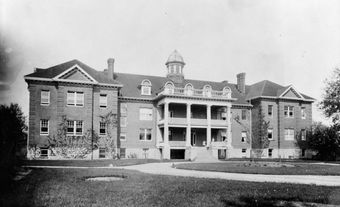
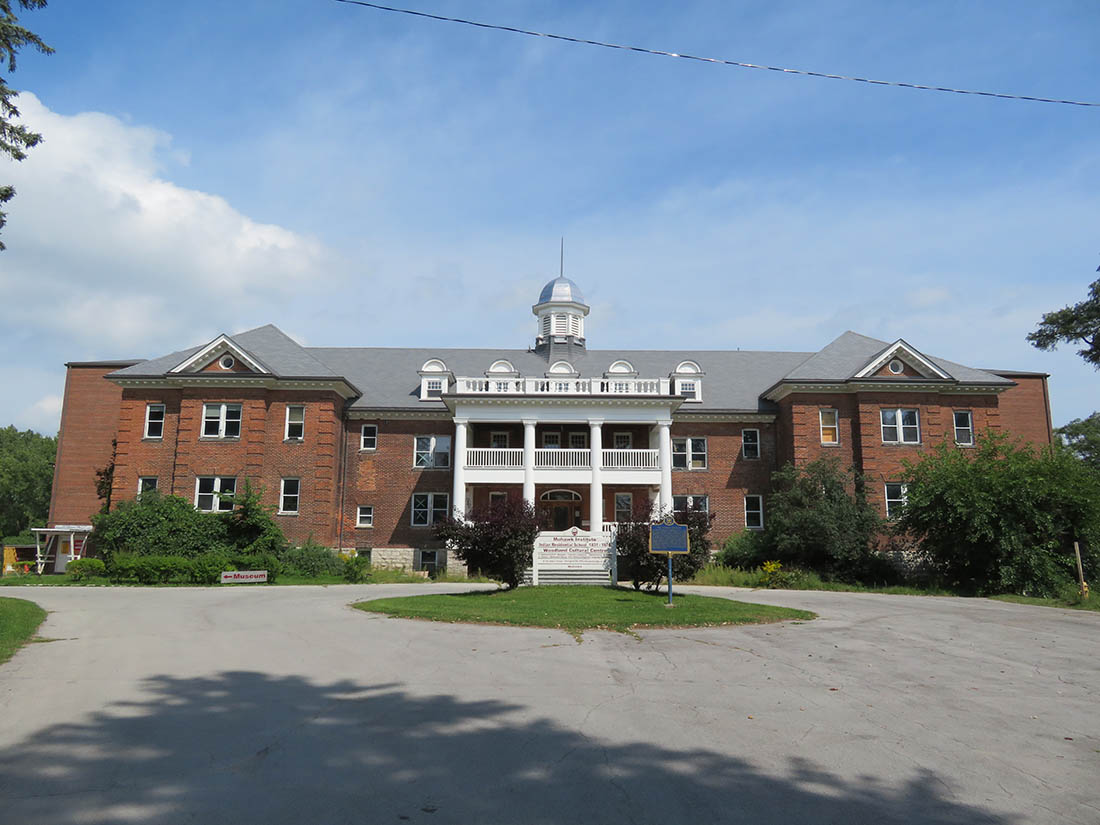
The Association of Iroquois and Allied Indians (AIAI), a provincial/territorial First Nations organization in Ontario, founded the Woodland Indian Cultural Education Centre (now Woodland Cultural Centre [WCC]) in 1972. The WCC works “to preserve, promote and strengthen Indigenous language, culture, art and history; bringing the story of the Hodinohsho:ni people of the Eastern Woodlands to life through innovative exhibitions and programs.” The WCC’s board of directors includes community members from the Six Nations of the Grand River First Nation, Mohawks of the Bay of Quinte (Tyendinaga Mohawk Territory) and Wahta Mohawks. The WCC was established by repurposing the Mohawk Institute, Canada’s first Indian residential school, following its closure. In 2014, the WCC launched its Save the Evidence campaign to restore the Mohawk Institute. This effort culminated in the substantial renovation and unveiling of the Mohawk Institute on 30 September 2025, Canada’s National Day for Truth and Reconciliation.
The Mohawk Institute and the Emergence of AIAI
First Nations political organization and activism was increasingly prevalent on the national stage in the late 1960s and early 1970s. First Nations people first gained the right to vote in Ontario’s provincial elections, without losing Status or treaty rights, in 1954 and in federal elections in 1960 (see also Indigenous Peoples and the Fight for the Franchise; Rights of Indigenous Peoples in Canada). In 1963, the government commissioned Dr. Harry B. Hawthorn to investigate the social conditions surrounding First Nations people in Canada. He produced a two-volume report titled A Survey of the Contemporary Indians of Canada, published in 1966 and 1967, which labelled First Nations people as “citizens minus.”
In 1969, several events occurred. In response to the Hawthorne Report, the federal government released the White Paper, 1969. First Nations people, leaders and institutions completely rejected the paper.
Minister of Indian Affairs and Northern Development Jean Chrétien stated, when discussing the White Paper, that he would deal only with Indian Associations. This led the First Nations of St. Regis, Six Nations, Tyendinaga, Mississaugas of the Credit and Oneida to form the Association of Iroquois and Allied Indians (AIAI). The AIAI defined itself as “a political organization to represent its member Bands in negotiation or consultation with any level of government affecting the welfare of the member Bands as a whole.”
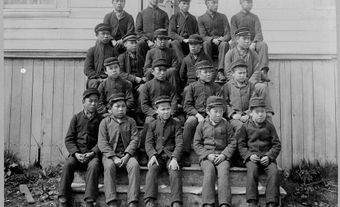
In 1962, internal Department of Indian Affairs and Northern Development communications about the Mohawk institute indicated that “Unfortunately, [all involved have done an] extremely poor job of interpreting to the Indians the roles of the church, the Society for the Propagation of the Gospel in New England and Parts Adjacent and the [federal government].” In 1970, the federal government had fully committed to plans to close the Mohawk Institute. The federal government closed the Mohawk Institute as a school in 1970. By 1971, it was completely shut down.
Cultural and Education Centres Program
In response to the White Paper, First Nations organizations across Canada published various reports in opposition, including Citizens Plus. Citizens Plus proposed the creation of the Alberta Indian Education Centre, “started by Indian people…run by Indian people for Indian people.” It proposed three objectives for their centre: to adapt traditional knowledge into contemporary life; to revitalize and teach cultural foundations for cultural continuity and resilience; and to equip First Nations people for engagement in modern society. Similar requests emerged from Saskatchewan, British Columbia and New Brunswick (see Union of British Columbia Indian Chiefs). Moreover, the National Indian Brotherhood’s (now Assembly of First Nations) policy document, Indian Control of Indian Education, was adopted by the federal government in 1973. It incorporated the principles of parental responsibility and local control. Ultimately, the federal government created the Cultural/Education Centres Program (CECP) without meaningful or appropriate consultation with First Nations people.
In 1972, the Six Nations Elected Council requested funding promised by the AIAI to complete a feasibility study to use the Mohawk Institute as a cultural centre. It asked the AIAI to present the final report of the feasibility study to the federal government, apply for appropriate grants, operate the centre until a permanent body was established and use the buildings and contents of the Mohawk Institute. The AIAI, in partnership with the Six Nations of the Grand River, the Mohawks of the Bay of Quinte (Tyendinaga Mohawk Territory), and the Wahta Mohawks, repurposed a portion of the former Mohawk Institute by 1972 as the Woodland Indian Cultural Education Centre.
The AIAI obtained funding from the newly established CECP. By at least 1974, a more permanent body was established to govern the centre, after which the AIAI’s role was concluded. In 1988, the centre became known as the Woodland Cultural Centre.
“Save the Evidence” Campaign
One of the Woodland Cultural Centre’s (WCC) initiatives is the Save the Evidence campaign. Launched by 2014, it aims to support the restoration of the Mohawk Institute’s main building. Survivors of the residential school system, Six Nations of the Grand River and other First Nations called for the building to remain intact as a space for healing, truth-telling and remembering across generations. This call to action, issued by survivors and members of the supporting communities, was implemented by the board of directors of the WCC (see also Reconciliation in Canada).
Some say that the restoration is a way to honour those who survived and those who didn’t and to ensure that future generations understand the full impact of residential schools. The building’s charred beams, a remnant of three fires in 1903 started by children or youth within the institute, are incorporated and remain visible on the third floor. These charred beams are directly beside an isolation cell. This cell was used to hold children. At least one child, Ruth Miller, was held there for at least three days with limited food and after having been whipped. Despite laws preventing First Nations people from hiring lawyers, Ruth Miller’s father, George Miller, was able to make a legal claim against the principal of the Mohawk Institute for this punishment. He won.
A Centre for Culture, Language and Learning
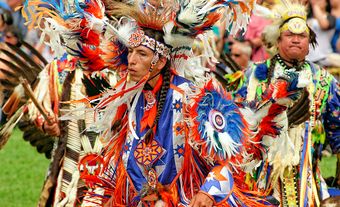
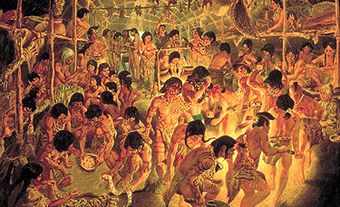
The Woodland Cultural Centre (WCC) began operations at a time when the world, including the affected member nations, had yet to grasp the facts of the Indian residential school system fully. Today, the WCC’s mandate is expansive, and it is not just a former residential school site, but also exists: “to preserve, promote and strengthen Indigenous language, culture, art and history; bringing the story of the Hodinohsho:ni people of the Eastern Woodlands to life through innovative exhibitions and programs.” Through exhibitions, workshops, outreach and other initiatives, and with over 50,000 artifacts in the museum collection, the WCC fosters cross-cultural understanding while empowering First Nations within supporting communities to reclaim their heritage.
“It’s very meaningful for us to ensure that [survivors’] stories are represented and that the public has access to those stories right in the very space where the abuse and the experiences…happened.”
– Heather George, Executive Director, Woodland Cultural Centre
The WCC's work is not just about preserving knowledge of the past. The WCC plays a key role in knowledge and learning through its program offerings, including art, education, language and library and museum services. On 30 September 2025, Canada’s National Day for Truth and Reconciliation, the WCC reopened the Mohawk Institute, with renovation and reinterpretation substantially complete. It is now identified by the WCC and the International Coalition of Sites of Conscience as a “site of conscience.”
Did you know?
According to the International Coalition of Sites of Conscience, a site of conscience is defined as “a place of memory — such as a historic site, place-based museum or memorial — that prevents this erasure [of the past] from happening in order to foster more just and humane societies today.”