Share on Facebook
 Share on X
 Share by Email
 Share on Google Classroom
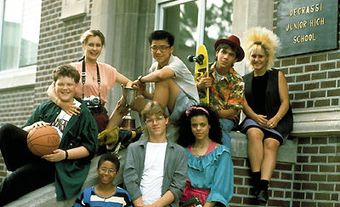
Watatatow was a French-language téléroman dramedy aimed at teenagers. Broadcast on Radio-Canada, the program ran for 1,220 30-minute episodes across 14 seasons, from 1991 to 2005. The program has been compared to Degrassi for its cultural impact and the topics it addressed, as well as its appeal to an entire generation of French Canadian youth. Watatatow was a coming-of-age program strongly associated with Quebec’s millennial generation. At the height of its popularity, the program drew an average of 800,000 viewers per episode.

Concept and Origin
Watatatow debuted on Radio-Canada on 17 September 1991. Producer Jean-Pierre Morin developed the program specifically for teens, who at the time were considered a difficult demographic to attract. Morin believed that if teens saw themselves on television, they would be more inclined to watch. Morin hired teenage actors to portray their characters realistically, showing them dealing with the daily problems and challenges common to teenagers, as well as the life lessons learned through their disappointments and successes.
The program took a close look at friendships, family, love and self-image, which were identified as issues of particular significance to teens. Most of the show’s storylines revolve around these subjects. The target audience was between the ages of 12 and 18. Many of the characters grew up on the show, both on and off camera, and their growth — physically as much as emotionally — was an integral part of the program’s unique character.
Synopsis
Watatatow is set in a working-class neighbourhood of a big city and revolves around three families and a local youth centre. The families are distinguished by different socio-economic profiles and backgrounds. These differences were meant to accurately portray contemporary society. As such, a variety of family dynamics were depicted, including young people sharing an apartment, divorced families, children living in foster care or with adoptive families, as well as traditional nuclear families. Many of the characters are bound together through their school, their friendships and competition with one another.
Though Watatatow was a drama, it also had comedic and lighthearted moments. It also reflected the society and culture it portrayed at the time, including its music, language and the problems faced by teens in the 1990s and early 2000s.
Production
In keeping with its basis as a téléroman (serial drama), Watatatow was initially broadcast three times a week, starting at 4:30 p.m. (after school was finished but before local evening news programs had started). This was increased to four episodes per week starting in the 1994–95 season, a reflection of the show’s popularity.
Because so many episodes were filmed each week, Watatatow required a very large production staff. To accurately reflect the range of emotions and experiences a teenager might encounter in their daily life, each episode would usually have about 20 different dramatic elements. There were generally no subjects too taboo for Watatatow.
During the show’s run, the production staff regularly met with upwards of 600 grade 9 and grade 10 students to ask them about their lives, their experiences and their concerns, to ensure that the program was faithful to its subject matter and accurately reflected teenagers’ lives. Themes addressed by Watatatow include love and relationships, disappointments in life, fear, jealousy, coming out, and sexism, as well as heavier subject matter like suicide, abortion, AIDS and domestic violence. Each episode was written by a team of scriptwriters. Ultimately some 25 writers would cut their teeth on Watatatow and go on to write scripts for a wide array of Quebec television programs. These writers developed between 300 and 400 characters over the course of the show’s 14-year run. In total, some 683 actors appeared in the series.
In the early 2000s, an American producer considered adapting the program for the US. However, they backed out after deciding that Watatatow’s pilot was too risqué for American audiences.
Awards
- Best Performance in a Youth Program or Series, Prix Gémeaux (1992)
- Best Youth Drama Program or Series, Prix Gémeaux (1992, 1993, 1999, 2000)
- Best Direction in a Youth Program or Series, Prix Gémeaux (1994, 1998)
- Best drama in French, Alliance for Children and Television’s Awards of Excellence (1995)
- Best Writing in a Youth Program or Series, Prix Gémeaux (1996)
- Best Supporting Performance in a Youth Role (2004, 2005)