Share on Facebook
 Share on X
 Share by Email
 Share on Google Classroom
The urban effect on climate is one of the best examples of unintentional human modification of the atmosphere (see Climatology). The construction of every building, road, and parking lot creates a new local microclimate. Taken together with air pollution from human activities, these changes constitute the local effect of a settlement upon its climate. In Canada, such effects have been observed in villages with as few as 1,000 inhabitants, in metropolitan areas, and across all climatic regions.

Description
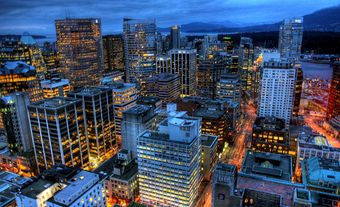
Both land surface and air are altered by urbanization. Buildings change the geometric arrangement of the land surface, creating a rigid, rough system of blocks and street "canyons," especially in the centre of cities. This changes the airflow over the city and creates traps for incoming and outgoing radiant energy. Construction materials alter the rate of heat or water uptake or loss by the surface. Changes in the composition of the air are caused by the release of heat, water vapour, and pollutants from the combustion of fuels and other activities. Pollutants may alter both the transfer of radiation and the growth of cloud droplets.

All of the climatic elements (sunshine, temperature, humidity, wind, etc) are affected by the presence of the city. The impact is discernible annually and over the years as a city grows, but it is usually best observed on individual days during fine weather (clear skies and light winds). For example, pollution decreases the amount of solar energy in Montréal by about 9 per cent annually, but on individual days the decrease may be as great as 25 per cent. A "heat island" often exists in a city centre because it is warmer than the surrounding countryside. In most large cities in Canada, the annual heat island effect is 1–2°C, but occasionally it is much larger. On clear, calm summer evenings, the heat island can be as large as 5–6°C in Brandon, 6–7°C in St-Hyacinthe, 9–10°C in Hamilton, 10–11°C in Vancouver, and 11–12°C in Winnipeg, Edmonton, and Montreal. The latter values are some of the largest in the world. Even during arctic nights, towns such as Inuvik have a heat island.
The relative humidity is almost always lower in a city (because of the warmth), but the actual amount of moisture is often greater, especially at night and in winter. In Prairie centres such as Edmonton, the winter release of water vapour from the combustion of natural gas used for heating increases humidity and the risk of ice fog at temperatures below about -30°C. Ice fog is also an unpleasant feature of high-latitude settlements such as Inuvik.
Winds are generally reduced in the city except around tall buildings, where "jetting" may be a problem. Cities also induce their own breeze circulations. Little is known about the effects of Canadian cities on precipitation. Foreign research suggests that cities increase summer precipitation, but the urban heat island may melt some of the snowfall before it is recorded.