Share on Facebook
 Share on X
 Share by Email
 Share on Google Classroom
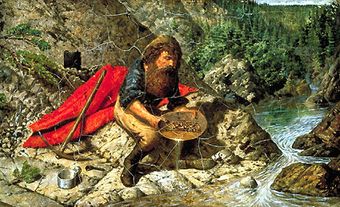
Stikine (or Stickeen) Territory was Russian land leased to the Hudson’s Bay Company from 1839 to 1867. The discovery of gold in the Stikine River in 1862 led to its creation and removal from Hudson’s Bay Company authority. Within a year, it was absorbed into British Columbia territory.
Creation and Administration of the Territory
Between 1839 and the 1867 American purchase of Alaska, the Hudson’s Bay Company leased the continental portion of the Alaska Panhandle from the Russian American Fur Company.
In 1861 gold was found on the Stikine River in British territory contiguous to the leased area; the region was removed from HBC authority and organized as Stikine (or Stickeen) Territory on 19 July 1862. The boundaries were, on the west, Alaska; on the south, the colony of British Columbia (BC); on the east, 125° W longitude; and on the north, 62° N latitude.
BC’s governor was territorial administrator, with the power to appoint officials; the BC Supreme Court was responsible for civil and criminal matters, and English law was in force. Thus, Britain ensured British authority in a region with a potential gold rush. Stikine Territory had a short existence: in July 1863 most of it was absorbed into an enlarged BC (see also Territorial Evolution).