Share on Facebook
 Share on X
 Share by Email
 Share on Google Classroom
Sparrow is the name given to several unrelated groups of birds. Sparrows are classified in two families: Passerellidae, which includes American sparrows; and Passeridae, which includes the familiar house sparrow. About 25 species of the family Passerellidae regularly occur in Canada. Some notable native species are the song sparrow (Melospiza melodia), white-throated sparrow (Zonotrichia albicollis) and the lark bunting (Calamospiza melanocorys).

Description
Sparrows are small to medium-sized, ranging in length from LeConte's sparrow (Ammodramus leconteii), as small as 11 cm, to the spotted towhee (Pipilo maculatus), up to 21 cm.
Generally, sparrows have dull plumage with distinctive head markings; the exceptions are the brightly coloured towhees and the sharply patterned juncos. Males and females of most species are similar in size and plumage; for example, male and female song sparrows (Melospiza melodia), widespread in Canada, are virtually indistinguishable by plumage alone. Male lark buntings are all black with large, white wing patches; females are brown with dark streaks and light wing patches.

Song
Usually, only males sing; thus, a singing song sparrow is almost certainly male. Songs differ considerably among species. Lark sparrows (Chondestes grammacus), of dry fields with scattered bushes and trees, sing long, melodious songs containing many trills. White-throated sparrows (Zonotrichia albicollis), of coniferous and mixed forests, utter songs of pure tone; one rendition, paraphrased as "Oh sweet Canada Canada Canada," has given them the local name Canada bird. Grasshopper sparrows ( A. savannarum), of grassy fields in extreme southern Canada, give tuneless, insectlike reelings. Henslow's sparrow (A. henslowii), of weedy fields of southern Ontario, gives one of the poorest vocal efforts of any bird, a hiccoughing "tsi-lick." Lark bunting males often sing in flight, holding their wings at an angle above the body and circling slowly back to earth while uttering a long and varied song of whistles, trills and buzzes.
Diet
Primarily ground feeders, sparrows eat mostly seeds, although insects are eaten in summer. Adults of most species feed insects to their young.
Migration and Distribution
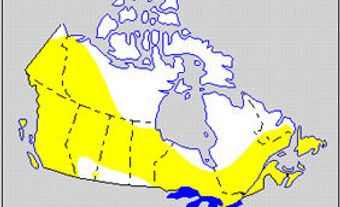
All species of sparrows in Canada are migratory to some extent. American tree sparrows (Spizella arborea) nest in scrub willow of the Subarctic and winter in southern Canada and northern US. Clay-coloured sparrows (S. pallida), of brush-covered prairies, winter in Mexico. The Ipswich sparrow (Passerculus sandwichensis princeps), a well-marked subspecies of the widely distributed savannah sparrow (P. sandwichensis), breeds only on Sable Island and winters on the Atlantic seaboard. The lark bunting (Calamospiza melanocorys) breeds locally in the open grassy prairies of southern Alberta, Saskatchewan and southwestern Manitoba. Lark bunting numbers and breeding-range boundaries fluctuate considerably from year to year.
Conservation and Status
Several species of sparrows are classified as at-risk by the Committee on the Status of Endangered Wildlife in Canada (COSEWIC). The Baird's sparrow, Harris's sparrow, Ipswich sparrow and pratensis grasshopper sparrow are classified as species of special concern. The lark bunting is classified as a threatened species. The coastal vesper sparrow and Henslow's sparrow are endangered. Broadly speaking, sparrow declines are often due to the destruction of their grassland habitat and the decline in insect populations.