
 Share on Facebook
 Share on X
 Share by Email
 Share on Google Classroom
Soccer (Association Football) is a sport played by two teams of 11 players each, using a round ball on a grass or turf field called a “pitch.” Only the two goalkeepers may intentionally handle the ball, which is moved from player to player by kicking. A goal may be scored by kicking or heading the ball into the opponent's goal. Association Football, the traditional name of the game, has now been shortened to football. The term soccer is derived from the second syllable of the word association. In Canada and the United States, the game is referred to as soccer to distinguish it from North American football. The most popular sport in the world, soccer has spread to almost every nation in the world. More than 200 countries are now members of the Fédération Internationale de Football Association (FIFA). Soccer is also the most popular participation sport for children and youth in Canada. In 2014, 824,181 players were registered in soccer at all levels. More than 41 per cent of those players were women or girls.

Early History
Soccer in Canada was played under a variety of rules from the early years of the 19th century. The first game played as we would play it today seems to have taken place in Toronto in October 1876 between two local clubs. From 1876 on, the game grew and spread across the country. However, it was not considered an appropriate activity for women for many years.
The Dominion Football Association was organized in Montreal in 1877. It operated a loosely arranged cup competition largely involving college teams from Southern Ontario. The Western Football Association (WFA) of Ontario was formed in January 1880 in Berlin (now Kitchener). It had 19 member clubs by April of that year. Its formation led to the first international soccer match in North America. Canada defeated the United States 1–0 in November 1885 in Newark, New Jersey. The following year, Canada lost 3–2.
On the Canadian side in both games was David Forsyth, a teacher at Berlin High School. He was instrumental in founding the WFA, playing the first internationals and organizing a tour to Britain in 1888. In Britain, the Canadian touring team won nine games, tied five and lost nine against some of the finest teams of the day. A similar tour took place in 1891; the touring party this time was made up of both Canadian and American players.
Represented by the Galt Football Club, Canada entered Olympic competition for the first time in 1904 and came away with the gold medal at the Olympic Games in St Louis, Missouri. Faced with only two American teams in the competition, Canada won its first game 7–0 and the second 4–0.
In 1912, the Dominion of Canada Football Association (the forerunner of today's national governing body, the Canada Soccer) was formed. At the time, there were leagues and associations across the country. In 1914, Canada gained full membership in the Fédération internationale de football association (FIFA), the governing body of world soccer.
A national championship came into being in 1913 when the Connaught Cup (presented by the duke of Connaught) was offered for competition. The first winners were the Norwood Wanderers of Winnipeg. In 1926, the Connaught Cup was succeeded by a new trophy, known as the Challenge Trophy. It was donated by the Football Association of England and is still played for today (as is the Jubilee Trophy, the equivalent in women’s soccer). The most successful national champions have been the Westminster Royals. They have appeared in 10 finals and won eight times (1928, 1930, 1931, 1936, 1953, 1955, 1958, 1960).
A Canadian national team toured Australia in 1924 and New Zealand in 1927. In the 1920s and 1930s, numerous teams from Britain toured Canada. One member of the Canadian team in New Zealand was Dave Turner. Another notable player of this era, Joe Kennaway, played for Canada and Scotland. In his day, he was one of the finest goalkeepers in the world.

Men’s International Competition
The influx of immigrants from around the world following the Second World War changed the face of Canadian soccer. In the pre-war years, the influence had been largely British. But it rapidly became international, particularly in the 1950s and 1960s. As immigrants were assimilated into Canadian life, the emphasis began to shift to the development of Canadian players. As a result, Canada's status as a soccer power steadily improved throughout the 1970s and early 1980s. (See also Canada at the 1986 FIFA World Cup.) However, a series of poor results in the late 1980s and throughout the 1990s set the game back. Even so, Canada fielded teams regularly in Olympic, Pan American and Francophone Games (Jeux de la Francophonie).
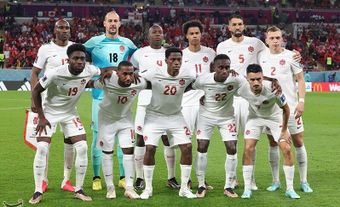
Canada first entered a men’s team for the World Cup in 1957. Team Canada did not pass beyond the first preliminary round until 1978, when the team narrowly missed qualifying for the final rounds. In 1982, the team missed the finals by only one goal. In 1985, Canada won its first title at the CONCACAF (Confederation of North, Central American and Caribbean Association Football) championship, securing a place at the World Cup the following year. Canada reached the World Cup in 1986, under coach Tony Waiters. Despite losing to France, Hungary and the Soviet Union — all long-established world-class powers — the team distinguished itself by the quality of its play. Since then, the Canadian men’s team has qualified for two World Cups — in 2022 and automatic as a host country in 2026. (See also Canada at the 2022 FIFA World Cup.)
In Olympic competition, the men’s national team qualified for the final rounds of the Montreal Olympics in 1976, as the host nation. The team lost narrowly to the Soviet Union and North Korea. In the final, East Germany defeated Poland 3–1 before a crowd of 71,619 in Montreal's Olympic Stadium — a Canadian attendance record for a soccer match.
Canada went one step further in the 1984 Los Angeles Olympics, reaching the quarter-finals before being beaten by Brazil. The score was tied 1–1 after 90 minutes of regulation time and 30 minutes of overtime. Canada lost its bid for a place in the semifinal in the subsequent penalty shootout. Since then, the Canadian men’s team has failed to qualify for the Olympic Summer Games.
In February 2000, however, the Canadian men’s team made soccer history with a stunning title win at the CONCACAF Gold Cup, thanks largely to the play of goalkeeper Craig Forrest, the tournament’s Most Valuable Player. Canada’s victory was dubbed “The Miracle in Los Angeles.” Ranked 85th in the world, Canada upset 10th-ranked Mexico 2–1 in the quarter-finals and went on to defeat Colombia 2–0 in the final.
Women’s Soccer
When the Dominion Football Association was first organized in 1877, soccer was not considered a suitable activity for women in Canada. Athletic opportunities for women were limited. Only genteel activities such as skating, horseback riding and boating were acceptable to Victorian society. Towards the end of the 19th century, tennis, badminton and golf became more popular among women, but even cycling was suspect. “Manly” sports (sports that required running and the chance of physical contact) were considered clearly unacceptable. By the 1920s, women in Canada were playing team sports such as basketball, baseball/softball and ice hockey. However, few were playing soccer.
In 1922, a touring team from England — the Dick, Kerr Ladies Football Club — arrived in Quebec for a North American tour, expecting to find some women’s teams to play. However, the Dominion Football Association publicly announced their opposition to the idea of women playing soccer and even forbade any of their (men’s) clubs from competing against the Dick, Kerr Ladies. They were following the lead of the Football Association in England, which had banned the club from playing on its pitches. The touring team was therefore forced to compete against men’s teams in the United States.
Yet some women did play soccer in Canada in the early 20th century, despite the disapproval of the Dominion Football Association. During the First World War, for example, the Globe reported that a “ladies’ football [soccer] match” had taken place on 5 August 1918 in support of the War Auxiliary. In 1922, under the headline “Amazons Stage Terrific Battle,” The Lethbridge Daily Herald in southern Alberta reported on a game between two rival women’s teams — the single and married ladies, “all [of whom] showed a remarkable knowledge of the game.” According to historian M. Ann Hall, women also played soccer in Hamilton in the 1920s.
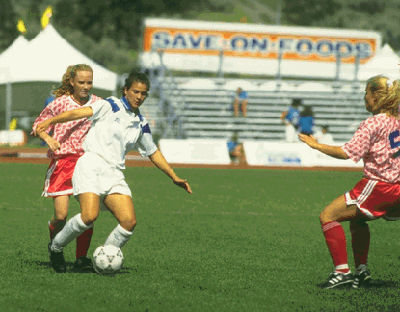
In 1936, an article in the Free Press (London, Ontario) reported that, “soccer has become an important fall sport for women undergraduates at the University of Western Ontario.” Girls were also playing soccer at Central Collegiate, a high school in the city. In 1950, McGill University formed a women’s soccer team. It played against teams from McDonald College, Bishop’s University and various local high schools. Overall, though, few women played soccer in the first half of the 20th century, as there was still resistance to the idea.
In the 1960s, the situation changed. Soccer became very popular among Canadian youth of both genders. By 1972, Scarborough, Ontario, could boast 14 girls’ teams — far fewer than the boys’ teams but still a significant number. By 1976, there were 60 girls’ teams in the Calgary Minor Soccer Association. By 1980, there were 317 teams in the British Columbia Girls Soccer Association.
Since then, soccer has become one of the most popular sports among girls and women. Moreover, the disparity between the number of male and female players has steadily fallen. In 1980, women and girls accounted for less than 10 per cent of all registered soccer players in Canada. By 2013, the number had risen to over 40 per cent. In 2019, Canada Soccer had more than one million registered soccer players, compared to 606,000 registered hockey players in Canada.
As of 2025, Canada had the third-highest number of registered girls and women among all FIFA countries. However, Canada Soccer still set out to even the imbalance between males and females playing the game. In November 2025, Canada Soccer introduced its “Close the Gap” program, “a formal commitment to closing the gender gap in participation and leadership — and increasing the visibility of women and girls in soccer across Canada.” Other programs, such as TELUS She CAN Coach and AccelerateHER, had similar mandates to grow the game among women and girls.
Women’s International Competition
Canadian women began competing internationally in the late 1970s. In 1977, a team from the Greater Vancouver Women’s Soccer League travelled to Hawaii on a two-week tour. The next year, they competed in the World Women’s Invitational Soccer Tournament in Taiwan. The team — the Imperial Order of the Daughters of Empire (IODE) Roadrunners — represented their club rather than Canada. They defeated several of the 13 teams in the world tournament.
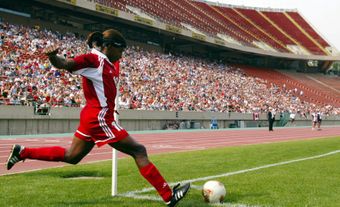
The first national women’s team was formed in 1986. It did not qualify for the inaugural Women’s World Cup in 1991. The team competed in the 1995 World Cup, but did not place high enough to secure a spot at the 1996 Olympic Summer Games in Atlanta — the first time women’s soccer was included at the Olympics. (The top eight teams from the World Cup automatically qualified for the 1996 Olympics because there was not enough time for a qualifying tournament.) Canada played in all subsequent World Cup tournaments, placing fourth at the 2003 World Cup. In 2008, the team qualified for the Olympic Games in Beijing, China, where they reached the quarter-finals.
The women’s national team has twice (1998 and 2010) won the title at the CONCACAF (Confederation of North, Central American and Caribbean Association Football) tournament. It has also medalled at the Pan American Games, including a gold medal in 2011.
Canada qualified for the 2012 Olympic Summer Games in London and performed remarkably well during the tournament. Millions watched its semifinal match against a favoured American team. Despite a very strong showing that saw captain Christine Sinclair score three goals, the United States won 4–3 in overtime. The American win came after a couple of controversial penalties against Canada that allowed the US to tie the match in the last seconds of the fourth quarter. Putting aside their disappointment, the Canadians defeated the French team three days later in a 1–0 win to take the bronze medal. (See Women's Soccer Team Wins Olympic Bronze.) At the 2016 Olympic Summer Games in Rio, Canada defeated Brazil 2–1 to again win bronze, with Deanne Rose and Sinclair each scoring a goal.
The Canadian women’s soccer team entered the 2020 Olympic Summer Games in Tokyo with the goal of “changing the colour” of its Olympic medal after two consecutive bronze medals. The women’s team played its first game before the opening ceremonies, tying Japan 1–1 on a goal by Christine Sinclair — her 187th international goal, the most ever by a men’s or women’s soccer player. The draw against Japan was followed by a 2–1 win over Chile and a 1–1 tie against Great Britain in Group E play. In the quarter-finals, Canada beat Brazil on penalty kicks and then beat the United States for the first time in 20 years, 1–0 in the semifinals. In the final, after being tied 1-1, Canada beat Sweden 3–2 on penalties, winning Olympic gold in dramatic fashion.
However, at the 2024 Olympic Summer Games in Paris, Team Canada entered competition under a cloud of controversy. The women’s soccer team was embroiled in scandal after they were found to have used a drone to spy on the New Zealand women’s soccer team during a practice. Assistant coach Jasmine Mander, team analyst Joseph Lombardi and head coach Bev Priestman were all sent back to Canada for their involvement. Further investigations revealed that both the men’s and women’s soccer team had made heavy use of drone spying since at least 2016. The incident and the subsequent revelations not only cast a pall over Canada’s Olympic presence in Paris but also over the Canadian women’s team’s gold medal victory at the 2020 Tokyo Olympics.
Players: Men’s Soccer
The increasing involvement in international competition has produced various outstanding Canadian men players. Bruce Wilson played in the North American Soccer League (NASL) and captained the Canadian team at the 1984 Olympics and the 1986 World Cup. Early in 1999, Wilson was voted one of the players of the century in the Americas. Playing alongside Wilson in many international games was Bob Lenarduzzi. He also had a notable career with the Vancouver Whitecaps of the NASL and went on to coach the national team. Others who distinguished themselves during the late 1970s and early 1980s were Randy Samuel, Sam Lenarduzzi (older brother of Bob), Buzz Parsons, Randy Ragan, Gerry Gray, Jimmy Douglas and Robert Iarusci, who also played for the world famous New York Cosmos. Most of the players who represented Canada during that time played in the NASL.
Many Canadian players have had international success as Canadian team members or on teams in other countries. Goalkeeper Craig Forrest distinguished himself with Ipswich Town and West Ham United. Forward Paul Peschisolido played with Birmingham City, Stoke City and Fulham. Defender Jim Brennan played with with Bristol City and Notts Forest, and Jason de Vos played with Dundee United, Wigan Athletic and Ipswich Town — all English clubs. Colin Miller, a midfielder, went to Scotland to play for Rangers, Hearts and Dunfermline Athletic. Forward Alex Bunbury played in Portugal for Maritimo.

Midfielder Dwayne De Rosario played with Germany’s FSV Zwickau at the beginning of his senior career. He then returned to North America to play in the MLS (including two stints with Toronto FC). A four-time Canadian Player of the Year, De Rosario was also MLS Cup Champion four times and was voted Most Valuable Player in the MLS in 2011. In 2012, De Rosario was named part of the all-time Canada XI men’s team. Fellow midfielder Julian de Guzman played professional football in France, Germany, Spain and Greece, as well as for Toronto FC and Ottawa Fury FC in the MLS. He was named Most Valuable Player at the CONCACAF Gold Cup tournament in 2007 and the Canadian Player of the Year in 2008.
Midfielder Atiba Hutchinson enjoyed a long and storied career as Canada’s ironman of soccer. A six-time Canadian Player of the Year — more than any other man — Hutchinson played professionally until retiring in 2023 at the age of 40. While playing for FC Copenhagen in 2010, Hutchinson became the first North American to be named the Danish Superliga Player of the Year.
Forward Cyle Larin is the all-time leading goal scorer for the Canadian men’s soccer team. He was the first Canadian player to be selected first overall in the MLS SuperDraft was named MLS Rookie of the Year in 2016. After scoring 43 goals in 87 games in three seasons with Orlando City SC, he was transferred to Beşiktaş JK of the Süper Lig in 2018. Larin helped Beşiktaş JK win the Süper Lig, Turkish Cup and the Turkish Super Cup in 2020–21. He also played for Canada at the FIFA World Cup in 2022 and 2026.
Winger Alphonso Davies is widely regarded as the greatest male soccer star Canada has produced. He has played professionally with the Vancouver Whitecaps FC and Bayern Munich of the Bundesliga, where he was named Rookie of the Season in 2020. The youngest player ever on Team Canada, Davies was named the Canadian Men’s Player of the Year in 2018, 2020, 2021 and 2022. He has also received the Lionel Conacher Award as Canada’s male athlete of the year and the Northern Star Award as Canada’s athlete of the year.

Players: Women’s Soccer
On the women’s side, Carrie Serwetnyk was the first Canadian woman to play soccer professionally. She signed to a Japanese club in 1992. Charmaine Hooper, who played professionally overseas as well as in the Women’s United Soccer Association, established herself as one of the finest woman players in the world. She represented Canada at three FIFA Women’s World Cups (1995, 1999, 2003) and won two silver medals for Canada at the CONCACAF Women’s Championships (1991, 1994). She also helped lead Canada to its first-ever CONCACAF gold in 1998. She was named Canadian Player of the Year in 1994, 1995, 2002 and 2003 and was the first player to have 100 caps for the women’s national team.
Christine Sinclair, Canada's premier female soccer player, is the greatest goal scorer in the history of international soccer. She scored more international goals (190) than any other player in the world — man or woman. Sinclair led the Canadian women’s team to three World Cups (2011, 2015, 2019) and four Olympic Summer Games (Beijing 2008, London 2012, Rio 2016, Tokyo 2020). The team won back-to-back bronze medals in 2012 and 2016 before winning gold in Tokyo. Named Canadian Player of the Year a remarkable 14 times, she received the Bobbie Rosenfeld Award in 2012 and 2020 and was named Canada Soccer Player of the Decade in 2019. She was also the first soccer player to win the Lou Marsh Trophy (now the Northern Star Award) as Canada's athlete of the year.
Sinclair and many of her national teammates (e.g., Diana Matheson, Erin McLeod, Karina LeBlanc, Melissa Tancredi, Rhian Wilkinson, Candace Chapman, Silvana Burtini, Sophie Schmidt, Andrea Neil, Kara Lang) have played in professional leagues in North America and Europe.

All-Time Canada XI (Canadian Soccer Association, 2012) |
||
|
In 2012, as part of the Canadian Soccer Association’s centennial celebrations, two teams (men and women) of Canada’s all-time best 11 players were selected by fans. Men |
||
|
Bruce Wilson |
Jason de Vos |
|
|
Randy Samuel |
Robert Iarusci |
Atiba Hutchinson |
|
Mike Sweeney |
Dwayne De Rosario |
Alex Bunbury |
|
John Catliff |
Dale Mitchell |
|
|
Women |
||
|
Erin McLeod |
Janine Helland |
Martina Franko |
|
Candace Chapman |
Rhian Wilkinson |
Diana Matheson |
|
Geraldine Donnelly |
Andrea Neil |
Kara Lang |
Professional Soccer in Canada
Professional opportunities for Canadian soccer players have changed over the decades. In the 1920s, a professional men’s league, the National Soccer League, was formed in Canada. It lasted until 1997. During the 1960s, the Eastern Canada Professional Soccer League (ECPSL) enjoyed considerable popularity, with some games drawing crowds of around 10,000. Toronto City, one of the ECPSL clubs, featured such prominent British soccer stars as Stanley Matthews, Danny Blanchflower, Johnny Haynes, Jackie Mudie and Tommy Younger.
From 1968 to 1984, Canadian men could also play in the North American Soccer League (NASL), a top-tier professional league. At its inception, the league included two Canadian teams (the Toronto Falcons and Vancouver Royals). By the time it folded early in 1985, it included five Canadian teams: the Calgary Boomers, Edmonton Drillers, Montréal Manic, Vancouver Whitecaps and Toronto Blizzard (formerly known as Toronto Metros and Toronto Metros-Croatia). The Metros-Croatia won the NASL championship in 1976, a feat duplicated by the Vancouver Whitecaps in 1979. The Blizzard made it to the finals in 1983 and 1984.
Following the collapse of the NASL, the Canadian Soccer Association formed the Canadian Soccer League (CSL). The league began play in the spring of 1987 with teams in Vancouver, Edmonton, Calgary, Winnipeg, Hamilton, Toronto, Ottawa and North York. It collapsed in 1992.

As of 2015, there were Canadian franchises in three North American professional leagues for men. Toronto FC, Vancouver Whitecaps FC and Impact de Montréal were playing in the top-tier Major League Soccer (MLS). FC Edmonton and Ottawa Fury were in the second tier North American Soccer League (NASL), which was reincarnated in 2009. Three Canadian franchises also played in the third-tier United Soccer League (USL) in 2015.
On the women’s side, several Canadian franchises played in the semi-professional W-League (e.g., Laval Comets, Toronto Lady Lynx, Vancouver Whitecaps Women and the Ottawa Fury). However, four Canadian teams pulled out of the league for the 2015 season due to low attendance. Canadian women have also played in the short-lived Women’s United Soccer Association (2001–03) and Women’s Professional Soccer (2009–12) league, as well as the National Women’s Soccer League (2013–present).
The first top-tier professional women’s league in Canada, the Northern Super League, began competition in April 2025. It plays within CONCACAF and features six teams: Calgary Wild FC, Halifax Tides FC, Montreal Roses FC, Ottawa Rapid FC, AFC Toronto, and Vancouver Rise FC. Former national team player Diana Matheson was the driving force behind the league.

.jpg)

.jpg)