Share on Facebook
 Share on X
 Share by Email
 Share on Google Classroom
The Royal Commission on Aboriginal Peoples was a Royal Commission established in 1991. It was created in the wake of the Kanesatake Resistance (Oka Crisis). The commission’s report was the product of extensive research and community consultation. It was a broad survey of historical and contemporary relations between Indigenous (then called Aboriginal) and non-Indigenous peoples in Canada. The report made several recommendations. The majority of these recommendations were not fully implemented. However, it is significant for the scope and depth of research.
Establishment of the Commission
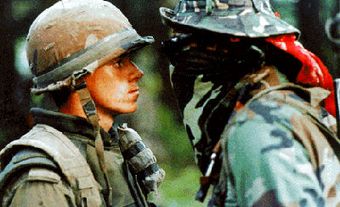
The Royal Commission on Aboriginal Peoples (RCAP) was established following the Kanesatake Resistance (Oka Crisis) in the summer of 1990. It was part of a package of federal government initiatives in response to concerns arising from the resistance. Former Chief Justice Brian Dickson developed the terms and reference (the scope) of the RCAP. He consulted with national and regional Indigenous groups, Indigenous leaders in various fields, federal and provincial politicians, and a variety of experts before establishing the scope. The federal government established the RCAP by order-in-council on 26 August 1991. The mandate of the commission was to study the evolution of the relationship between Indigenous peoples, the Government of Canada and Canadian society as a whole. Justice Dickson identified 16 areas for special attention.
Members
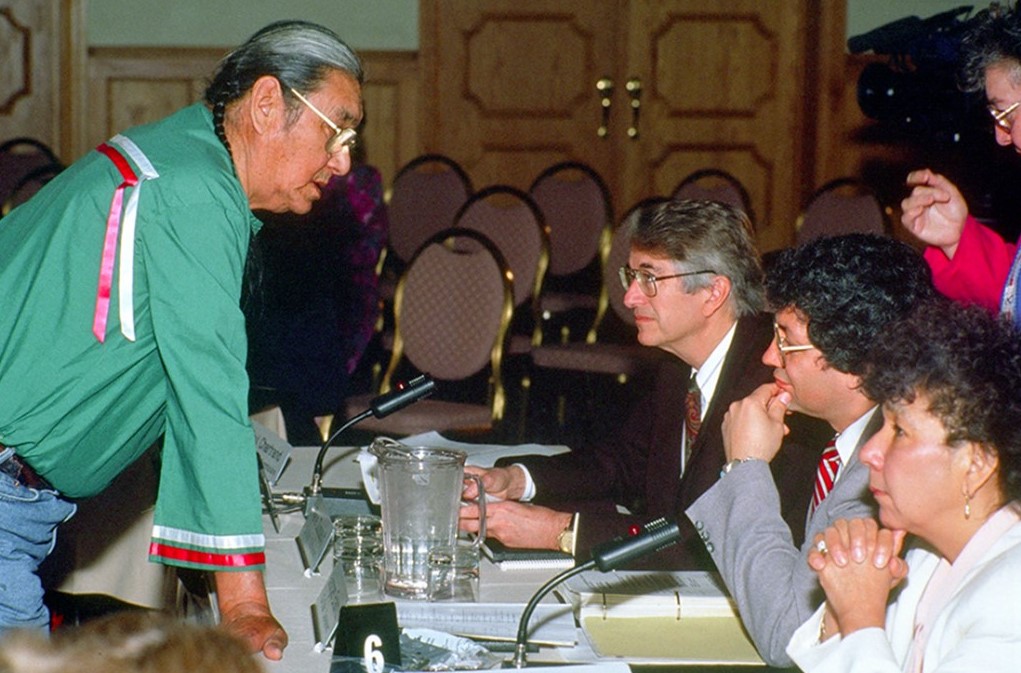
On the recommendation of Chief Justice Brian Dickson, four of the seven commissioners were Indigenous people. The co-chairs were Georges Erasmus, a former national chief of the Assembly of First Nations, and Justice René Dussault from the Quebec Appeal Court. Other members of the RCAP were Viola Robinson, former president of the Native Council of Canada (now the Congress of Aboriginal Peoples); Mary Sillett, former president of Paukuutit Inuit Women of Canada and vice-president of the Inuit Tapiriit Kanatami; Paul Chartrand, a Métis lawyer and head of the Department of Native Studies at the University of Manitoba; Madame Bertha Wilson, former justice of the Supreme Court of Canada; and Allan Blakeney, former premier of Saskatchewan. When Blakeney resigned in April 1993, he was replaced by Professor Peter Meekison. Meekison was a political scientist from the University of Alberta and former provincial deputy minister of Federal and Intergovernmental Affairs in Alberta.
Mandate and Consultations
The broad mandate of the RCAP was translated into a large and complex research agenda. The integrated research plan was published in 1993 after consultation with Indigenous organizations. It had four theme areas: governance; land and economy; social and cultural issues; and the North. In addition, the RCAP addressed these themes from four perspectives: historical, women, youth and urban. Two co-directors managed the research program. In its public hearings process, the RCAP visited Indigenous communities across Canada. It heard briefs from over 2,000 people. The RCAP commissioned more than 350 research studies.
The Report and Its Recommendations
The five-volume report was released on 21 November 1996 at a special ceremony in Hull, Quebec. The report included Vol 1: Looking Forward, Looking Back; Vol 2: Restructuring the Relationship (2 parts); Vol 3: Gathering Strength; Vol 4: Perspectives and Realities; and Vol 5: Renewal: A Twenty-Year Commitment.
The main conclusion of the report was the need for a complete restructuring of the relationship between Indigenous and non-Indigenous peoples in Canada. Some of the broader recommendations included the proposal for a new Royal Proclamation. This proclamation would require the government to commit to a new set of ethical principles respecting the relationship between Indigenous peoples and the state. This new relationship would acknowledge and respect Indigenous cultures and values. It would also recognize the historical origins of Indigenous nationhood and the inherent right to Indigenous self-determination. Implementing many of the recommendations of the RCAP would have required constitutional change.
Indigenous Governance
The commission reviewed a variety of models of self-determination and self-government. It also reviewed related issues of jurisdiction for each of the three Indigenous groups (First Nations, Inuit and Métis) including those living in urban centres. It recommended that the further development of Indigenous governments should focus on Indigenous nations rather than single communities. It estimated that there were potentially 60 to 80 Indigenous nations which might be candidates for self-governments. It also called for the establishment of an Indigenous parliament. This parliament would be comprised of Indigenous representatives. It would advise the Canadian Parliament on matters affecting Indigenous peoples.
Land and Economy
The RCAP made recommendations regarding land and economy. It acknowledged the need to significantly increase land holdings for First Nations in southern Canada. Additionally, the commission recommended an independent lands and treaties tribunal. The tribunal would oversee negotiations about land issues among federal, provincial and Indigenous governments. Indigenous governments were encouraged to establish economic institutions that reflected cultural values. It recommended these institutions be accountable and protected from political interference. (See also Indigenous Territory and Economic Conditions of Indigenous Peoples in Canada.)
Social and Cultural Issues
The RCAP made recommendations on social and cultural issues. It recommended the adoption of Indigenous health and healing strategies. Regarding education, it recommended the creation of an Indigenous peoples’ international university and educational programs to support Indigenous self-government. For the Canadian public, the RCAP recommended public education initiatives to promote cultural sensitivity and understanding among non-Indigenous people. (See also Health of Indigenous Peoples in Canada, Social Conditions of Indigenous Peoples in Canada and Education of Indigenous Peoples in Canada.)
The RCAP also provided conclusions and recommendations respecting "the North." It focused on ensuring full opportunity for Indigenous peoples to participate in political and economic development. (See also Nunavut and Nunavut and Confederation.)
The report also put forward recommendations for immediate action. It called for a First Ministers Conference within six months of the report. Additionally, it called for a major increase in spending on Indigenous programs to the amount of $1.5 to $2 billion per year over 15 years. Increased funding would help address pressing health, educational, employment and housing needs. It recommended the creation of a new federal Department of Aboriginal Relations to assist Indigenous groups transitioning to self-government. Additionally, it recommended a Department of Indian and Inuit Programs to provide services to communities which were not ready for change.
Government Response
When the report was released, the federal government made a commitment to study it and its recommendations. However, the federal government did not call a First Ministers' Conference within six months of the report's release. Rather, it issued a lengthy information document outlining government achievements from 1993. The federal government made a formal response on 7 January 1998. Its proposals emphasized non-constitutional approaches to selected issues raised by the report. The four objectives of the federal response were renewing partnerships; strengthening Indigenous governance; developing a new fiscal relationship; and supporting strong communities, people and economies. The federal government issued a Statement of Reconciliation. It expressed profound regret for errors of the past and a commitment to learn from those errors (see also Reconciliation in Canada). This was accompanied by a commitment of $350 million to support community-based healing. In particular, it was meant to deal with the legacy of abuse in the residential school system. Provincial governments provided very little response, as they viewed the report as a federal initiative.
Legacy and Significance
Federal and provincial governments recognized and supported some initiatives to address social and economic issues included in the report. However, there was relatively little government interest in constitutional discussions on issues affecting Indigenous peoples and communities. The RCAP’s report provides an Indigenous perspective on Canadian history and the role Indigenous peoples should play in contemporary society. The scope of the recommendations was more far-reaching than any other Royal Commission (see also Royal Commission on Bilingualism and Biculturalism; Royal Commission on Economic Union and Development Prospects for Canada). However, because of barriers, or reluctance, to constitutional change, the government did not implement many of the RCAP’s recommendations.